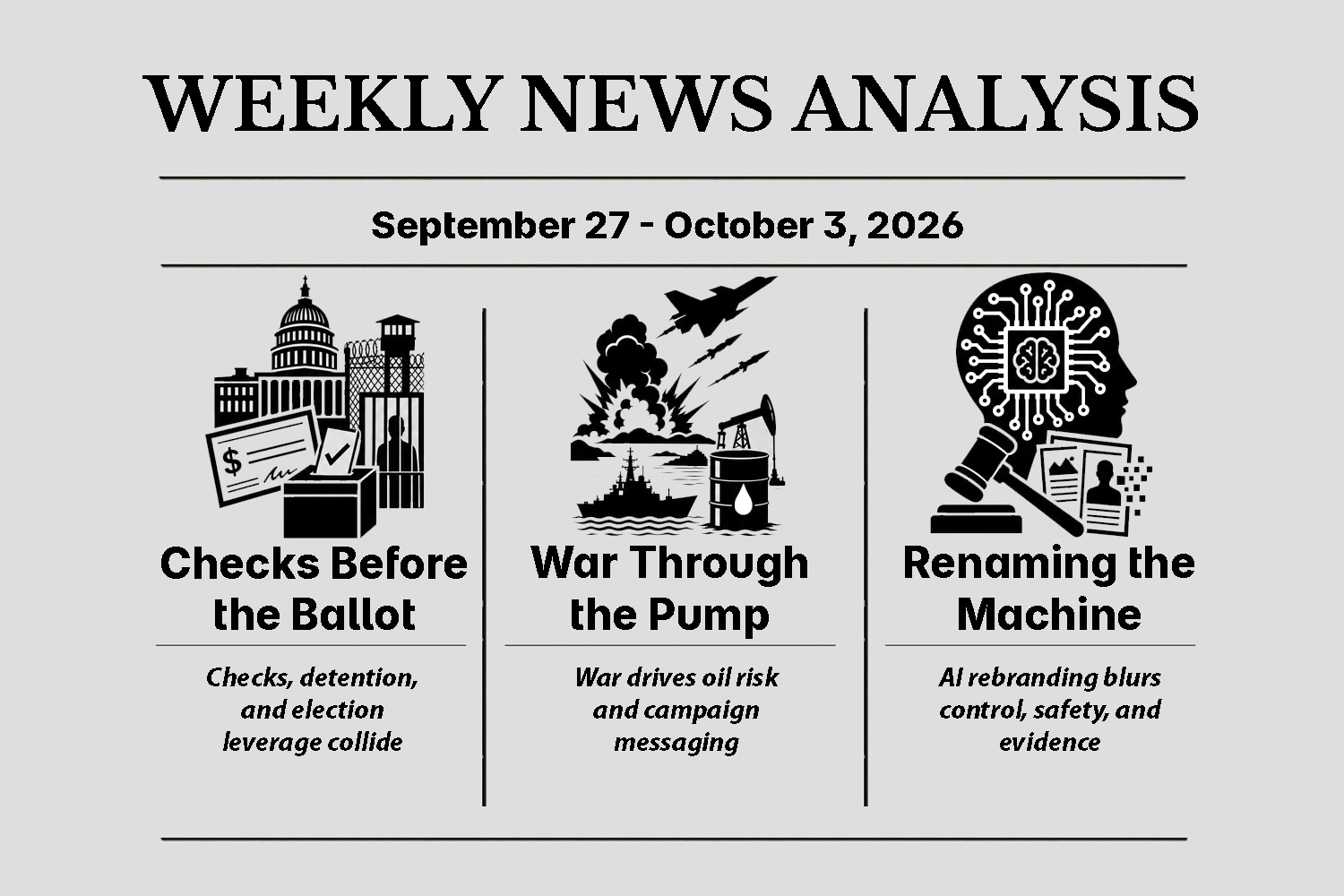
Three seemingly separate stories converged this week around a single mechanism: managing public consent. In domestic politics, direct payments, taxpayer-funded government advertising, immigration detention, election administration, and the approach of midterm elections increasingly occupy the same rhetorical space. In foreign policy, the Iran war is no longer insulated from domestic politics; energy prices, the Strait of Hormuz, military escalation, and the November elections now interact openly. In technology, the government has attempted something even more elemental: changing the vocabulary itself, directing the executive branch to replace “artificial intelligence” with “Super Intelligence” while major technology corporations enter a voluntary safety pact with Washington. The common thread is that government increasingly operates by controlling incentives, information, terminology, institutional procedure, and crisis response rather than merely through conventional legislation.
The deeper pattern is the conversion of instability into institutional leverage. Affordability anxiety becomes a platform for direct checks. War becomes inseparable from electoral messaging and energy intervention. Anxiety about AI becomes an opportunity simultaneously to rename the technology, centralize federal terminology, create government AI infrastructure, and establish a public-private governance framework dominated by the same corporations developing the systems. None of these facts alone proves an overarching coordinated scheme. Together, they show why citizens should distinguish outcomes from intentions and institutional capability from political promises. Power acquired for one advertised purpose rarely remains confined to that purpose.
Checks Before the Ballot
Trump check investigation - Raw Story
Trump to send out $90 checks to 20 million - The Hill
US Supreme Court to hear clash over Trump’s immigration detention policy - Reuters
Judge blocks Trump tying anti-terrorism grants to election changes - Reuters
Trump ads - The New York Times
Donald Trump has placed direct government payments conspicuously close to the ballot box. His larger proposal is a $5,000 “dividend” for American adults if Republicans retain control of Congress, while a separate program is sending $500 refunds to nearly one million Affordable Care Act enrollees in 30 states. Additionally, Trump is sending $90 checks to 20 million seniors. The distinction matters. The White House is presenting the $500 payments as refunds of excess HealthCare.gov exchange fees and the $90 checks as offsets to Medicare Part B premiums, whereas the $5,000 proposal is a future political promise whose implementation would require a viable funding mechanism and congressional action. Trump explicitly connected the larger payment to Republican control of Congress. That converts an economic proposal into electoral rhetoric: political victory becomes the condition attached to a promised material benefit. Whatever one thinks of the underlying policy, the rhetorical structure is unmistakable—retain political power and receive a dividend.
The $500 and $90 checks employ a different linguistic mechanism. The administration calls the $500 checks refunds rather than stimulus, welfare, subsidies, or government assistance, while the $90 checks are government assistance to help with rising Medicare premium costs. That framing is consequential because “refund” implies restoration of property already belonging to the recipient. The White House says the Biden administration accumulated excessive exchange fees and that Trump is returning that money to people who paid full premiums without premium assistance. Critics dispute the administration’s characterization of the underlying finances and question the political timing. The $500 checks also arrive with a presidential letter, making the political benefactor's identity hard to separate from the government transaction itself. The Grammar question therefore precedes the partisan argument: who paid the fees, how were the $500 and $90 amounts calculated, who qualifies, and why is a uniform amount appropriate? Only after answering those questions can we evaluate these transactions accurately, rather than accepting them simply because the government chose the words.
That distinction becomes more important when the payment strategy is considered alongside taxpayer-funded advertisements promoting the administration. Reporting this week described government-funded advertisements resembling Trump campaign material, with congressional critics arguing that public resources were being transformed into political promotion. The administration characterizes the material as legitimate public-service communication. Reporting on one funding stream found that $20 million allocated within the Department of Homeland Security budget was redirected toward advertising, while separate reporting identified nearly $1.5 million already spent across three pro-Trump advertising campaigns. The legal question is not automatically resolved by their political appearance: federal spending restrictions, appropriations law, the Hatch Act, and prohibitions against government propaganda involve specific statutory tests. But the institutional contradiction deserves scrutiny. A government claiming aggressive taxpayer stewardship also faces questions about whether taxpayer money is financing communications that enhance the president’s political brand and drive for-profit revenue.
That contradiction becomes sharper when fiscal rhetoric is compared with the underlying principle rather than merely with party identity. Administrations routinely claim to eliminate waste while continuing expenditures they regard as strategically useful. The important logical error is special pleading: spending becomes “waste” when performed by an opponent but “necessary,” “educational,” “patriotic,” or “investment” when performed by one’s own institution. The problem is bipartisan and structural, not unique to one administration. The Fallacious Belief in Government develops precisely this criticism of taxation, arguing that public money can be redirected toward activities individual taxpayers neither requested nor support. The relevant question therefore is not whether a voter likes Trump. It is whether government officials should be permitted to use compulsory public revenue to promote themselves or their political accomplishments, regardless of which party controls the executive branch.
The courts are simultaneously confronting another dimension of executive power. The Supreme Court agreed to hear the administration’s mandatory-detention policy for immigrants who entered the country illegally. The policy departs from an interpretation of federal law used for nearly three decades under which certain immigrants already residing inside the United States could receive bond hearings while removal proceedings continued. The administration contends that federal immigration law authorizes mandatory detention; multiple appellate courts have rejected that interpretation, and Reuters reported more than 73,000 federal cases filed by immigrants in 2026 seeking release. The Supreme Court’s decision to hear the dispute is therefore not itself a ruling that Trump’s policy is lawful. It is a decision to resolve a conflict over statutory authority and whether bond hearings are available. The central issue reaches beyond immigration rhetoric: when may executive interpretation transform a discretionary detention system into categorical detention without individualized bond review?
A lower federal court confronted a different attempt to connect federal power with election administration. U.S. District Judge Amir Ali blocked the administration from withholding 20% of roughly $1.1 billion in counterterrorism grants from jurisdictions that refused specified election changes, including hand-marked ballots, manual audits, and voter-roll verification against DHS information. The administration argued that the conditions strengthened election security; the judge concluded that FEMA lacked authority to attach those election requirements to grants Congress created for counterterrorism purposes. That is an important separation-of-powers dispute hidden beneath politically attractive terminology. “Election security” and “counterterrorism” both invoke protection, but placing two desirable objectives side by side does not establish statutory authority to combine them. The logical danger is equivocation through the word security: because terrorism concerns security and elections concern security, money appropriated for one security purpose is treated as available for the other. The court rejected that reasoning at this stage.
All of this arrives as October begins and the midterm campaign enters its final month. The “October surprise” is not evidence that every late-breaking scandal is manufactured; historically the term encompasses both deliberately timed disclosures and genuinely unexpected events capable of affecting an election. What can reasonably be expected is an intensified information environment in which investigations, leaks, foreign-policy developments, economic statistics, court rulings, recordings and accusations receive maximum political amplification because voters have little time to evaluate them before Election Day. History offers ample precedent: late campaign revelations have repeatedly dominated American elections even when their ultimate significance remained contested. The appropriate response, then, is not to assume the coming scandal is true or fabricated. Instead, apply the Trivium ruthlessly: establish provenance, separate evidence from allegation, identify who benefits from the timing, examine omitted context, and refuse to let urgency substitute for verification.
War Through the Pump
Oil rebounds after Trump rejects Iran peace deal - Reuters
US sends third aircraft carrier to Middle East - The Guardian
Crude exports through Strait of Hormuz recover - The Guardian
Fact check Trump Iran timeline - CNN
Iran US war live coverage - The Independent
The Strait of Hormuz remains one of the clearest examples of how geography can become an economic weapon. By late September, roughly 10 million barrels of crude per day were again moving through the strait, and reporting this week indicated crude exports had largely recovered toward prewar levels as producers, shipping companies and governments developed workarounds. But that headline conceals an important distinction: crude recovery does not mean the petroleum system has normalized. More than 70% of crude passing through Hormuz in August reportedly changed tankers, compared with almost none before the war, while less than 20% of prewar refined-product volumes such as diesel were moving through the route. The logistics network has therefore adapted, but adaptation itself has a price. Oil can move while the system that transports, refines, insures, and distributes it remains severely disrupted.
That is why statements implying that one level of Hormuz traffic mechanically determines retail fuel prices are incomplete. Crude is a major input, not the final product. The price paid at a pump includes the crude acquisition price, plus refining capacity, refinery margins, transportation, tanker availability, maritime insurance, port costs, storage, pipeline constraints, labor, distribution, taxes, and regional supply-demand conditions. War introduces additional risk premiums into several of those layers simultaneously. A tanker traveling through a region where vessels have been attacked carries not only petroleum; economically, it also carries insurance risk, rerouting risk, delay risk, and the possibility that the cargo never reaches its destination on schedule. Consequently, crude volumes can recover while diesel remains scarce and retail prices remain elevated. That apparent contradiction disappears once the entire supply chain, rather than a single throughput number, becomes the unit of analysis.
Markets demonstrated this complexity immediately after Trump rejected Iran’s proposed arrangement to end hostilities and reopen Hormuz. Brent initially jumped more than $4 a barrel before moderating and ultimately settled around $105.28, while West Texas Intermediate settled around $92.60. The movement is revealing because petroleum markets price expectations as well as physical barrels. A rejected peace proposal does not instantly remove millions of barrels from storage tanks, yet it changes assumptions about future availability, shipping security, refinery inputs, and geopolitical risk. Conversely, reports of renewed mediation can reduce prices without producing a single additional barrel that day. This is why political rhetoric can become an economic input. Words from Washington or Tehran alter probability calculations across futures markets, shipping contracts, and procurement decisions long before the physical supply chain visibly changes.
The military situation simultaneously moved in the opposite direction from de-escalation. The United States began dispatching another carrier strike group and an amphibious readiness group toward the Middle East, carrying more than 7,000 sailors and roughly 2,000 Marines. If deployment schedules hold, three U.S. aircraft carriers could be operating in the region by late October. Trump has also warned of additional strikes, while Iran has prepared for potentially broader retaliation if large-scale American attacks resume. The conflict initially discussed on compressed timelines has therefore developed into a prolonged confrontation requiring ongoing force deployment, logistical support, and political explanation. This is a familiar rhetorical cycle in warfare: a limited objective is announced, the operational environment expands, new threats appear because of the intervention, and those new threats then become justification for maintaining or expanding the intervention. That does not prove the original objective was insincere; it demonstrates how military missions can become self-reinforcing.
Trump’s changing descriptions of the war deserve the same grammatical scrutiny. Nuclear prevention has been central to the administration’s public justification, yet Trump this week also described targets associated with Operation Midnight Hammer as “drug factories,” adding narcotics to his explanation of what American forces had attacked. A changing justification does not by itself prove deception: military operations can have multiple targets and intelligence can evolve. But shifting rationales create a moving-goalpost problem when each newly introduced objective is used retrospectively to validate the same intervention. Citizens evaluating war therefore need a stable proposition to test against evidence. Was the mission to eliminate a nuclear capability, compel negotiations, reopen Hormuz, suppress Iranian military infrastructure, combat narcotics production, protect allies, or accomplish several of these simultaneously? Using only one as justification and then providing others later is effectively moving the goalpost. Without clearly bounded objectives, success becomes impossible to measure because every continuation of conflict can be justified by another unfinished mission.
The Iran conflict has also crossed unmistakably into electoral rhetoric. Trump has accused Iran of attempting to affect the midterm elections and has said the conflict could end immediately after those elections. Meanwhile, energy costs and the war’s duration have become campaign liabilities debated inside the United States. That does not establish that military decisions are being made principally for electoral purposes. It does establish something more limited but still consequential: the president himself has rhetorically linked the war’s trajectory with the electoral calendar. Once war and election messaging become intertwined, every escalation and diplomatic rejection acquires two audiences—the foreign adversary and domestic voters. Decisions may still be driven by military strategy, but their presentation becomes inseparable from political strategy. That creates precisely the environment in which citizens should resist accepting either patriotic appeals or partisan accusations as substitutes for independently verifiable evidence.
The historical pattern extends far beyond Iran. Governments confronting external enemies have repeatedly expanded executive authority, spending, and surveillance by invoking emergency necessity. The United States after September 11 offers a clear modern example: powers introduced as counterterrorism measures became enduring institutional architecture. The Fallacious Belief in Government describes this process as a feedback loop in which fear enables expanded governmental authority and temporary emergency measures become normalized components of the state. The relevant lesson is not that every security measure is illegitimate or that every war is manufactured. It is that emergency powers should be evaluated by what institutions actually acquire, how long those capabilities remain, and what mechanisms exist to relinquish them. Iran therefore matters beyond crude prices. The war is simultaneously reshaping military deployment, government spending, energy policy, campaign rhetoric, and public tolerance for intervention—the exact conditions under which temporary responses can become permanent systems.
Renaming the Machine
Trump and tech leaders sign AI accord - Associated Press
Trump AI deal rebrands artificial intelligence as superintelligence - The Guardian
Call it AI call it Super Intelligence only 2 percent of consumers are buying it - TechCrunch
Trump expected to name intelligence chief Jay Clayton new AI czar - The Washington Post
Pentagon chief set to announce additional cuts in senior officer positions - Reuters
Sentence tossed after AI generated victim video - Associated Press
Government does not merely regulate vocabulary; sometimes it manufactures vocabulary. Trump signed an executive order directing executive-branch departments and agencies to replace “Artificial Intelligence” and “AI” in official communications and non-statutory documents with “Super Intelligence” and “SI.” This is more than branding because terminology determines conceptual boundaries. Artificial intelligence has accumulated years of negative associations: job displacement, deepfakes, surveillance, hallucinations, autonomous weapons, algorithmic discrimination, cybersecurity incidents, and fear of uncontrollable systems. “Super Intelligence,” by contrast, embeds a qualitative judgment. Artificial describes origin; super describes superiority. The replacement therefore does not merely identify the same technology with different letters. It shifts the rhetorical frame from something synthetic and potentially suspect toward something implicitly elevated. The first task of Grammar is consequently to refuse the linguistic substitution until the underlying technology itself has materially changed.
History offers many examples of institutions changing terminology after an older label acquires unwanted associations. Governments rename departments, military operations, surveillance programs and regulatory initiatives; corporations rename products after scandals; political movements replace terminology when focus-grouped language becomes more effective. Renaming does not necessarily imply malicious intent. Sometimes terminology genuinely becomes obsolete. The analytical question is whether the definition changed with the label. In this case, an executive order cannot technologically transform artificial intelligence into hypothetical artificial superintelligence simply by directing agencies to use different words. The semantic maneuver therefore illustrates why the Grammar stage of the Trivium is indispensable. The Fallacious Belief in Government argues that accurate definitions and factual collection must precede rhetoric because manipulation becomes easier when meanings are allowed to drift. Calling AI “SI” may immediately alter perception, even though the underlying models, training methods, hardware, and failure modes remain substantially the same.
The terminology arrived alongside the Joint Commitment on Frontier Responsibilities, a voluntary agreement involving major technology corporations including Google, Meta, Nvidia, OpenAI, Anthropic, and xAI. The agreement calls for internal controls, external auditors or evaluators, and board-level review of safety findings. Trump described it as “morally binding” and emphasized industry self-policing. That formulation contains an institutional tension. If advanced AI represents sufficient risk to justify a White House agreement involving the largest developers, why should compliance remain principally voluntary? Conversely, if mandatory regulation would unnecessarily suppress innovation, what measurable protection does a morally binding pledge provide beyond existing corporate safety programs? Neither question automatically invalidates the agreement. Independent audits and board accountability can create meaningful controls. But without enforceable standards, transparent metrics, or consequences for noncompliance, the public is being asked to trust organizations with enormous financial incentives to keep deploying increasingly powerful systems.
To drive home that point, five out of the six corporations that signed the voluntary Super Intelligence accord already have established commercial ties with the federal government, with several relationships involving national-security AI and Pentagon systems. Four of these corporations received Pentagon frontier-AI awards, each with a ceiling of up to $200 million. Nvidia has participated in Pentagon classified-network AI deployments, and Meta's Llama has been approved for federal use. However, none of these six corporations is currently among those in which the Trump administration has directly bought U.S. government equity. This distinction matters: although the government may not own a stake in these corporations, it functions as their regulator, customer, deployment partner, and, in several cases, their national-security client.
The institutional alignment becomes more significant with the expected appointment of intelligence chief Jay Clayton to an additional AI leadership role. Combining intelligence and AI responsibilities does not prove an attempt to construct an automated surveillance state, but it would be a step toward a dystopian surveillance state. National-security agencies have legitimate reasons to understand strategically important technologies. Yet institutional architecture matters because organizational placement reveals how government conceptualizes a technology. Putting AI governance near intelligence leadership frames AI not merely as software or industrial policy but as national-security infrastructure. That shift should focus scrutiny on procurement, classified deployment, surveillance, autonomous decision support, cyber operations, and the boundaries separating civilian from military applications. The essential question is not whether machines can perform these tasks efficiently. It is who establishes the objectives, who audits the outputs, who can challenge the system, and who remains accountable when an automated recommendation produces consequences for someone who never consented to being evaluated by it. Qualified and distributed immunity should not grant unlimited power to those who violate rights and create victims.
At the same time, Defense Secretary Pete Hegseth is moving toward a 20% reduction in general and flag-officer billets, doubling the earlier 10% target. Reporting indicates that this is primarily a restructuring of positions: some jobs would be downgraded, and others eliminated rather than simply firing 20% of serving generals and admirals. It is tempting to draw a straight causal line between this restructuring and the military’s increasing adoption of AI, but the available reporting does not establish that connection, nor does it rule it out. Correlation must not be promoted into causation merely because it supports a compelling rhetoric. The more defensible concern is prospective. As militaries increase reliance on automated intelligence analysis, targeting support, logistics, surveillance, and decision-support systems while simultaneously flattening human command structures, safeguards should ensure that automation augments rather than eliminates meaningful human judgment. However, the risk remains very real. Efficiency is not synonymous with wisdom, and fewer organizational layers can make automated recommendations travel faster through a command structure without necessarily making them more correct.
That distinction between intelligence and wisdom becomes especially important in military environments. A machine can process sensor feeds, classify targets, detect patterns, and generate recommendations at speeds no human staff can match. But obedience is not judgment. An algorithm does not possess moral responsibility simply because its output is statistically sophisticated, and an officer cannot ethically outsource accountability by saying the model recommended an action. The danger therefore is not literally that the Pentagon can create a machine that “never questions orders”; contemporary AI systems are not autonomous moral agents with human motives. The danger is organizational: decision-makers may begin treating computational output as authoritative because it appears objective, precise, and technologically advanced. That is an appeal-to-authority fallacy translated from the human expert into the machine. When probabilistic output acquires institutional prestige, questioning the model can become culturally harder even though the system may contain incomplete data, embedded assumptions, hallucinations, or optimization goals that do not correspond with ethical judgment.
Arizona has already provided a concrete warning about what happens when synthetic representation crosses into a domain where human judgment determines liberty. A lower court permitted an AI-generated depiction of deceased victim Christopher Pelkey to be presented during sentencing in the manslaughter case against Gabriel Paul Horcasitas. The synthetic Pelkey appeared to communicate sentiments constructed from information supplied by his family. Horcasitas received a 10-year sentence. The Arizona Court of Appeals later vacated that sentence and ordered resentencing, concluding that the AI depiction was not a reliable representation of what Pelkey himself actually would have said. The appellate decision does not establish that AI can never appear in a courtroom, nor does it erase the legitimate right of victims’ families to speak. It establishes a critical evidentiary boundary: a simulation of a dead person must not quietly acquire the epistemic status of testimony from that person.
That precedent reaches far beyond one sentencing hearing. Generative systems can reconstruct voices, faces, and language with increasing plausibility, producing material that feels emotionally authentic without being historically authentic. Courts depend upon provenance precisely because emotional force cannot substitute for evidence. Once synthetic people can “speak” in sentencing hearings, the next questions become unavoidable: Can an AI reconstruction represent a murder victim’s probable wishes? Can it reconstruct a dead witness? Can police generate simulations of events? Can risk-assessment models influence bail or sentencing? Can military AI identify someone as a threat using opaque probabilities? The constitutional and ethical problem is therefore larger than deepfakes, which were warned about in COVID19: Short Path to “You’ll Own Nothing. And You’ll Be Happy.” and The Fallacious Belief in Government. Society is entering an era in which simulated evidence can possess greater rhetorical power than verified evidence. The Trivium becomes almost literal infrastructure for survival: Grammar establishes what is authentic, Logic determines what follows, and Rhetoric must never be allowed to reverse-engineer a desired reality from a persuasive synthetic image.
Managed Reality
The week’s three stories converge around the same structural question: who controls the interface between reality and the individual? Direct checks can be legitimate fiscal policy while simultaneously functioning as political messaging. Counterterrorism grants can serve genuine security objectives while still exceeding statutory boundaries when attached to unrelated election requirements. Military deployments can respond to real geopolitical threats while creating new economic and institutional consequences. AI can provide extraordinary analytical capability while also generating synthetic evidence that can influence human judgment. The error is believing that one description excludes the other. Institutions are rarely one thing at a time. A policy can help someone and increase political leverage. A technology can improve productivity and expand surveillance capacity. A military system can deter an adversary and increase the probability of escalation. Critical analysis begins where binary partisan narratives end.
The larger trajectory is toward increasingly mediated governance: citizens encounter government through checks, advertisements, algorithmic interfaces, automated assessments, security classifications, and managed terminology. A recurring cycle in government creates instability and fear, which authority uses to consolidate under promises of stability and protection. Emergency powers, direct financial incentives, militarized crises, and technological systems should be judged by the durable authority they create after the immediate justification disappears. Natural rights become most vulnerable not when government openly announces their elimination, but when restrictions are presented as temporary, beneficial, technologically inevitable, or necessary for protection.
October therefore begins with more than an election countdown. It begins with an information test. Scandals will arrive, accusations will accelerate, economic promises will multiply, war developments will be translated into campaign arguments, and increasingly sophisticated machines will help produce the information citizens consume. The appropriate defense is neither automatic trust nor automatic disbelief. Both surrender independent judgment. The defense is disciplined verification: define the words, establish the facts, identify contradictions, distinguish causation from correlation, examine incentives, trace authority, and only then construct rhetoric. In an environment where governments can rename technology, machines can recreate the dead, public money can finance political-looking messages, and foreign wars can become domestic campaign material, control over language and perception is itself a form of power. The question is who retains the final authority to judge reality—the institution, the algorithm, or the individual.
Listen to this week's news in verse for a quick recap!