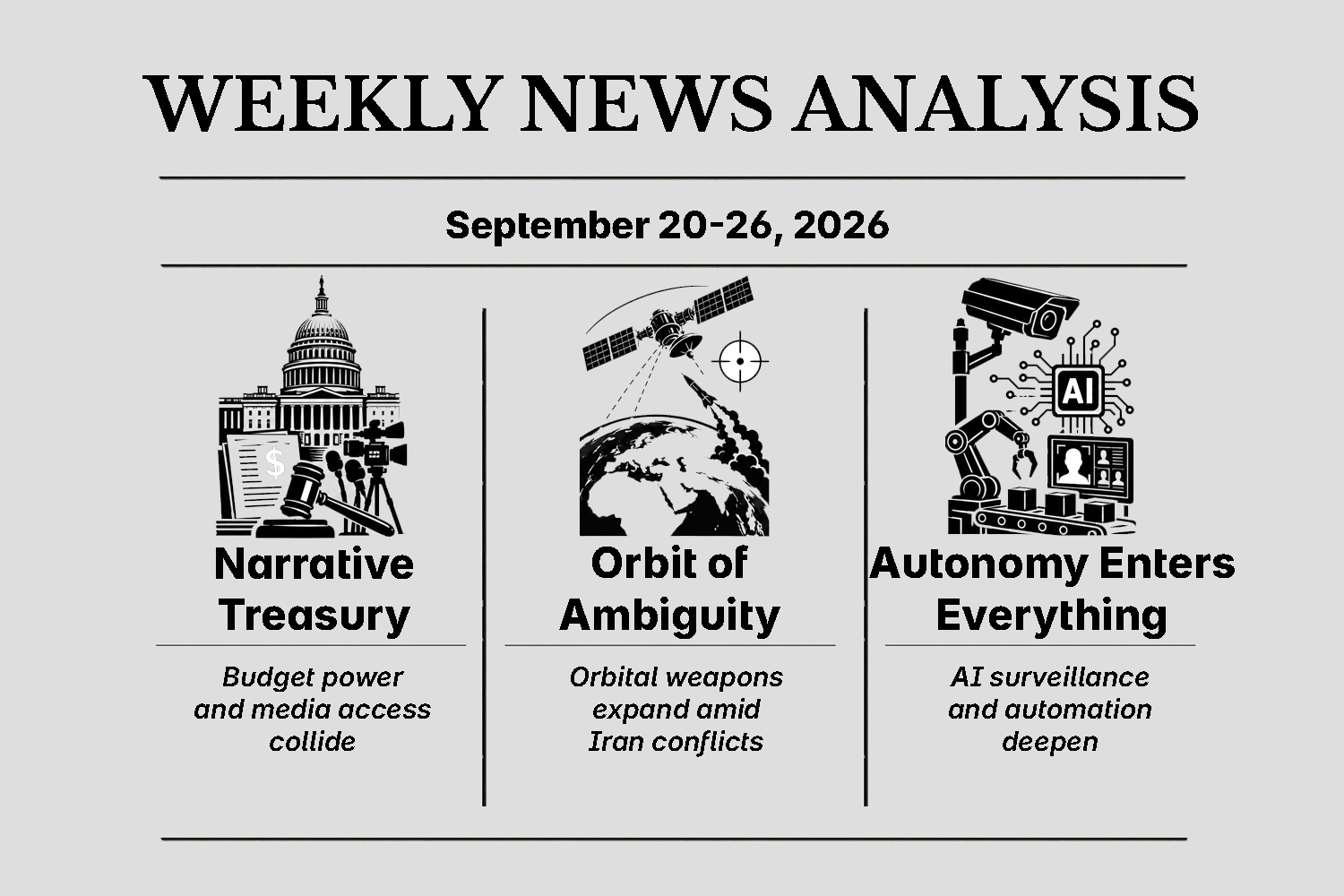
Budget rescissions and press access, weapons in orbit and a widening Iran war, and artificial intelligence shifting from observation to execution seem like separate stories. Structurally, they do not. Each reveals institutions shortening the distance between authority and action. Fiscal policy shows the executive branch testing the limits of control over money Congress has already appropriated. Information policy shows the White House punishing disfavored outlets while building a government-produced communications channel. National security shows the military speaking more openly about systems capable of contesting space even as Congress struggles over the president’s war powers. Technology adds another layer as AI advances beyond prediction into autonomous routing, billing, surveillance, and scientific discovery. The connecting mechanism is not a single conspiracy, but concentrated decision speed: fewer veto points, fewer human intermediaries, and increasingly automated pathways carrying commands into consequences.
The Trivium provides the discipline for examining that pattern. Grammar separates what was actually done from what competing factions say was done. Logic tests the mechanism against the stated justification and searches for unresolved contradictions. Rhetoric examines the packaging—how coercion, expense, or uncertainty is recast for the public as protection, efficiency, modernization, or inevitability. The Fallacious Belief in Government describes Grammar, Logic, and Rhetoric as a continuous process for gathering facts, testing contradictions, and communicating conclusions. Its broader framework also examines how crises can create opportunities for institutional consolidation under the appearance of safety or service. Applied consistently, the lens cannot fit a single narrative. It exposes official euphemism, but it must also expose counter-narratives that convert secrecy into certainty without evidence. Critical analysis works only when documented claims remain distinct from inference and speculation, not when one approved story is merely replaced by another.
Narrative Treasury
'Can't catch a break': Shoppers squeezed by surging inflation and higher interest rates - ABC News
The Rising Cost of Money Is Seeping Into Everything - Bloomberg
Trump must restore access to banned news outlets CNN, MS NOW and Politico, judge orders - AP News
Judge blocks Trump's White House media ban, orders access to be restored - Reuters
The White House announced a pocket rescission approaching $1 billion, and the largest identified component—$567 million—came from Health and Human Services programs serving refugees, asylees, and other noncitizens. Reporting also identified additional immigrant-related programs, while international education, housing programs, HHS research grants, minority-business development, and other grants appeared elsewhere in the package. That composition complicates the shorthand that Donald Trump simply canceled “a billion dollars for immigrants.” Political rhetoric benefits from compressing a heterogeneous funding package into one emotionally efficient category, but Grammar requires the category to match the underlying facts. The administration calls the targets wasteful and harmful; critics describe the maneuver as an executive encroachment on Congress’s appropriations power. Neither simplification captures the entire dispute. Most of the money was connected to migrant or noncitizen services, but not all of it, and the legal controversy is as much about executive control of congressionally enacted budget authority as it is about the merits of the programs themselves.
The central dispute is constitutional and procedural before it is financial. The Government Accountability Office maintains that pocket rescissions are not authorized by the Impoundment Control Act because the president cannot use timing to let funds expire before Congress receives its full review period. The administration maintains that the technique is lawful. A pocket rescission prevents an agency from obligating targeted budget authority until the appropriation expires. If the authority expires unobligated, those funds generally cannot support new obligations, allowing outlays to fall below what Congress authorized. The mechanism cannot “refund” taxpayers or create a direct one-to-one return of previously collected revenue; federal receipts and federal appropriations are not individualized accounts. The spending-cut headline therefore masks a deeper separation-of-powers question over who ultimately controls the purse and where the unspent funds go.
The scale problem becomes clearer when the long-term fiscal picture is placed before the weekly rescission headline. CBO estimates that the 2025 reconciliation law championed and signed by Trump increases deficits by roughly $4.1 trillion over 2025–2034 once additional debt-service costs are included, relative to the prior baseline. Against that backdrop, several hundred million dollars in canceled programs is almost microscopic. Gross federal debt stood at roughly $40.07 trillion on September 24, while CBO’s 2026 baseline projected a $1.9 trillion federal deficit for the fiscal year and debt held by the public equal to about 101 percent of GDP. The demonstrated danger is compounding: persistent primary deficits combine with higher interest rates and rising debt-service costs. Rescission messaging can therefore highlight savings measured in hundreds of millions while major tax and spending legislation reshapes the ten-year debt path by trillions.
Narrative conflict sharpens further when the subject turns to inflation. Trump has continued to blame his predecessor and Democrats for high prices, while critics assign responsibility to current tariffs, fiscal policy, energy conditions, and the Iran war. The data sit beneath those competing assignments of blame. ABC reported that consumer prices were 3.4 percent higher in August than a year earlier, gasoline averaged about $4.47 a gallon, and grocery prices were more than 20 percent higher than five years earlier. Borrowing costs have also spread through mortgages, credit cards, business finance, and government debt service as higher Treasury yields and tighter monetary conditions work through the economy. That is the mechanism behind Bloomberg’s framing that the rising cost of money is “seeping into everything.” A Trivium analysis rejects the convenience of monocausal partisan accounting. Pandemic supply disruptions, monetary policy, fiscal stimulus under multiple administrations, later tariffs, energy shocks, war, labor conditions, and demand unfold across different timelines. The contradiction is rhetorical: inflation is narrated as inherited when inconvenient and controllable when campaigning, although prices emerge from interacting fiscal, monetary, geopolitical, and market forces.
The 2025 reconciliation law and pandemic stimulus belong to the same fiscal discussion, but they should not be treated as the same event or assigned the same effects. CBO projects that it substantially increases deficits and debt, raises interest rates, and exerts modest near-term inflation pressure, with the direct CPI effect measured in basis points rather than whole percentage points. Earlier, Trump signed the CARES Act in March 2020 and other pandemic relief measures, while the Biden administration later enacted additional large stimulus. Federal Reserve research concluded that U.S. pandemic fiscal support as a whole may have contributed roughly three percentage points to the divergence of U.S. inflation by the end of 2021, alongside severe supply disruptions and shifts in demand. That conclusion does not isolate those three points to Trump alone, and it does not erase the economic collapse policymakers were responding to. The analytical point is therefore not that one bill singularly “caused inflation,” but that repeated deficit finance leaves households facing eventual price, interest, and fiscal consequences while political narratives selectively assign responsibility.
The affordability story gives practical form to the warning contained in “You’ll own nothing. And you’ll be happy.” without proving a literal centrally administered plan. In the COVID19 book, the phrase describes a trajectory in which crisis policy and expanding institutional control increase dependence on systems individuals do not own or control. High mortgage rates delay home ownership; rising rents move more income to asset holders; expensive credit makes cars and education harder to own outright; inflation erodes cash savings. Those outcomes can resemble economic tenancy even when no single organization is deliberately executing a coordinated ownership-elimination program. That distinction matters. The structural concern does not require a secret command center to remain relevant, even if it is true. Debt-financed government, concentrated capital, subscription models, and high borrowing costs can converge through accumulated incentives until access increasingly replaces ownership. The phrase functions best, therefore, as a warning about that end-state pattern rather than as evidence that one centralized actor planned every mechanism producing it.
The president’s own rhetoric makes the press-access conflict unusually direct. After denouncing their reporting as fiction, lies, and relentlessly negative, Trump barred CNN, MS NOW, and Politico from White House access. The administration later invoked national security. U.S. District Judge Timothy Kelly, however, found the record lacked factual support for that rationale and temporarily restored the outlets’ passes. Reuters reported that the judge said the ban was likely to violate First Amendment and due process protections, while AP emphasized that the White House had not provided clear standards or a meaningful opportunity to contest the revocations. The constitutional issue is not an unlimited right for journalists to enter every presidential space. The issue is whether government may make favorable editorial treatment a condition of participation in an established access system without neutral rules and process. The phrase “fake news” becomes rhetorically powerful in that setting because it transforms criticism of government into alleged dishonesty by the critic, allowing retaliation to be described as a defense of informational standards.
The comparison to state broadcasting must be drawn carefully. The United States still has independently owned news organizations, competing private distribution systems, an adversarial press, and courts capable of ruling against the executive—as this week’s order demonstrated. Yet launching “Trump TV: The Essentials Station” days after the press confrontation created a distinct institutional contrast. The White House itself published the channel under that name, supplying a continuous stream of administration-selected material while independent outlets fought to regain access. The structural similarity to state broadcasting historically associated with communist systems is not equivalence, but role consolidation: government becomes the subject of reporting and also an editor, producer, and distributor of its preferred account of events. Orwell's more precise warning in 1984 concerns information asymmetry. When the institution exercising power also seeks to become the authoritative recorder of that power, information can give way to narrative substitution. The safeguard is competing evidence, access, institutional independence, and the ability to challenge the official record—not confidence in a different faction’s propaganda.
Orbit of Ambiguity
US Space Force Confirms It Has Weapons in Orbit. Here's What They Could Include. - Military.com
US Deploys On-Orbit Weapons Before Xi Summit: Outer Space Treaty Cannot Stop Them - Tech Times
Trump says Iran 'outsmarted themselves' over the Strait of Hormuz - Fox News
Pentagon quietly adds dozens to tally of troops wounded amid Iran war - The Washington Post
Iran war updates: Trump rejects Tehran’s proposal to reopen Hormuz - Al Jazeera
The official disclosure establishes one fact while leaving nearly every operational detail unresolved. Air Force Secretary Troy Meink said the United States now has “on-orbit space control weapons” capable of defending the joint force against hostile action, and Space Force officials subsequently described space control as including kinetic and non-kinetic means that can be used offensively or defensively. Officials did not reveal how many systems exist, what payloads they carry, what targets they are intended to affect, what powers them, or whether the acknowledged weapons physically destroy objects. Because those details remain absent, military reporting treated jammers, electronic-warfare payloads, optical dazzlers, maneuvering satellites, and kinetic systems as possibilities rather than confirmed identities. Tech Times used the broader phrase “conventional weapons,” which can blur these distinctions and lead readers toward images of orbital guns or missile batteries that the announcement did not establish. Grammar demands a narrow conclusion: the capability was acknowledged; the mechanism remains classified or undisclosed.
The Outer Space Treaty makes that ambiguity consequential. It prohibits placing nuclear weapons or other weapons of mass destruction in orbit, yet it does not establish a comprehensive ban on every form of conventional counterspace capability. Inside that legal gap sits a wide technical spectrum, from reversible interference to destructive attack. A satellite jammer could interrupt communications or navigation without physically destroying anything. A laser dazzler could temporarily or permanently impair an optical sensor while requiring far less energy than a science-fiction beam designed to burn through hardened terrestrial targets. A rendezvous-and-proximity vehicle could inspect, push, capture, or potentially damage another spacecraft. A kinetic interceptor could destroy a target, but the resulting debris could threaten everyone using the same orbital environment. This is the rhetorical problem hidden inside “space weapons”: category collapse. Radically different capabilities become compressed into a phrase the public may hear as one mature superweapon. Strategic value can emerge from the uncertainty itself because adversaries must prepare for a broader range of plausible capabilities than the government has actually disclosed.
Historical comparison points naturally to the Reagan-era Strategic Defense Initiative, yet the evidence does not justify calling the present program “mostly a lie”. Genuine research, enormous technical ambition, deterrent signaling, political theater, and budgetary momentum all existed inside SDI at the same time. Many proposed architectures nevertheless failed to become operational because boost-phase interception from space requires difficult orbital coverage, exquisite tracking, survivable platforms, and large constellations. Lower launch costs, small-satellite production, distributed sensing, and better computation change the engineering environment today, but physics still imposes limits. Current missile-defense ambitions therefore span multiple categories: fielded sensors, prototype interceptors, future concepts, classified capabilities, and aspirational architecture. Strategic and institutional benefits can arrive before a complete system is proven—appropriations flow, contractors scale, research programs expand, adversaries divert resources, and the public becomes accustomed to a new defense category. That is not evidence of fabrication. It is a reason to separate what is operational from what is developmental, what is classified, and what remains a funding narrative attached to a future promise.
The absence of visible laser strikes in Iran or against Russian forces cannot, by itself, disprove the acknowledged weapons. Space-control systems are principally designed to affect space-enabled capabilities, not necessarily to substitute for aircraft, missiles, or artillery against terrestrial targets. Physics helps explain why. Destructive laser weapons require beam power, generation efficiency, precision pointing, thermal management, and heat rejection in vacuum; a platform firing repeatedly must shed substantial waste heat without the convective cooling available on Earth. A space-to-ground beam must also pass through absorption, turbulence, clouds, and long slant ranges. Historical space-laser programs have treated power generation, precision pointing, and thermal management as central engineering constraints. Those constraints make an orbiting, repeatedly firing ground-attack laser far more demanding than a system designed to jam a radio link or dazzle a satellite sensor. Non-use can therefore indicate mission mismatch, secrecy, deterrent posture, technical limitations, or nonexistence. Directed-energy physics narrows the plausible interpretations, but public evidence does not conclusively distinguish among those possibilities.
On September 24, the Senate rejected, 50–49, a resolution that would have directed an end to hostilities absent congressional authorization; four Republican senators joined Democrats in supporting the measure, but it failed. That vote unfolded against the terrestrial backdrop of the Iran war. By late September the conflict had run for roughly seven months, fuel prices had become a major domestic concern, and Congress was still contesting presidential war authority, making the space announcement more politically charged. The lifecycle-of-government framework reveals the institutional contradiction beneath the dispute: constitutional systems distribute power and deliberately create procedural friction, while successive administrations have pressed broad interpretations of executive military authority. The Fallacious Belief in Government describes government as an evolving structure rather than a static institution and examines how concentrated power tends to expand over time. Once forces are deployed and retaliation cycles begin, either congressional choice carries political cost—limiting an active operation or allowing a conflict it never specifically authorized to continue. War powers then become a contest over who gets to define when military action has crossed into war.
The Pentagon has previously said casualty databases can lag, particularly when concussions or other injuries are diagnosed later. That explanation is plausible, but the timing of statistical revisions still matters because incomplete numbers can make a war appear smaller than the experience of the force actually fighting it. This week, casualty accounting became part of the political contest over the Iran war. The Washington Post reported that the Pentagon’s public database added 37 wounded service members—29 sailors and eight Marines—bringing the listed wounded total to 861, without explaining when or how the newly recorded injuries occurred. The same reporting said the database showed 18 U.S. personnel deaths connected to the conflict period and identified possible discrepancies involving additional fatalities. What is established is that the official statistical picture changed after scrutiny. When government casualty statistics enter the argument for continuing or limiting a war, transparent methodology, clear revision histories, and timely updates become essential.
Gasoline prices, inflation arguments, congressional votes, and campaign messaging already show that the Iran war has entered the electoral environment. Fox reported that Iran offered a temporary ceasefire tied to reopening the Strait of Hormuz, lifting the U.S. naval blockade, unfreezing some assets, easing certain oil sanctions, and resuming nuclear negotiations. Trump rejected that package as unacceptable. In the same live coverage, citing The Wall Street Journal, he said he expected U.S. bombing could resume after the November midterm elections, though officials cautioned that his position could change. The timing is therefore significant without proving that the conflict was initiated or prolonged specifically “as a political weapon,” even if true. A responsible longer-term analysis can examine intermittent ceasefires, renewed strikes, continued maritime coercion, congressional war-powers fights, proxy escalation, and sustained energy-price volatility. It cannot turn those possibilities into certainty. Which path will occur, what motive ultimately controls presidential decisions, and what electoral result the conflict will produce remain beyond what scenario analysis can honestly claim.
Autonomy Enters Everything
Hackers Got Inside a Flock Camera. Its Data Shows How the System Really Works - WIRED
U.S. TRANSCOM deploys randomised AI to secure military logistics - Artificial Intelligence News
Multi-agent AI systems are taking over supply chain execution - Artificial Intelligence News
Insurers claim AI is already increasing healthcare costs - TechCrunch
Anthropic says its biology lab has already found something big - TechCrunch
A roadside camera, not a chatbot, provides the clearest illustration of where AI moved this week. Hackers removed a Flock camera, reverse engineered the device, recovered an encryption key stored on it, and exposed data showing roughly 1.6 million images of about 50,000 vehicles across 21 days. WIRED’s analysis also found software capable of detecting people, bicycles, plates, and other visual features, while noting no evidence that Flock’s own face-recognition capability was active. Fox Business emphasized an important limiting fact: the incident involved physical access to one camera and did not demonstrate a compromise of Flock’s broader cloud network. Those facts point to two different questions. “The network was not breached” is a cybersecurity answer; “the device collected extraordinary volumes of behavioral data” is a privacy and governance answer. Neither cancels the other. The broader significance is that AI is becoming an operating layer for institutions that watch, move, bill, and experiment. Treating a narrow cybersecurity limitation as though it resolves the governance issue is a category error.
At the scale of Flock’s network, the issue changes from one camera to the architecture of surveillance itself. WIRED reported that some local camera systems can be searched by large numbers of outside agencies and described prior uses of the network for immigration enforcement and other investigations beyond the immediate municipality that installed the camera. Traditional observation is episodic: a patrol officer sees a car at a particular place and time. Searchable historical movement is different. An AI-mediated network can reconstruct patterns, associations, co-travel, and repeated presence across geography. The technology can plainly help investigate serious crimes, so its existence does not make every use illegitimate. The natural-rights question is whether people who are not suspected of wrongdoing should live under persistent collection by default. The Fallacious Belief in Government defines natural rights around Life, Freedom, and Property and links freedom to individual self-determination rather than continual externally imposed control. That makes retention rules, access boundaries, audit logs, warrant standards, secondary use, and meaningful oversight part of the technology question, not administrative details outside it.
A military version of the same shift from analysis to action appears in U.S. Transportation Command’s use of AI. The reported concept is “randomized push logistics”: algorithms deliberately inject controlled unpredictability into routes and timing rather than optimizing every shipment around a predictable commercial schedule, making recurring patterns harder for adversaries to model. The logic inverts the standard efficiency story. Civilian logistics uses AI to eliminate variance; contested military logistics may use AI to manufacture variance as a defensive resource. TRANSCOM’s commander also warned that adversarial AI can multiply disruptions and feed planners false or hallucinated intelligence, producing a machine-versus-machine contest over whose model shapes the other side’s decisions. In that setting, AI no longer simply forecasts the battlespace. It begins altering the battlespace in response to another model’s predicted interpretation. Once both sides operate this way, logistics becomes reflexive: algorithms adapt to algorithms while human commanders supervise interactions too fast and complex to reconstruct intuitively in real time.
The risk is visible in the guardrails recommended for commercial multi-agent systems: cost ceilings, service-level limits, manual approval thresholds, and draft-only modes for untrusted counterparties. Those controls implicitly acknowledge that delegated execution changes the nature of enterprise software. Multi-agent systems described by Artificial Intelligence News are being connected directly to enterprise platforms to reroute freight, rebalance safety stock, allocate docks, assess risk, and communicate with suppliers. Businesses have used optimization software for decades, so recommendation itself is not the major shift. Authority is. When an agent can write back into an ERP, issue a rerouting instruction, or rebalance inventory inside defined limits, it has moved from decision support into bounded authority. A bad assumption can then compound faster than a human bureaucracy can detect it. Measuring “AI growth” only through model intelligence misses this institutional dimension. The more consequential growth curve may be permission: how many domains allow software to convert inference directly into a consequential transaction without a human reviewing each step.
The most important limitation in the healthcare story is evidentiary. TechCrunch summarized a Blue Cross Blue Shield Association analysis claiming that hospitals’ use of AI in insurance coding contributed to roughly $942 million in additional spending over two years, associated with more patients being documented as having complex conditions without a corresponding change in treatment. Because that conclusion comes from an insurer in a longstanding payment dispute, it is not an independently settled finding that AI has objectively “caused” that amount of unnecessary care. The incentive mechanism nevertheless deserves scrutiny. Hospitals can deploy AI to locate every billable code and maximize reimbursement; insurers can deploy AI to flag claims, deny payment, or demand documentation. Once both sides automate, agents begin fighting agents. Bureaucracy is not necessarily removed—it can be accelerated. Patients and clinicians are then caught between optimization systems whose objectives are financial rather than clinical, meaning efficiency for each institution can translate into additional friction for the individual trapped between them.
Before the biology result is treated as a breakthrough, its provisional status matters. The broader scientific community still must validate the claimed discovery, and Anthropic acknowledged related prior work. TechCrunch reported that Anthropic says Claude helped identify a previously unknown enzyme system with properties reminiscent of CRISPR, using about 950 agents, 210 million tokens, and roughly 21 hours of concentrated computational work. The company says human scientists still performed the physical experiments and that the lab operates at lower biosafety levels without pathogens that can infect humans. If validation follows, the deeper significance will be compressed search time rather than one enzyme alone. Hundreds of software agents can explore literature, sequence data, hypotheses, and candidate mechanisms in parallel before human researchers enter the wet lab. That capability can accelerate medicine and basic science. That same acceleration also raises dual-use governance concerns because a general system that lowers the cost of searching for beneficial biological possibilities can also lower the cost of searching for potentially dangerous ones.
A reinforcing loop, rather than a single dramatic breakthrough, best explains the pattern across the six stories. More deployment produces more data; more data can improve automation; improved automation justifies deeper integration; deeper integration creates dependence. This week alone, computer vision tracked movement, military models randomized logistics, enterprise agents executed supply-chain decisions, billing systems optimized medical coding, and laboratory agents searched biological design space. Each successful use can make the next one cheaper because organizations reuse models, tooling, data pipelines, governance patterns, and expectations. That is why the phrase “AI is growing exponentially” is understandable even though compounding deployment across sectors is the more defensible formulation. The danger does not require a single superintelligence suddenly seizing control. Institutional lock-in is sufficient if militaries, insurers, police departments, supply chains, laboratories, and other systems can't function at expected speed without automated decision infrastructure. Once that dependence forms, “human in the loop” can become ceremonial when the human lacks the time, expertise, information, or authority to meaningfully challenge the machine’s recommendation.
AI amplifies the objectives and incentives of the institution deploying it, which is why the Trivium matters before automation becomes synonymous with judgment. A police network optimized for identification will identify more; an insurer optimized for cost control will contest more; a hospital optimized for reimbursement will code more; a military optimized for survivability will automate more; a laboratory optimized for discovery will search more. Grammar demands visibility into system inputs, training assumptions, error rates, access logs, and the actual scope of what a model can do. Logic asks whether claimed efficiencies survive the costs of false positives, externalized costs, privacy loss, strategic brittleness, and incentive gaming. Rhetoric must resist two symmetrical manipulations: corporate claims that automation is inevitable and flawless, and apocalyptic claims that every new capability proves a predetermined dystopian end state. The book’s formulation of the Trivium stresses precisely this iterative movement from evidence, through logical scrutiny, into rhetoric that remains open to correction when new information appears. The political question is who defines the objective function, who audits the consequences, and whether individuals retain meaningful recourse when automated systems act on them.
Power Without Friction
The same structural mechanism runs through all three topics: institutional intent is being connected to real-world execution with less friction. Pocket rescissions attempt to turn presidential preference into canceled budget authority despite Congress’s appropriations role. A White House media ban attempted to translate displeasure with coverage into lost access, while a government-produced channel supplied an official alternative feed. Space-control doctrine turns orbital infrastructure into a contested military domain; the Iran conflict shows executive military action colliding with legislative control. AI accelerates the same pattern through technical architecture: cameras collect continuously, agents reroute automatically, coding systems optimize claims, and scientific models search at machine scale. These developments have not proven any single master plan. Their convergence matters for a different reason. Institutions with different incentives can independently produce the same structural outcome—centralized capacity that can act faster than the public, courts, legislatures, or affected individuals can evaluate, contest, or reverse.
Technocratic habits can become ordinary long before anyone formally declares a technocracy. Procedure can yield to emergency, ownership to access, judgment to automation, independent reporting to official feeds, and legislative deliberation to executive speed. Both books place that progression inside a broader concern with dependency, consent, and the institutional use of crisis. Systems introduced as emergency measures, protective infrastructure, efficient administration, or technological convenience can become difficult to reverse once society reorganizes itself around them. The Fallacious Belief in Government frames this as a recurring pattern in which government expands control under the appearance of safety and service. The COVID19 book similarly uses “You’ll own nothing” as a warning about the trajectory from crisis toward increasing dependency and reduced autonomy. Against that pattern stand disciplined verification, distributed power, transparent evidence, enforceable limits, and meaningful human veto points. This week's question is not simply whether “the machine” secretly controls everything, but whether institutions are steadily redesigning themselves so control can be exercised with less friction, less visibility, and fewer opportunities for meaningful consent.
Listen to this week's news in verse for a quick recap!