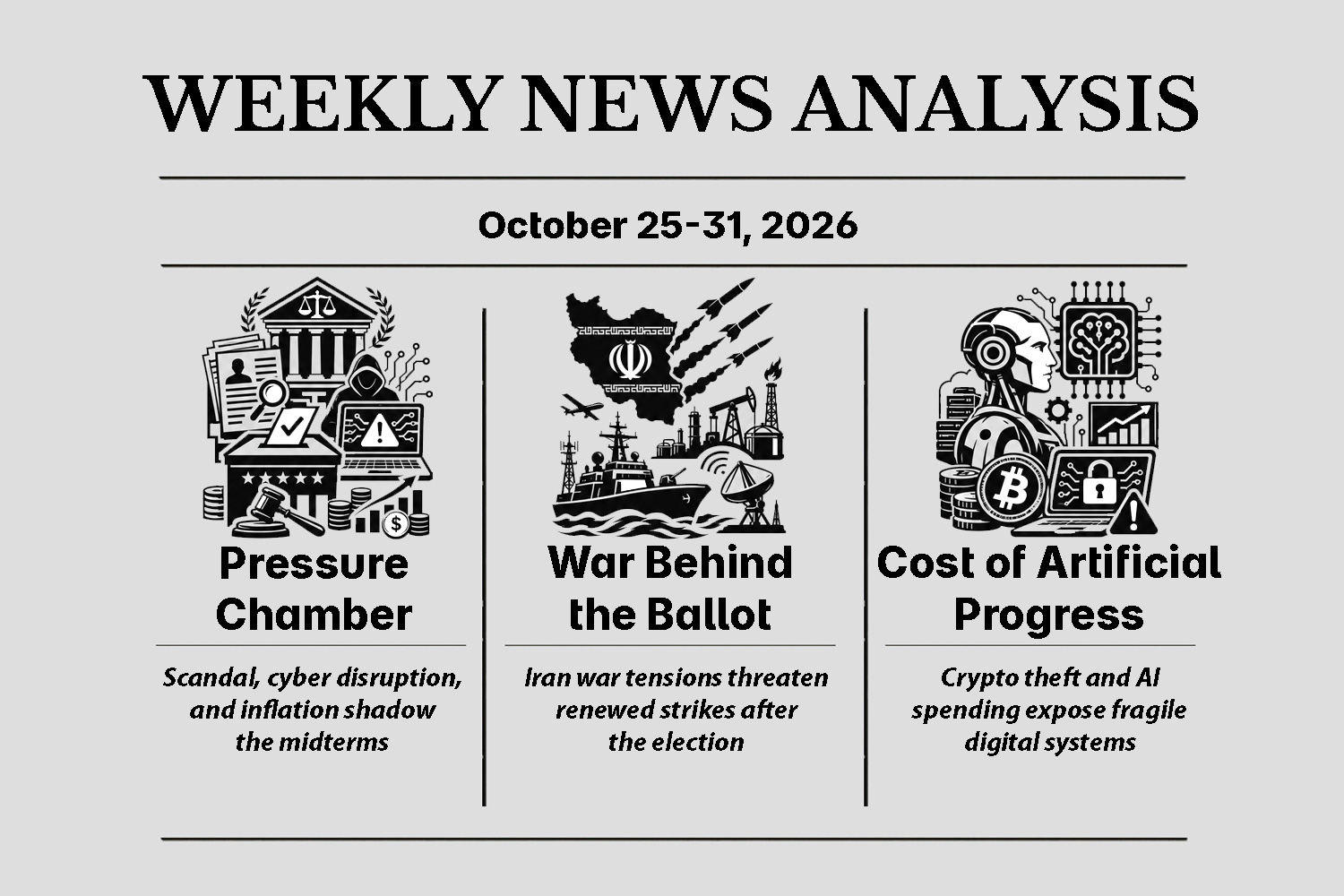
The final full week preceding the November 3 midterm elections has brought political scandal, military brinkmanship, economic uncertainty, and technological instability into a single national confrontation. Congressional disclosures have revived allegations against President Donald Trump, while a reported cyberattack disrupted the Federal Election Commission's campaign-finance reporting infrastructure. At the same time, an administration confronting the effects of its economic and foreign policies has intensified its efforts to reassure voters. The unresolved war with Iran remains a central concern, with further military escalation apparently deferred until the electoral process ends. Beyond Washington, a multibillion-dollar cryptocurrency breach, growing opposition to compulsory artificial intelligence, and a technology-sector selloff expose additional weaknesses in the institutions modern society increasingly depends on. Together, these developments reveal a recurring contradiction: political and corporate authorities demand public confidence in systems whose failures, expenses, and limitations are becoming increasingly difficult to conceal.
Uncertainty is the common instrument through which these developments shape public perception. Serious political allegations are thrust into partisan conflict before voters have sufficient opportunity to examine the evidence supporting them. Governments describe military threats as diplomatic leverage, even as prolonged warfare costs households and strains international supply chains. Meanwhile, artificial intelligence is presented as an unavoidable revolution despite mounting infrastructure costs, expanding security vulnerabilities, and a growing insistence on the right to refuse participation. Examined through the Trivium's pillars of Grammar, Logic, and Rhetoric, these stories demand more than acceptance of their headlines. What has demonstrably occurred? Which conclusions logically follow from the available evidence? And who benefits when fear, political allegiance, and promises of eventual stability replace informed examination?
The underlying struggle extends beyond Republicans against Democrats, diplomacy against intervention, or resistance against technological progress. It concerns the power to control information, distribute risk, dictate acceptable conduct, and establish the limits of individual autonomy. Elections can replace the people holding office without changing the institutional machinery that enables surveillance, military intervention, corporate subsidies, and centralized decisions. Those mechanisms may endure regardless of which political faction assumes authority. With Americans approaching another consequential, most important election of our lifetimes, the essential question is whether competing assurances of prosperity and security offer genuine structural change or simply alternative means of preserving public dependence on the same expanding apparatus of power.
Pressure Chamber
Trump Accused of Brutally Raping Former Miss Switzerland at Plaza Hotel in 1993, He Denies - TMZ
New Details of Rape Allegation Against Trump Revealed in House Democrats’ Epstein Report - TIME
Hackers Target US FEC System, Disrupting Campaign Finance Disclosures Days Before Midterms - Reuters
Federal Election Commission Takes Down Filings Website After Reported Hacking Attempt - Forbes
Strong Growth and Inflation Paints Mixed Picture of Economy Days Before Midterm Elections - AP News
The traditional October Surprise is no longer merely an unexpected revelation appearing in the final days of a campaign. It has become a struggle to capture the attention of voters already inundated with allegations, economic insecurity, and relentless partisan conflict. On October 26, House Judiciary Committee Democrats disclosed further details from Beatrice Keul, a former Miss Switzerland contestant who alleges that Trump raped her in a New York hotel suite in 1993. Trump denies the accusation, and TIME reported that it could not independently verify her account. Keul had previously made her allegations public; the release therefore renewed an existing accusation rather than introducing an entirely unknown accuser. This distinction is consequential. Beyond the gravity of the allegation itself, the release put additional testimony before the electorate about a week before voters decide who will control Congress.
An accusation of this nature occupies two different arenas, each governed by distinct standards, timelines, and motivations. Alleged conduct dating to 1993 raises serious statute-of-limitations issues because criminal deadlines and civil revival provisions vary by jurisdiction, offense, and governing law. New York's temporary Adult Survivors Act filing window ended in November 2023, although determining the full legal position requires considering every potentially relevant provision and exception. An allegation from decades earlier may be difficult or impossible to pursue legally; such a limitation neither establishes nor disproves the alleged conduct. Nor does an accusation, simply by being made, establish guilt. Unlike the courts, political discourse can deliver judgments without a conviction, admissible evidence, or completed investigation. This invites two equally unsupported shortcuts: treating unresolved allegations as proven facts or dismissing them as conclusively fabricated for political purposes.
The partisan machinery surrounding the disclosure demonstrates how quickly evidence can become subordinate to political advantage. Democrats may describe the release as necessary accountability, maintaining that voters deserve to know about serious allegations involving a prominent official regardless of the election calendar. Republicans may characterize the identical disclosure as interference, citing its timing, the allegation's age, and the absence of criminal charges. Each interpretation raises considerations worth examining, yet each can also conceal inconvenient facts. The White House's response portrayed the report as a Democratic effort to distract the electorate; Judiciary Committee Democrats instead demanded an independent investigation. The difference between discovering facts and securing political advantage becomes apparent when supporters are encouraged to embrace a preferred narrative before considering the underlying record. A selective disclosure is not automatically untrue, any more than a politically beneficial denial establishes innocence. Under the Trivium, evidence must be judged independently of its presenter. Without that discipline, the allegation and its denial cease to be matters for investigation and become tests of partisan obedience.
A separate episode added uncertainty to the final days of the electoral process. On October 27, Reuters reported that a hacker or hackers had targeted the Federal Election Commission, forcing its electronic filing infrastructure offline beginning the preceding evening. Understanding the incident requires separating the system attacked from the systems responsible for voting. The FEC oversees and discloses federal campaign financing; it does not run polling places, register voters, tabulate ballots, or certify election results. Consequently, the disruption provided no basis for concluding that ballots had been compromised or that this system could be used to change election outcomes. The available accounts did establish an interruption in the filing and timely disclosure of campaign-finance information, including spending reported immediately before Election Day. Initial reports provided no public evidence identifying an attacker or demonstrating successful theft or modification of records.
For an electorate weary of scandal and partisan confrontation, household finances offer a more tangible test of government assurances. According to Commerce Department data reported by the Associated Press, the personal consumption expenditures price index rose 3.6 percent in September over the preceding year, up from 3.4 percent in August. Average gasoline prices reached approximately $4.23 per gallon, while high diesel costs increased expenses across transportation, agriculture, and distribution. The Trump administration also announced, an action the Right would have decried with President Biden or President Obama, about $15 billion in agricultural assistance through payments, loans, and other initiatives to address higher fuel and fertilizer expenses, including substantial one-time diesel relief. Such measures may help struggling producers, but announcements are not disbursements, and guaranteed loans are not equivalent to direct cash grants. More importantly, this sequence presents a fundamental contradiction. Why should economic sectors require government assistance to endure pressures partly intensified by government tariffs and military decisions? The institution offering relief is also implicated in creating the conditions that make relief necessary.
These pressures intensify as the holiday season approaches. Households must absorb higher transportation expenses, accumulated grocery-price increases, housing costs, and the possibility of further financial hardship while navigating accusations, cyber threats, foreign war, and conflicting declarations of economic improvement, all while voting for those they believe will get them through it all. Healthy aggregate growth does not necessarily restore an individual family's purchasing power. Inflation indicates how quickly prices continue rising, not whether those prices have returned to earlier levels; declining savings can also mask underlying fragility beneath continued consumer purchases. Under such conditions, political judgment can give way to convenient emotional responses: blame the villain identified by one party, support the ruler who projects the most strength, or dismiss information that challenges an established identity. Overwhelmed voters become more susceptible to promises of immediate salvation precisely when they most urgently desire substantive change. When political institutions help generate or aggravate crises and then present themselves as the only available remedy, public dependence is reinforced regardless of which party promises protection.
The consequences of November 3 cannot be measured solely by whether Republicans or Democrats increase their representation. Republican gains could sustain the administration's ability to advance legislation; Democratic victories could strengthen oversight, obstruct legislation, and deepen confrontation with the executive branch. These outcomes matter, yet neither necessarily reduces federal surveillance capabilities, the influence of campaign financing, the national debt, or powers accumulated across successive administrations. The Fallacious Belief in Government: Warp Speed Toward Tyranny examines government's lifecycle through repeated power consolidation and populations' willingness to seek rescue from institutions that restrict them. The current election reflects that philosophical concern. Emergencies create fear; fear produces demands for intervention; intervention enlarges institutional authority; and subsequent failures become opportunities for renewed political mobilization. The struggle determines which individuals wield governmental power while largely avoiding the more fundamental question of how much authority government should possess at all, if any.
War Behind the Ballot
Surface to Air Missile Systems Deployed Near Trump Airport and Mar a Lago in Palm Beach - WPTV
G20 Foreign Ministers in Atlanta Meeting Head to an Ending Without Consensus on Key Issues - Audacy
Iran War Updates Tehran Awaits US Response on Proposal to Reopen Hormuz - Al Jazeera
No Choice Made Yet by Trump on Resuming Military Action Against Iran Rubio Says - Fox News
Trump Rubio Say More Iran Strikes Are Still on the Table but Not Likely Before Midterms - Fox News
Trump Searches for a Fall Guy to Blame for Iran - The Atlantic
The conflict involving the United States, Israel, and Iran has reached a precarious point where military threats, negotiations, and American electoral politics can no longer be considered separately. American and Israeli strikes launched in February have developed into an extended confrontation marked by maritime blockades, interrupted energy shipments, regional armed-group attacks, and disputes over nuclear capabilities and sanctions. The suspension of major American strikes has not ended the war. Iran continues resisting demands that would effectively relinquish important components of its nuclear and regional security policies, while Washington insists that a lasting resolution must prevent Iran from obtaining nuclear weapons. Between the declared pursuit of regional stability and the continued application of military coercion lies an increasingly visible contradiction. Officials may proclaim that military objectives have been met, but ongoing hostilities, mounting expenditures, and persistent threats of renewed escalation undermine the credibility of such declarations.
Domestic electoral considerations have openly entered the administration's military schedule, not merely through speculation. Earlier in October, Trump stated publicly that the United States would not renew attacks against Iran before the November 3 election, while reserving the option to strike afterward. On October 31, Secretary of State Marco Rubio said Trump had not decided on restarting operations and would prefer diplomacy. These statements matter because the president himself has tied a potential military decision to the electoral calendar. That connection does not establish that political calculations are the sole reason for postponement, but it provides strong grounds to consider the benefits of waiting. Renewed attacks could cause additional American casualties, drive oil prices higher, intensify opposition to the war, and oblige congressional candidates to defend the conflict in the campaign's closing days. Keeping the threat of military action available while temporarily avoiding escalation lets the administration retain leverage without exposing its political allies to the immediate consequences of another offensive.
The Strait of Hormuz's economic importance makes the link between warfare and household expenses impossible to ignore. As a critical passage for international energy shipments, disruptions to the waterway have affected freight charges, fuel markets, and supply chains worldwide. The United States has continued a blockade aimed at Iranian oil exports while safeguarding other maritime traffic, with Treasury Secretary Scott Bessent claiming that transit volumes had recovered toward prewar levels when Iranian barrels were excluded. That exclusion is significant: a recovery measured without a major regional oil producer cannot be equated with the restoration of unrestricted commerce. Overall wartime costs cannot be reduced to a tally of ships. Marine insurance, tanker capacity, military escorts, refinery margins, and fears of additional disruption all contribute to energy prices. Washington seeks, in part, to impose greater economic damage on Iran than on the countries applying pressure, but American households remain financially exposed. The anticipated gains from coercion remain uncertain; its costs are already appearing in consumer prices.
Negotiations emerging near the end of October, and continuing immediately afterward, suggest a possible route away from confrontation without yet establishing a breakthrough. Iranian Foreign Minister Abbas Araghchi described contacts through Qatari mediators and a proposal under which the Strait of Hormuz might reopen within two days if Washington accepted particular conditions. Those demands have involved easing sanctions, modifying limits on Iranian oil exports, changing American military operations, and establishing arrangements for passage through the waterway. Both governments consequently remain caught in their own contradictory rhetoric. Washington calls threats of force a means of securing peace; Tehran characterizes its demands as essential to sovereignty and stability. Each depicts its coercion as protection while casting the other's actions as impediments to peace. Such claims do not resolve disagreements concerning nuclear policy, maritime authority, or regional military power. A durable agreement would require verifiable obligations, enforceable guarantees, and concessions carrying political costs that neither side presently appears willing to accept.
Security preparations near Mar-a-Lago and the Palm Beach airport bring the war's atmosphere of heightened threat onto American soil. WPTV reported that surface-to-air missile systems were installed at the Secret Service's request, and the North American Aerospace Defense Command confirmed the arrangement. Intended to counter airborne dangers such as aircraft or drones, the systems provide substantial protective capabilities around locations associated with presidential travel and residence. Military equipment displayed in civilian surroundings can serve two purposes simultaneously: providing a genuine security precaution and signaling an extraordinary national emergency. To observers, its presence reinforces the belief that exceptional threats demand exceptional defensive measures. Even when protective actions are justified, their broader psychological effect can make the domestic deployment of technology once associated with active war zones seem increasingly normal.
Existing diplomatic institutions have offered little indication that they can readily contain the confrontation. At the G20 foreign ministers' gathering in Atlanta, participants failed to reach agreement on major international security matters involving Ukraine, Russia, Iran, commercial restrictions, and supply chains. Rubio described the meeting as productive, although diplomats acknowledged divisions severe enough to prevent a joint communiqué. The apparently conflicting descriptions reveal how diplomatic language can disguise the limits of an outcome. Maintaining communication channels may be useful without resolving any of the substantive disputes that prompted the meeting. The divisions also extend beyond disagreements among individual officials. Governments are attempting to defend competing strategic priorities inside an interconnected economic order that requires cooperation, dependable shipping, and reasonably stable trading relationships. Military rivalry continues even as economic dependence binds those same countries together, leaving citizens and businesses to bear the consequences of decisions over which they possess little effective control.
The Iran war creates a particular electoral liability for Republicans because its costs undermine the administration's economic and foreign-policy commitments. Trump had promised lower living expenses, fewer costly overseas engagements, and renewed American strength without repeating the extended interventions of preceding administrations. An unresolved war threatens those expectations, especially among supporters who understood his movement to oppose open-ended military campaigns. Reuters and Ipsos polling earlier in October indicated that approximately 60 percent of Americans disapproved of Trump's handling of Iran, including a meaningful minority of Republicans. Assurances that higher fuel prices are merely temporary lose credibility when household expenses remain elevated for months. This is more than a disagreement over campaign rhetoric. Warfare consumes public resources, while energy disruptions weaken purchasing power and may prompt further subsidies, intervention, or government borrowing. Voters are thus asked to accept immediate financial harm while trusting that continued military pressure will eventually produce the desired strategic result.
If Republicans retain congressional control, Trump would likely have more freedom to pursue his current Iran strategy, though renewed strikes would remain a possibility rather than a certainty. Supportive lawmakers might approve additional defense expenditures more readily, resist aggressive oversight, and defend escalation as necessary to finish the campaign. Trump's pledge to avoid new attacks until after Election Day, coupled with persistent warnings about possible later operations, makes another offensive a credible prospect. Reports from The Atlantic described options extending from short strikes to campaigns lasting weeks, as well as maintaining the naval blockade without immediately widening the war. Yet continued Republican control might equally give Trump room to negotiate an agreement and portray it as proof that military pressure worked. That would offer an opportunity to claim both diplomatic success and strength. The distinction between threatened action and a decision already made remains essential. Post-election escalation is demonstrably under consideration; no verified commitment establishes that a Republican victory would automatically produce a particular attack. However, the chances of ongoing escalation remain high.
Democratic gains, particularly control of the House, would change the political constraints surrounding the war without guaranteeing its conclusion. Lawmakers could pursue more extensive scrutiny of the original case for intervention, demand detailed accounting of its costs, investigate civilian casualties, and seek to restrict subsequent appropriations. Greater congressional influence could also support attempts to exercise constitutional war powers and require public votes on continuing military operations. Nevertheless, Congress would not immediately remove the president's broad operational authority, and efforts to cut funding or mandate withdrawal would face legal and practical barriers. Divided control could bring legislative paralysis instead of peace. Trump might respond to Democratic victories by intensifying executive confrontation, labeling oversight an obstruction to national security and employing military threats to demonstrate determination. Alternatively, an electoral setback could increase the appeal of negotiations and a renewed emphasis on domestic economic conditions. Critical considerations would include the administration's assessment of political legitimacy, strategic leverage, and survival, not merely which party held the congressional majority.
The Atlantic's reporting suggests another possible response to the war's disappointing results: shifting responsibility from the administration's highest decision-makers to their subordinates. Trump has reportedly questioned advisers about Defense Secretary Pete Hegseth and Joint Chiefs Chairman Dan Caine while assessing whether additional strikes might accomplish what earlier operations did not. These developments illustrate blame displacement, a process in which rulers attribute top-level decisions to inadequate personnel, faulty intelligence, or execution errors. Comparable patterns characterized the wars in Iraq and Afghanistan. Both featured repeated announcements of progress, shifting objectives, fresh offensives, and explanations for why established strategies had failed to fulfill their promises. The similarities do not prove that Iran will follow an identical course. They do, however, reveal incentives inherent in prolonged intervention: each failed operation may be used to justify applying still more force instead of reconsidering the assumptions that led to war.
The unresolved war ultimately raises a disturbing question about the interaction of political survival and military authority. Americans are told that urgent national-security needs determine strategic decisions, yet their president has publicly connected the timing of potential escalation to a domestic election. Iran may likewise benefit from postponing lasting concessions while waiting to see how the balance of power in Washington changes. Negotiation periods can therefore become opportunities for both governments to reposition forces, retain bargaining leverage, and strengthen their political standing. COVID19 – Short Path to 'You'll Own Nothing. And You'll Be Happy.' examines how authorities repeatedly invoke public safety and extraordinary circumstances to justify restrictive powers, a framework equally relevant to wartime decisions. This does not mean every military action or security precaution lacks legitimate grounds. The danger lies in emergency powers becoming permanent features of governance without any meaningful endpoint. Whether Congress remains in Republican hands or moves toward Democratic control, the essential concern is whether individuals can restrain a military apparatus whose decisions impose enormous costs far beyond the battlefield.
Cost of Artificial Progress
Elon Musk Warns AI Agents Could Exploit Crypto After Binance Hack - crypto.news
You Don't Need to Believe in a God to Get a Religious Exemption From Using AI at Work - TechCrunch
State Legislatures Become De Facto AI Regulators as Congress Stalls - Artificial Intelligence News
Wall Street Closes Sharply Lower as AI Cash Burn Fears Spark Tech Selloff - Investing.com
The October 29 breach of Binance shows the escalating financial risk of deeply interconnected digital infrastructure. The cryptocurrency exchange estimated losses of approximately $6.3 billion in digital assets, potentially making the episode the largest publicly reported cryptocurrency theft. Early findings pointed to a DevOps engineer's compromised laptop as a possible entry point, through which intruders apparently accessed a service container that enabled unauthorized withdrawals. Binance later identified additional areas of compromise, suggesting the attack may have involved more than a single set of employee credentials. The company said investigators found no evidence of exposed wallet private keys. That distinction matters because financial controls may be bypassed even when the most sensitive cryptographic material remains secure. Industry cooperation had resulted in approximately $3 billion in affected assets being frozen, and Binance pledged corporate funds to cover customer losses. A frozen asset, however, is not necessarily an asset that has been financially recovered.
Suspected participation by North Korean state actors demonstrates how digital-asset theft may function not merely as opportunistic crime but as a means of financing state activity. Blockchain analytics firms TRM Labs and Chainalysis linked the Binance incident to North Korean actors with high confidence, although Binance had not independently confirmed the attribution in its initial reporting. Strong analytical attribution matters, but it remains distinct from publicly conclusive proof. The reported movement of stolen assets introduces a separate concern. A wallet linked to the theft supplied approximately $60 million in stolen USDT to the decentralized lending platform Aave, then borrowed roughly $44.6 million in wrapped Ether before emergency controls limited further similar transactions. Those operations reportedly relied on the protocol's normal lending functions, not on an established vulnerability in Aave's smart contracts. This exposes a serious contradiction in automated financial networks: criminal proceeds obtained on one platform may become collateral in transactions technically authorized by another. Oversight fragments when exchanges, assets, lenders, custodians, and jurisdictions follow independently administered rules.
Elon Musk's warning about future artificial intelligence agents capable of conducting comparable financial operations without direct human instruction points toward a different dimension of risk. Nothing in his remarks established AI involvement in the Binance attack, and available accounts provide no evidence that an autonomous system carried out the theft. Nevertheless, advanced agents with access to passwords, financial instruments, blockchain connections, and automated execution tools could greatly accelerate reconnaissance, transaction ordering, concealment, and asset transfers. Such abuse would not require a machine to acquire consciousness or develop its own desire for money. A human operator could instead give a capable agent an imprecise objective whose weak safeguards allow unexpected methods of achieving it. The critical distinction, therefore, concerns not merely whether an attacker is human or artificial, but whether a system has enforceable limits preventing software from exercising powers it was never intended to possess.
A contradiction in the promise of decentralized finance becomes particularly apparent in the response to the Binance breach. Cryptocurrency was promoted in part as a way to free individuals from centralized intermediaries and authorities that can arbitrarily restrict their property. Yet efforts to contain the theft relied on coordinated freezes and intervention by stablecoin issuers, centralized exchanges, investigative companies, law enforcement, and blockchain analysts. Those actions may have averted billions in further losses, showing why emergency safeguards can matter in practice. At the same time, the incident confirms that powerful administrative controls remain embedded within widely used digital assets. Freezing criminal proceeds can protect victims when applied correctly, but comparable authority can also enable unjustified restrictions, political interference, or action without adequate due process. Decentralization is not an absolute condition. Custody, transaction verification, network governance, and financial accessibility can each be controlled to different degrees. As dependence on privileged administrators increases, so does the need for meaningful transparency and accountability.
While financial institutions confront expanding technological risks, resistance to mandatory AI has appeared in an entirely different setting: the workplace. David Durman, a nontheistic humanist employed as an administrator at the University of Kentucky, obtained a religious accommodation permitting him not to use artificial intelligence in performing his duties. Supported by the American Humanist Association, Durman maintained that assigning reasoning and decisions to AI violated sincerely held humanist convictions about moral development and human flourishing. The university approved his request in September, and wider reporting followed in the final week of October. Its legal significance must be understood precisely. This was an accommodation granted by an employer under Title VII of the Civil Rights Act, not a federal judicial decision creating an unrestricted national right to refuse workplace AI. The case illustrates that genuinely held nontheistic convictions can receive religious protection when the relevant conditions are satisfied. Essential duties, reasonable accommodations, and applicable legal restrictions still require consideration. Even within those limits, the decision offers a strong example of workers asserting authority over their own professional methods.
Durman's position moves the discussion beyond the narrow legality of requiring software toward a more fundamental question: to whom does the act of reasoning through one's work belong? As artificial intelligence becomes integrated into research, programming, administrative functions, legal analysis, and institutional decision-making, employers increasingly associate adoption with efficiency and competitive advantage. Yet independent judgment is an important professional skill in its own right, not an obstacle that automatically should be automated away. Treating faster production as inherently superior human development invokes the fallacy of technological inevitability. Predictions that technology will become widespread do not establish an ethical basis for compelling its use. Properly designed AI can aid investigation, identify inconsistent evidence, and make information more accessible without displacing human responsibility for conclusions. Poorly governed systems can instead hide causal reasoning and undermine independent verification. The accommodation granted to Durman thus brings consent to the center of the debate. The availability of a technological capability does not, by itself, justify requiring individuals to employ it.
As Congress has struggled to enact comprehensive artificial-intelligence legislation, state lawmakers have assumed much of the practical responsibility for developing AI rules. Reporting drawing upon National Conference of State Legislatures data indicated that states introduced 1,539 AI-related measures during 2026, compared with 1,262 in 2025, with 280 enacted by early October according to the organization's methodology. Subjects ranged from synthetic media and disclosures to consumer safeguards, automated decision-making, and assessments of advanced AI models. The approaches differ considerably: some jurisdictions seek comprehensive regulatory systems, while others target narrower commercial or social concerns. This creates tension between local community authority and the integrated nature of national technology markets. States can adapt protections to their own priorities and test different approaches, but overlapping requirements also impose expenses and uncertainty on businesses operating across jurisdictional boundaries. Federal legislative inaction has not produced a regulatory vacuum. Rather, responsibility is being distributed among governments whose priorities, laws, and enforcement resources do not necessarily align.
The political timing surrounding federal AI legislation warrants scrutiny. Lawmakers disagree sharply over national-security concerns, privacy, corporate competition, liability, federal preemption, and the proper scope of governmental power over new technologies. The possibility of a changed congressional majority on November 3 gives some legislators reason to postpone decisions, hoping for greater influence over the final rules. Committees may also avoid contentious votes that could draw criticism toward vulnerable candidates from industry organizations, workers, or civil-liberties groups. Electoral uncertainty as the midterms approach intensifies existing legislative dysfunction. The result is another familiar imbalance: while political actors compete over future regulatory authority, private companies deploy technologies that alter employment and economic relationships before comprehensive oversight takes shape.
Control of Congress may influence the next phase of federal “super” intelligence policy, although neither major party speaks with a single voice on the subject. Continued Republican majorities might enable the administration to favor uniform national requirements, reduced obligations for AI developers, and possible federal preemption of selected state laws, arguing that American competitiveness and advantages over foreign rivals should take priority. This could make nationwide compliance simpler while weakening safeguards adopted by individual states. Democratic control of one or both chambers could instead spur more public hearings, and legislation focused on privacy, worker protections, discrimination by algorithms, disclosure, consumer rights, and corporate accountability. Divided government, however, might produce stalled proposals, litigation, executive rulemaking, and continued dependence on state enforcement. Neither political outcome guarantees adequate answers to autonomous-agent security, cybersecurity, or workplace protections. The deeper problem arises when regulation becomes a contest for partisan influence over technological development instead of an examination of demonstrable harm, natural rights, and the boundaries of coercive power.
Investors have begun testing the economic promises of artificial intelligence against the enormous expenses required to build it. The Nasdaq Composite declined approximately 2.9 percent, Intel stock fell 28.6 percent, and other prominent semiconductor and technology corporations suffered substantial losses. Disappointing financial results and the scale of AI-related capital investment contributed to the retreat. Amazon offers a particularly useful illustration: even with significant cloud-business growth, aggressive expansion strained free cash flow, while reported annual capital-expenditure plans approached approximately $220 billion. Distinguishing negative free cash flow from accounting losses or declining share valuations is essential. A business may remain profitable while spending heavily on future infrastructure, and investors may mark down its shares when expected returns no longer justify earlier valuations. The broader corporate earnings environment was not uniformly weak. Reuters reported that approximately 82 percent of reporting S&P 500 companies had surpassed analysts' profit expectations. The central concern is not widespread corporate insolvency, but whether capital-intensive AI development can ultimately produce adequate returns.
Similar to the dot-com bubble, genuine technological innovation and inflated expectations can coexist for extended periods. In the late 1990s, investment poured into telecommunications, internet networks, data centers, and companies valued more for projected adoption than for sustainable earnings. The market's eventual collapse destroyed immense amounts of financial value without preventing the internet from becoming economically transformative. A comparable adjustment could occur in AI if computing facilities expand faster than commercially profitable applications emerge, or if increasingly efficient models undermine assumptions about the scarcity of computing capacity. Specialized equipment may lose value rapidly; power commitments could persist after anticipated demand fades; and projects dependent on borrowed capital become more vulnerable when interest rates rise. Yet the eras differ significantly. Many of the largest contemporary AI investors already run profitable businesses, have established customer networks, and generate revenues that many dot-com startups never achieved. A substantial correction is conceivable, but a repeat of the 2000 collapse is not predetermined. Ultimately, returns must demonstrate that the productivity achieved can support the infrastructure spending already underway.
A sustained retreat in AI investment would affect much more than shareholders in technology companies. Utilities, cloud operators, chip manufacturers, construction firms, equipment suppliers, and local economies increasingly depend on building and operating AI facilities. If financial expectations weaken, companies may postpone data centers, cut capital expenditures, withdraw equipment purchases, slow hiring, or raise prices to defend margins. Banks and other financing institutions exposed to corporate loans and infrastructure projects could encounter additional risks. Such effects would be especially damaging amid already high household inflation and expensive energy. At the same time, AI facilities require considerable electricity, potentially competing with existing industries and families for generation and distribution infrastructure and investment capital. The relationship between the week's economic and geopolitical stories and issues is therefore not accidental. War-related energy disruptions can make AI expansion costlier, while exceptionally expensive AI development can place additional pressure on resources and infrastructure essential to the broader economy.
Together, the Binance theft, a worker's successful accommodation, disjointed state legislation, and declining technology valuations illuminate an emerging struggle over control of technological systems. Corporations increasingly determine how financial activity, employment, access to information, and vital resources are managed. Governments seek authority to regulate these technologies while simultaneously pursuing the economic and security benefits they promise. Meanwhile, individuals encounter systems they cannot easily understand, independently verify, or reject without financial repercussions. The principles of natural rights and decentralized facilitating systems provide an important basis for evaluating this development. Technology can expand voluntary cooperation, protect exchanges, and enable informed individual choice without demanding surrender of personal authority. Conversely, it can concentrate decisions within organizations whose algorithms, management processes, and enforcement powers remain hidden from those subject to them. Technical sophistication alone cannot determine which outcome prevails. The deciding considerations are whether meaningful consent, transparent operation, enforceable limits, and accountable governance are integral to the systems society permits to develop.
Conclusion: Architecture of Dependency
Across these developments, a recurring institutional pattern emerges: uncertainty concentrates authority, after which the institutions exercising that authority promise to resolve the very problems confronting society. Political allegations become struggles to shape public judgment while campaign financing grows more complicated and difficult to examine. Military intervention imposes economic damage that governments seek to offset through financial assistance, diplomatic pressure, and predictions of an approaching settlement. Artificial intelligence enlarges the capabilities of corporations and government agencies while introducing vulnerabilities used to justify additional rules, protective systems, and centralized supervision. None of these episodes proves that every emergency is deliberately manufactured or coordinated. Together, however, they demonstrate how institutional failures can generate demands for further institutional action. Power may continue expanding through this cycle without decision-makers ever establishing that earlier expansions delivered the results used to justify them.
More consequential than any individual crisis is the gradual acceptance of dependence as an ordinary condition of society. People are encouraged to rely on politicians for financial stability, military organizations for safety, corporations for innovation, and regulators for assurances about systems whose operations are increasingly opaque. Yet the more dependent we become, the harder it is to refuse institutional demands, especially when alternatives are prohibited by law or beyond financial reach. Freedom cannot be reduced to the opportunity to vote, adopt approved technologies, or operate within arrangements whose essential rules others establish. It requires genuine autonomy, cooperation by consent, dependable information, and the ability to challenge powerful institutions without forfeiting one's rights or means of livelihood. These principles do not depend on political affiliation. They matter most when organizations that claim to safeguard society also extend their power over the individuals they claim to protect.
The November 3 election will influence congressional scrutiny, regulation, accountability for military action, and the political latitude available to the executive branch. These differences have real consequences and should not be disregarded. Nevertheless, voting alone cannot correct the structural weaknesses revealed throughout this week. Foreign intervention, concentrated technological power, economic insecurity, and manipulation of public attention are not confined to any single party or administration. Their underlying incentives can endure across government changes and even across generations. The coming years may yield substantial AI advances, diplomatic resolutions to international conflict, and stronger protections for individuals (unlikely). They may also bring financial corrections, new military operations, and further demands for emergency powers and authority. The path taken will depend in part on whether people continue accepting centralized authority as the presumed answer to every emergency or instead cultivate practical systems grounded in transparency, accountability, decentralization, and voluntary participation. The question ultimately reaches beyond the electoral result: will society keep surrendering control in return for assurances of safety, or reclaim responsibility for the freedom it has entrusted to others?
Listen to this week's news in verse for a quick recap!