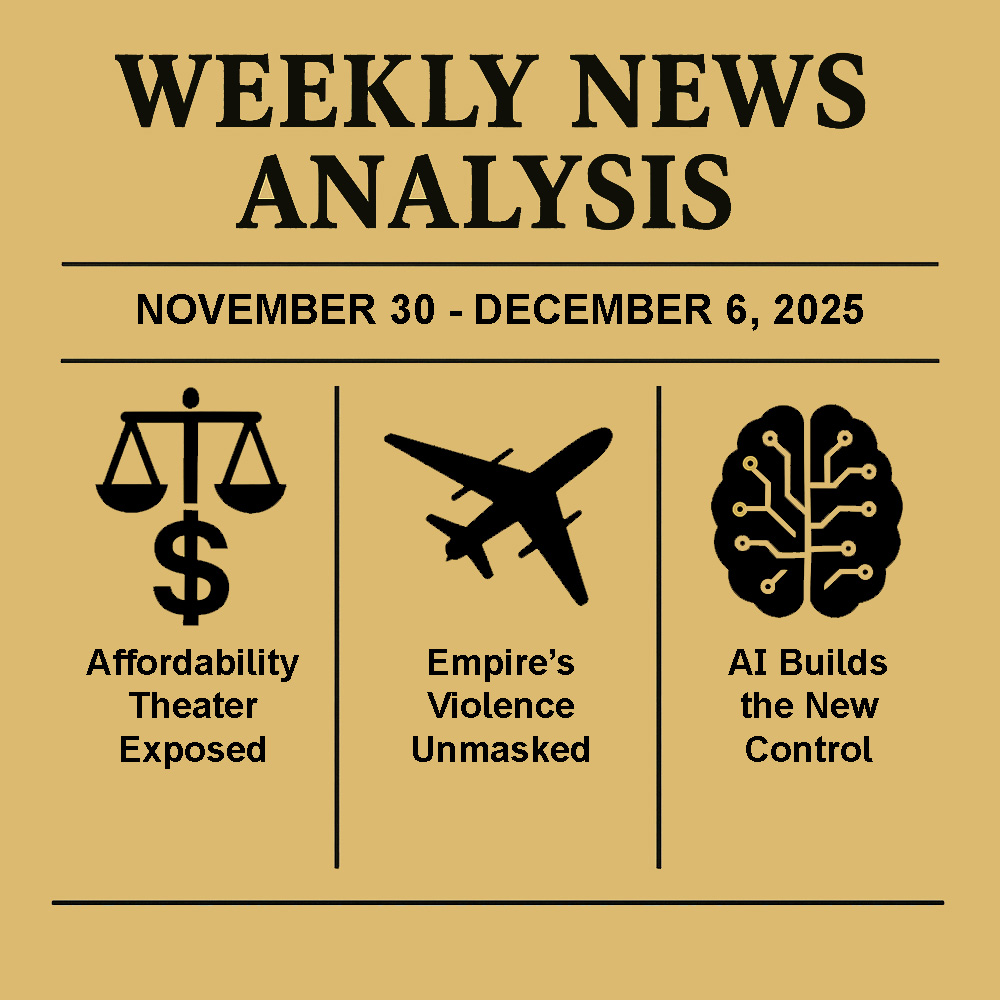
The headlines of the week expose a framework of control: domestically, political spectacle around affordability and “protecting consumers” conceals a system deliberately crafted to enhance dependency through crisis-management tactics. Trump’s new food supply executive order, congressional strategies on Obamacare subsidies, and media stories about inflation all suggest a bipartisan consensus: the cost of living will continue to rise, with both parties offering superficial fixes rather than real solutions. This is not actual governance; it is an orchestrated narrative. As discussed in COVID19 – Short Path to ‘You’ll Own Nothing. And You’ll Be Happy.’ and The Fallacious Belief in Government, crises are not accidental; they function as drivers for technocratic consolidation.
At the same time, U.S. foreign policy persists in its pattern of empire-building, violence, and resource control. From abandoned U.S. weapons now aiding the Taliban, to disputed maritime strikes in Venezuela, and growing domestic debates about political violence, we observe the predictable cycle of tyranny advancing to its next stage. This pattern is reflected in the development of an AI-managed bureaucracy, where disputes over copyright, regulation, biometrics, and digital currency are shaping future control frontiers. All these areas form different parts of the same system—each preparing society for a future where artificial scarcity is created, obedience is automated, and even rebellion could be programmed.
Affordability Theater Exposed
Trump signs executive order creating food supply chain task forces - Fox Business
Trump signs order to create food supply chain task forces – Reuters
Trump’s affordability messaging - Washington Post
House Republicans push to extend Obamacare subsidies – Newsweek
Trump’s executive order to establish food-supply-chain task forces is portrayed as a strong stance against unfair competition, foreign influence, and monopolies in the grocery sector. Fox Business and Reuters highlight a White House statement that positions the government as a supporter of family budgets, while leveraging antitrust measures to reassure voters still concerned about inflation. Meanwhile, The Washington Post notes that the public remains overwhelmed by living costs even as officials claim wage increases. These reports collectively illustrate a government attempting to restore trust while sidestepping deeper structural issues it has contributed to.
Newsweek’s coverage of House Republicans backing the extension of Obamacare subsidies highlights an ironic aspect of the executive order's storyline. After years of campaigning to repeal it, these lawmakers now argue that subsidies are essential to avoid higher premiums for their constituents. Seen as practical governance, this shift underscores the heavy reliance of both parties on the corporate insurance system. The debate doesn’t involve decentralizing healthcare or dismantling this monopolistic system, but focuses only on how to fund it.
When examined together, the executive order and subsidy extensions reveal an orchestrated political performance. Both sides assert they are defending the public, yet they back policies that hinder access to essentials. Task forces give the appearance that the administration is combating corporate consolidation. Still, they overlook core issues such as monetary policy and regulatory capture, which are viewed as primary drivers of price volatility. Meanwhile, subsidy extensions allow both parties to claim they are "reducing costs," while they continue to support insurers that benefit from the ongoing crisis. Corporate socialism.
However, the truth is that the modern economy is structured to maintain widespread insecurity. Elements such as inflation, supply-chain “instability,” and rising healthcare costs are not mere policy failures but instruments of control. Each crisis prompts the formation of new task forces, increased bureaucratic oversight, and federal interventions, fostering greater dependence. This gradual technocratic system is a form of governance where the majority exists in a controlled state of vulnerability.
Task forces and subsidies act as safety valves for the narrative. They soothe public frustration by giving the appearance of significant action. This helps keep anger away from the creators of the economic system—such as central banks, entrenched bureaucracies, and corporate-financial alliances—that have influenced the current cost-of-living crisis. However, this performance doesn’t solve the problem; it merely maintains it.
The government that purports to defend domestic consumers from monopolistic tactics is simultaneously using military force overseas, leaving behind billions in weapons, and sparking new crises. Domestic economic turmoil and international imperial violence are linked—they are two facets of the same coin—demonstrating how the government edges closer to outright Tyranny.
Empire’s Violence Unmasked
U.S. weapons left behind strengthen Taliban - Fox News
Trump says airspace above and around Venezuela should be ‘closed in its entirety’ - Reuters
U.S.–Venezuela tensions escalate amid regional anxiety - CNN
In the Line of Fire - The New Yorker
Fox News’ coverage of U.S.-funded weapons abandoned in Afghanistan reveals how American policies frequently equip future adversaries. The Taliban’s present security forces are based on equipment funded by U.S. taxpayers. What appears to be negligence is actually part of a recurring imperial pattern: today’s stabilization efforts become tomorrow’s rationale for further intervention. The empire sustains itself by fostering issues it later claims to resolve.
The Guardian’s coverage of U.S. boat strikes near Venezuela exposes the flexibility and moral ambiguity of American foreign policy. Legal experts criticize “double-tap” strikes on survivors—actions that clearly breach international standards—yet the government defends them as essential in the fight against “narco-terrorism.” This rhetorical strategy reframes extrajudicial violence as a matter of national security. It serves as a language shift that permits wartime reasoning to function without official declarations of war.
CNN’s broader regional analysis indicates that Latin American countries are now affected by American unpredictability. The U.S. simultaneously destabilizes and oversees the region, resulting in a continuous state of controlled tension. This aligns with the typical cycle of empire: instability justifies U.S. presence, presence leads to intervention, and intervention inevitably spurs the next crisis.
The New Yorker’s analysis of domestic political violence is seen as a problem rooted in polarization. However, examining it alongside America’s foreign policies reveals a more precise pattern: a government that supports targeted killings abroad often also normalizes surveillance, suspicion, and security measures at home. Empire consistently shapes domestic policies, with tactics reaching inward. This has been the case for the U.S. since the 1963 Warren Commission and its subsequent report.
According to the lifecycle outlined in The Fallacious Belief in Government, these patterns tend to recur. A government that increases its power during international crises is often inclined to do the same domestically. Every ambiguous attack, along with supposed "accidental” escalations involving terrorists or cartels, provides a pretext for expanding authority later. Tyranny relies on continuous crises—some natural, some fabricated, and others deliberately provoked. When efforts are made to grow tyranny within the government, it becomes a natural reaction to resist that tyranny with political violence. The rhetoric and condemnation of any political violence used aim to cultivate obedience and support for political figures. Think on this: without political violence, would the American Revolution have been successful?
The concept of a “scripted revolution” has historical origins. Governments frequently anticipate resistance and develop strategies to redirect, suppress, or co-opt it. Typical methods include managed opposition groups, controlled uprisings, and color revolutions. Using terms like “domestic extremism” and “threats to democracy” helps justify delegitimizing dissent that falls outside sanctioned channels.
As the empire expands, its focus moves from physical dominance to digital infrastructure. AI, data networks, programmable currency, and biometric identification are not merely upgrades but signify the empire's shift inward—creating a population managed through automated enforcement.
AI Builds the New Control
Conservatives warn White House against Big Tech “fair use” push - New York Post
Senate sinks AI moratorium - Fox News
Opinion: Congress must stop AI amnesty - Fox News
HHS, RFK Jr., Health AI strategy - AP News
AI and premature birth prediction - PBS
The discussion surrounding AI copyright centers on creative rights, with conservative leaders urging the government to oppose Big Tech’s “fair use” claims. However, at a deeper level, the real battle is over control of the infrastructure that will influence society. Those who own the training data and algorithms will hold the key to the U.S.'s future. This issue goes beyond culture—it signifies a continued shift in power.
The Senate’s decision to oppose a federal ban on state AI rules underscores the deeply divided, contentious environment. Trump’s advocacy for a single national standard reflects a desire for centralized authority. In contrast, critics fear that federal preemption could grant complete power to the political group that creates the regulations. This disagreement isn’t primarily about safeguarding citizens but about determining which elites will influence future governance.
AP News reports that HHS is incorporating AI into its systems to improve efficiency, but this is sparking concerns about privacy, data sharing, and decision-making algorithms. As AI becomes fully embedded in federal health services, it quietly handles tasks such as eligibility checks, risk assessments, and medical access. Bureaucratic processes are codified, bypassing public oversight.
PBS emphasizes the compassionate side of AI through its ability to predict premature births. This emotional appeal helps make intrusive data collection more acceptable. However, any predictive health model could also be used for behavioral monitoring, tracking compliance, risk patterns, or implementing “health-based restrictions” in a future public health system.
When integrated with CBDCs, digital IDs, and biometric authentication, AI governance becomes comprehensive. The state gains access to every transaction, movement, medical record, and social interaction. Rights cease to be inherent; instead, they become permissions granted by algorithmic systems. This increases the likelihood of automated punishment or exclusion.
This is where the 2030 slogan—“You’ll own nothing. And you’ll be happy.”—transitions from a meme to a deliberate plan. To realize this vision, crises must undermine the economic basis of ownership, including inflation, pandemics, supply chain disruptions, financial collapses, and cyberattacks. Each of these crises drives society further toward subscription services, dependence on platforms, and government-controlled access. AI will play a key role in building and maintaining these conditions.
Economic pressures at home, imperial violence abroad, and widespread digital governance all steer us deeper into an Age of Tyranny. In this era, obedience becomes automatic, scarcity is deliberately created, and authorities anticipate dissent before it even occurs.
The Machinery Behind the Narrative
These interconnected topics form a cohesive framework: political theater conceals economic extraction; foreign violence triggers future crises; and AI underpins a technocratic regime. Each sector—financial, military, digital—reinforces the others. Inflation fosters dependency; empire justifies force; AI promotes compliance. Collectively, they steer society toward a future in which autonomy is replaced by permission and ownership by access.
The upcoming challenge is not to pick sides in the theater but to grasp the stage itself. Identifying rhetorical tricks, strategic exploitation of crises, and the typical government cycle is the first step toward genuine resistance. We are in the early stages of this new Age of Tyranny, and the opportunity for spontaneous, authentic revolution diminishes with each exploited crisis. Awareness should precede action; clarity should come before strategy; and truth must surpass the narratives aimed at keeping the public passive as the system consolidates power.
Listen to this week's news in verse for a quick recap!