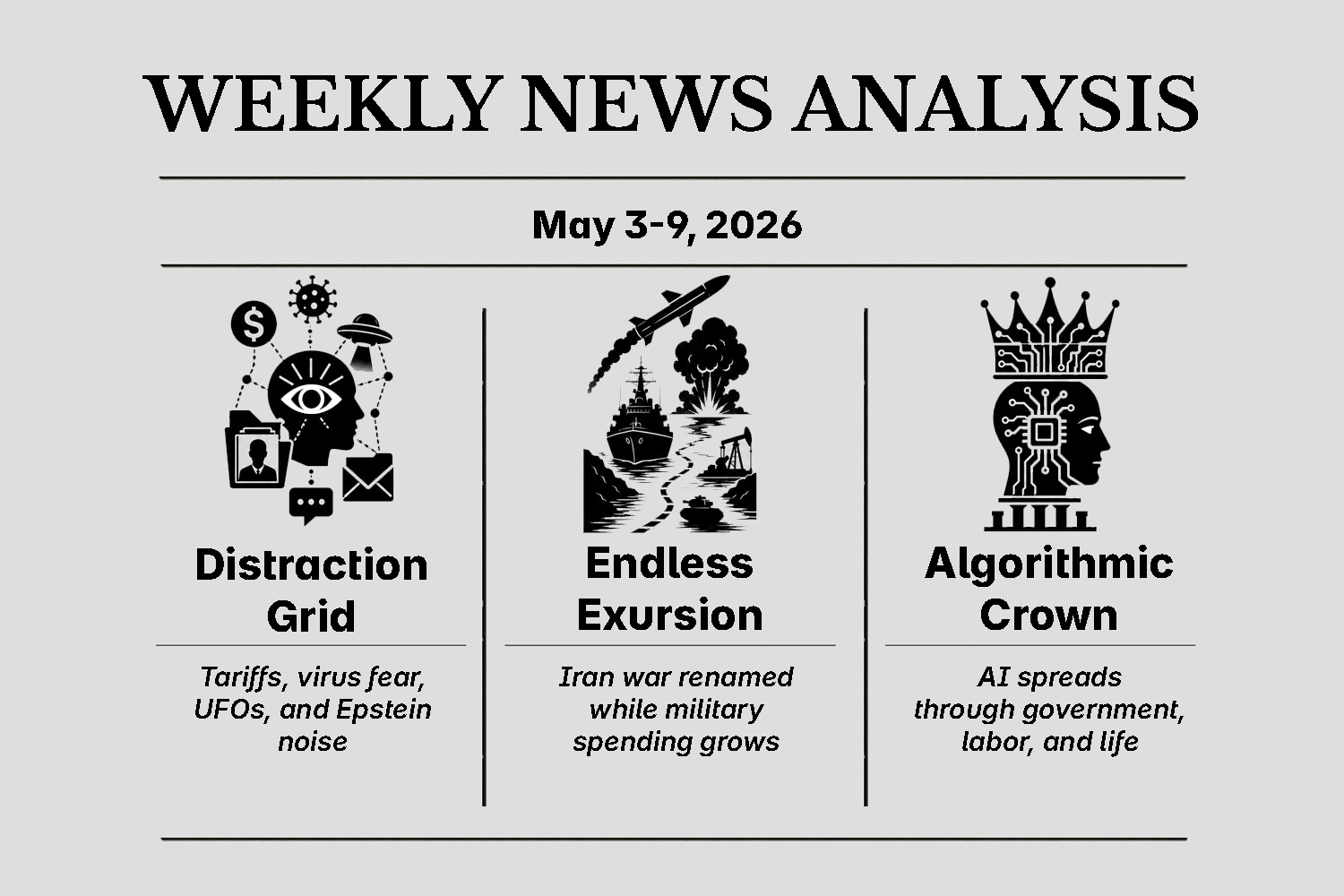
This week seemed like a coordinated stress test on public perception. Economic harm, tariff-induced inflation, pressure on national debt, a trillion-dollar military complex, a renewed virus scare, UFO disclosure events, Epstein evidence snippets, and AI integration across government and society didn't stand alone as separate headlines. Instead, they acted as interconnected signals within a controlled information environment, where the sheer volume of information itself became a weapon. The public isn't just being informed by the news cycle; they are overwhelmed, disillusioned, exhausted, and being reassigned focus.
The familiar pattern involves deprivation through prices, debt, war, and austerity; distraction via sensational disclosures and fear-based events; division through partisan loyalty tests; and deception through carefully timed narrative releases. This is not “4D chess” in the sense of strategic brilliance, but rather crisis choreography. The goal isn't necessarily that every event is fabricated but that all events are integrated into perception management processes. A damaged economy merges into one of many stories, a widening war reduces to a technical operation, AI governance becomes more efficient, and fear turns into consent.
The Trivium approach starts with Grammar: defining terms, recognizing actors, and separating facts from interpretation. It then moves to Logic, which questions the consistency of official explanations. Rhetoric considers what messages are intended to manipulate the public. In The Fallacious Belief in Government, the government is defined as a “tool or action of control,” and the Trivium is shown as a safeguard against propaganda, emotional appeals, and faulty reasoning. Although the stories vary visibly, their core structure stays the same: crisis, intervention, consolidation, dependency, and the emergence of a new crisis.
Distraction Grid
Hantavirus vaccine scramble after contact with people exposed to rat virus - Daily Mail
Pentagon releases declassified UFO files from various federal agencies - ABC News
Alleged suicide note written by Jeffrey Epstein unsealed by federal judge - The Guardian
The week began with economic difficulties, but these were overshadowed by spectacle. Moody’s chief economist Mark Zandi warned that Trump’s tariffs had caused significant economic damage, leading to faster inflation, slower job growth, and increasing commodity pressures from conflicts. The Independent pointed out that tariff revenues became a political tool, even as ordinary Americans bore most of the costs. Meanwhile, the national debt continued to rise, representing a form of deprivation disguised as policy. The public bears higher costs, the government gains more revenue, and those in power justify this extraction as a strategic move.
The rhetorical strategy is to portray tariffs as enhancing national strength while hiding that they function as a form of distributed taxation. Instead of acknowledging that households bear higher costs due to policy, officials frame tariffs as a position of leverage against foreign nations. This creates an equivocation fallacy: economic hardship is depicted as patriotic sacrifice when imposed by the government, but as exploitation when caused by private entities. The implicit assumption is that government extraction is justified when framed with nationalist rhetoric. Nonetheless, the real process is straightforward: tariffs pass the costs on to consumers, while political rulers can justify them as punishment of external actors.
Amid the current economic situation, a health scare involving hantavirus has arisen. The New York Post stated that passengers from the MV Hondius had traveled through multiple countries, including the U.S., following exposure to a lethal outbreak. One individual later tested positive, and officials confirmed a rare Andes-strain case, where human-to-human transmission could not be excluded. Although the virus, fatalities, and public health efforts are genuine, analyzing propaganda involves not just dismissing the event but also understanding how fear is shaped, timed, exploited, and leveraged to establish authority in the future.
The main warning from the COVID19 book applies here: crises can be used as a control mechanism if fear is exploited to bypass consent. During the pandemic, a familiar pattern emerged: isolating the threat, increasing uncertainty, moralizing compliance, dismissing dissent, financially supporting the pharmaceutical response, and normalizing liability shields. The framing around the vaccine “scramble” linked to hantavirus should be watched closely, as it prompts the public to emotionally jump from the threat of disease to trusting pharmaceuticals before a thorough, evidence-based understanding is established. While fear-based appeals are not always false, they are inherently risky because they tend to prioritize urgency over careful analysis.
Then came the UFO disclosures. ABC reported that the Pentagon has begun releasing decades-old UFO files through federal agencies. At the same time, the New York Post covered a new report of a military aircraft encountering a “super-hot” orb during a nighttime mission near an undisclosed government site. This shift appears as controlled wonder: the government, which previously spent years classifying, denying, misdirecting, and ridiculing, now presents itself as the authorized custodian of mystery. This same institution, which withholds evidence, claims moral authority when releasing only partial information.
The main issue isn't whether nonhuman intelligence exists but rather the level of trust in institutions. A government skilled in psychological operations, secret programs, surveillance deception, and narrative management shouldn't be seen as an impartial messenger just because the discussion shifts from warfare to aliens. Although Project Blue Beam, a plan to fake an alien invasion to further globalist agendas, is controversial and speculative, it symbolizes the manufactured crisis spectacle, emphasizing a genuine political danger: the ability to manipulate populations through staged or selectively revealed existential stories. The alien narrative gives the state a universal language of emergency that can transcend party lines, borders, religious beliefs, and legal frameworks.
Finally, the release of the Epstein note added to an already busy week. The Guardian reported that a federal judge unsealed what is purported to be Jeffrey Epstein's suicide note, but doubts about its authenticity and family opposition kept the story in a cycle of partial disclosure, disagreement, denial, and lingering questions. This pattern with Epstein repeats itself: instead of full transparency, only fragments are shown; instead of holding institutions accountable, only artifacts are provided; and instead of revealing names, networks, and power structures, people are left debating whether the document itself is genuine while pedophile clients continue to avoid justice.
Distraction operates without a central script, instead capitalizing on concurrent events. Topics such as economic decline, war, pandemic fears, UFO disclosures, Epstein revelations, and elite spending scandals all compete for attention at the same time, each dominating through volume. Citizens are not urged to analyze critically but are pushed toward impulsive reactions. This strategy manages a fatigued population not through silence but with an excess of noise. As a result, people struggle to understand their own reality before the next manufactured crisis arises.
Endless Excursion
Congress must stop rubber-stamping Trump’s war budget - The Hill
Here’s what’s behind the US Army’s $2.1B R&D funding increase - Military Times
Operation Epic Fury against Iran ‘is over,’ Rubio says - LA Times
Iran war tanker Ocean Koi - New York Times
Russia sends military support to Iran as conflict escalates - BBC
The Iran conflict has entered an absurdist phase of imperial language. It was initially supposed to be brief, then claimed as a victory, then dismissed as not a war. It was later described as an “excursion.” Despite ongoing attacks, ships being disabled, bases struck, and the Strait of Hormuz needing to be “reopened” to restore pre-conflict conditions, officials insisted the ceasefire persisted even while U.S. actions continued around the Strait. The Los Angeles Times reported these officials' claims, but this is not peace—it's semantic laundering.
The phrase “ceasefire is holding” becomes a form of doublethink when the shooting, disabling, targeting, positioning, and retaliation continue under different labels. In Orwellian logic, war does not need to end; it only needs to be renamed. A war can become an operation, an operation can become an excursion, an excursion can become a defensive corridor, and a blockade can become maritime stabilization. The public is trained to process vocabulary instead of reality. If the state controls the noun, it controls the emotional response. “War” sounds like escalation. “Excursion” sounds temporary, technical, and contained.
The budget story highlights the core priorities. Military Times reported that the Army’s $253 billion request includes a 12.9% boost in R&D spending, increasing from $16.6 billion to $18.7 billion. This funding focuses on command-and-control modernization, Palantir-connected visibility tools, next-generation aircraft, tank upgrades, and missile defense transition. Meanwhile, while the public grapples with debt, inflation, tariffs, and limited social services, the military’s research capacity grows. This contrast is striking: austerity for civilians versus abundance for the military system.
The fallacy here is a false dichotomy between security and collapse. The public is told that military expansion is needed because the world is dangerous, but they are rarely asked how much danger was caused by previous military actions. This reflects the Broken Window Fallacy on a geopolitical scale. Breaking the region, spending to fix it, and claiming the spending is necessary, then using the resulting instability to justify further interventions, creates a cycle. This isn’t true national defense; it’s a self-perpetuating war economy sustained by taxpayer debt.
Throughout history, the U.S., Israel, Russia, and Iran have engaged in overlapping proxy strategies. The Cold War period emphasized indirect conflict, often publicly denying intentions of direct confrontation. Countries like Afghanistan, Syria, Iraq, Ukraine, Yemen, and Iran exemplify this approach: they involve supporting client factions, controlling energy routes, influencing political shifts, and utilizing local populations as venues for global strategic competition. This proxy method enables rulers to sidestep the moral dilemmas of outright war while securing economic and strategic gains through ongoing instability.
The Strait of Hormuz is more than just water; it serves as a major global oil route, where issues of freedom of navigation are closely linked to energy control. Before the conflict, the strait was accessible. Following weeks of destruction, officials claimed the reopening as a success. This exemplifies a common cycle where governments create problems and then present their solutions. When a government destabilizes or intervenes in a troubled area, the resulting chaos is used to justify more force. Restoring the situation to how it was before the crisis is then portrayed as a strategic victory. The public is often made to commend the responders who might have actually contributed to starting the chaos.
A comparison with the book 1984 is meaningful. In Orwell’s view, the enemy, alliances, and propaganda change frequently, keeping the public emotionally involved in external conflicts. The purpose of perpetual war is not just conquest but also domestic control. War trains the population, consumes surplus goods, justifies secretive actions, and turns incompetence into patriotism. It also makes dissent seem suspicious. As sides shift constantly, the public struggles to follow guiding principles and instead focuses on loyalty. This shifting dynamic is the true victory of ongoing conflict.
If this pattern continues, the outlook is bleak. Warfare will grow more automated, financial-driven, and less linguistically transparent. Technologies such as AI command-and-control systems, predictive targeting, drone swarms, satellite surveillance, and data-fusion platforms will make battlefields less accessible to the public while increasing the state's visibility. These tools used overseas will eventually be adopted domestically. Practices normalized in international conflicts often find their way into domestic governance. The empire consistently imports its methods back home.
Algorithmic Crown
US government increases AI suppliers and rethinks Anthropic’s role - Artificial Intelligence News
AI helping ease the UK’s NHS burden - MIT News
Cloudflare says AI made 1,100 jobs obsolete, even as revenue hit a record high - TechCrunch
OpenAI launches new voice intelligence features in its API - TechCrunch
Civic Tech Partnership to Help Govt. Caseworkers Use AI - Government Technology
Trump administration pushes AI models into federal government - New York Times
The AI narrative this week was not just a single story but a depiction of how AI is integrated into every aspect of life — including defense, healthcare, government casework, labor markets, voice interfaces, and federal administration. Artificial Intelligence News reported that the U.S. government has expanded its list of preferred AI vendors for classified projects to include Microsoft, Reflection AI, Amazon, and Nvidia, as well as OpenAI, xAI, and Google. The Pentagon aims to avoid vendor lock-in and develop an “AI-first fighting force," indicating that this is more than just a software procurement update — it signifies the formal establishment of algorithmic state capacity.
The term “any lawful use” warrants careful examination. In everyday consumer settings, it appears broad yet harmless. However, within military and intelligence realms, it signals a flexible authority. “Lawful” refers not to morality but to what is permitted under the legal system established by the state. History demonstrates that legal frameworks tend to expand to justify power: surveillance, drone strikes, indefinite detention, emergency measures, and censorship via proxies all become lawful. The usage of “law” as a moral compass is a poor litmus test. Slavery is constitutionally legal in the U.S., even though it is a horrible and immoral practice. Therefore, invoking legality is not a moral safeguard; rather, it is often a cover for power after the rules have been defined.
AI integration into healthcare often follows a similar rhetorical pattern. Artificial Intelligence News presents AI in the NHS as a way to lighten doctors’ workloads, cut down administrative tasks, and enhance service delivery. These advantages might hold true in specific operational settings. However, the larger concern is what occurs when the doctor-patient relationship is increasingly mediated by predictive tools, triage algorithms, risk assessments, behavioral prompts, and consolidated data streams. While efficiency sounds appealing, it subtly assumes that a system optimized for maximum throughput also respects human dignity and natural rights—a false assumption.
Government casework represents a new frontier. GovTech highlighted civic tech collaborations that assist government caseworkers in utilizing AI. The initial appeal is administrative: delivering faster service, improving routing, and lessening workloads. However, the deeper concern is that decisions related to welfare, licensing, eligibility, benefits, enforcement, compliance, and intervention are increasingly influenced by machine-driven bureaucratic judgment. With AI integrated into the caseworker process, the government shifts from merely recording citizens to classifying, scoring, predicting, and managing them through automated interpretations.
The story of the labor market highlights the social cost of this change. TechCrunch reported that Cloudflare indicated AI rendered 1,100 jobs redundant, despite the company achieving record revenue. This illustrates a new feudal dynamic: as productivity and profits increase, human workers are let go, and the owners reap the benefits. Though there's a narrative that AI will free workers from mundane tasks, the reality is that workers are displaced without being granted control. Unless ownership, income, and decision-making are distributed more equally, AI risks becoming yet another form of enclosure—transforming human skills into private machine capital. AI acts as a double-edged sword: it can be a powerful tool when used responsibly, but it can also cause harm if misused.
Voice intelligence adds an extra dimension because speech is more than just data; it encompasses identity, emotion, intent, biometrics, and behavior. TechCrunch noted that OpenAI introduced new voice intelligence features for its API. For consumers, this offers convenience; for institutions, it enables ambient capture. Voice systems can transcribe, summarize, identify, infer sentiment, authenticate, monitor, and respond. When integrated into customer service, healthcare, policing, education, employment, and public benefits, voice AI serves as a behavioral interface between citizens and systems. The human voice acts as an additional sensor. AI will replace humans at the interface.
The paradox is that AI is marketed as a tool for personalization but is actually used to enforce standardization. It promises tailored experiences but relies on broad models, institutional goals, and centrally set categories. While claiming to better understand individuals, bureaucratic AI's real goal is classification rather than human understanding. This paradox makes the rhetoric around AI risky. For example, “support” can imply surveillance, “assistance” might lead to dependency, “safety” can transform into control, “optimization” could diminish human discretion, and “innovation” can automate obedience. This highlights how language can mask potential dangers in AI deployments.
The future signifies not just artificial intelligence but also artificial authority. As military, medical, civic, labor, and communication systems integrate via AI, decision-making shifts behind technical barriers. Citizens can question individuals, but challenging a model, a risk score, a proprietary system, or a hidden vendor agreement is more difficult. Accountability fades into system architecture. The algorithm takes on the role of authority: unseen, widespread, dismissible, and constantly active. Unlike the old ruler who required a throne, the new ruler needs only a dashboard and access to data.
The Control Loop
This week's stories all follow a similar structure, each wearing different masks. The first mask is a distraction: economic harm and elite extraction hidden behind fears of the virus, UFO spectacles, and Epstein-related issues. The second mask is war: a seemingly temporary conflict that evolves into a lasting management environment, where language hides escalation and debt finances military growth. The third mask is technological inevitability: AI portrayed as a means of efficiency, quietly becoming the foundation for government, medicine, labor, defense, and speech.
The overall trend suggests a move toward digital feudalism. Debt limits mobility, while war enforces discipline in politics. Health scares influence public compliance, and disclosure serves as a theater for controlling curiosity. Epstein's fragments serve to maintain suspicion without providing justice. AI integrates decision-making into systems that the public cannot scrutinize. This describes the evolution of government today: not just democracy falling into tyranny through overt violence, but liberty eroding through controlled dependence, automated classifications, constant states of emergency, and artificially engineered consent.
The concern isn't that every headline is false. It's that genuine events can be portrayed in a misleading way. A virus can exist and still be manipulated. War can happen and still be rhetorically sanitized. AI can offer benefits and also serve as a tool for control. Economic harm can be quantifiable yet hidden behind spectacle. The goal isn't panic but disciplined perception: prioritize understanding over immediate reaction, logic over allegiance, and rhetoric over blind consent.
Listen to this week's news in verse for a quick recap!