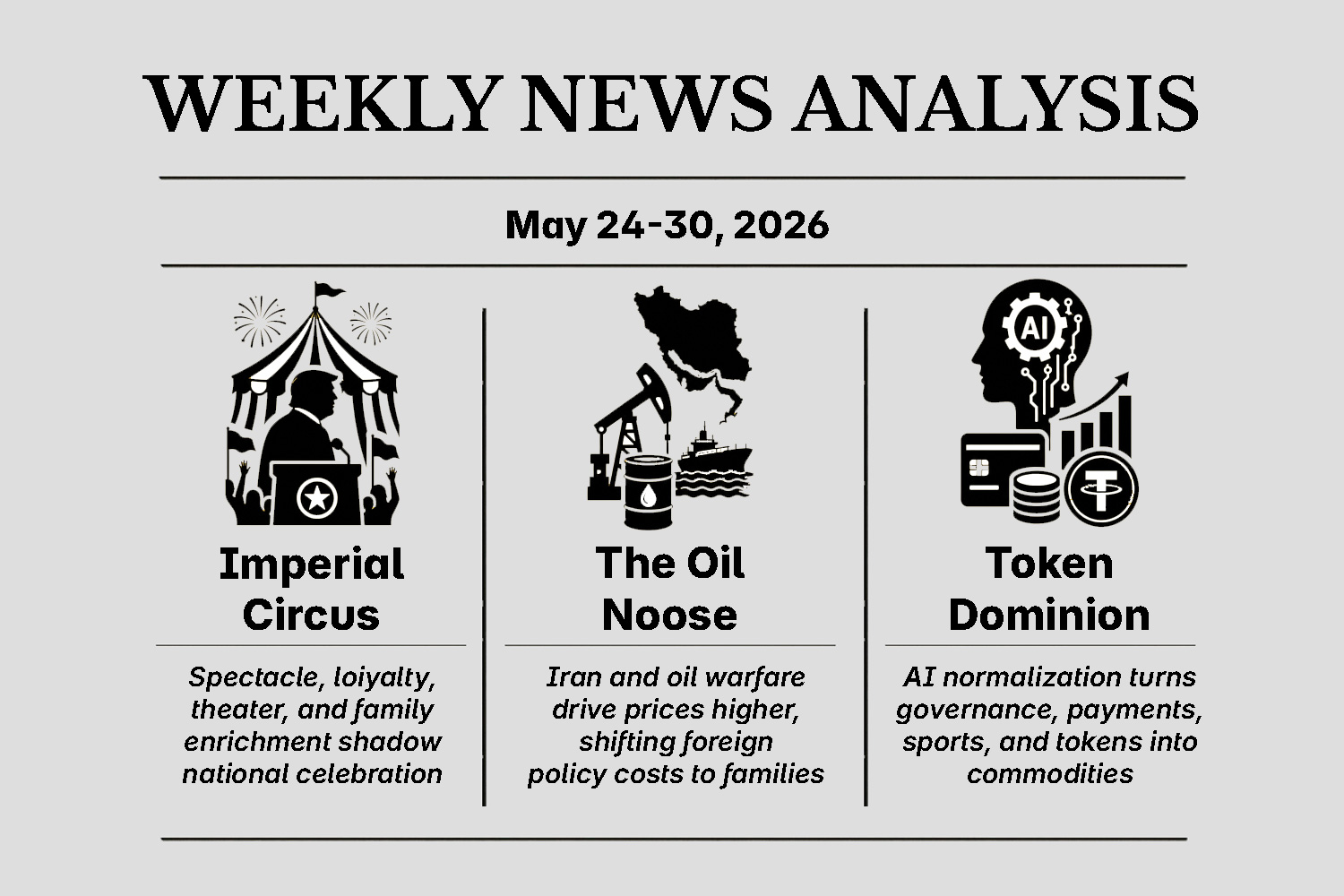
This week, three separate stories unfolded as a single governing pattern wearing three costumes: spectacle, scarcity, and automation. The first costume was patriotic theater, where national celebration became a platform for personality worship, militarized entertainment, currency symbolism, family enrichment, and immigration reversals that contradicted the populist language used to sell the political brand. The second was energy warfare, where Iran, Oman, Cuba, Hormuz, oil flows, and gas prices exposed how foreign policy becomes a domestic tax without needing to be called one. The third was AI normalization, in which governance frameworks, payment agents, sports officiating, token futures, and corporate AI waste revealed the same system coded into commerce, institutions, and behavioral expectations.
The shared mechanism is misdirection. Bread-and-circus politics draw attention away from debt, militarization, and institutional capture. War rhetoric pulls focus from the supply-chain consequences quietly passed to families through fuel, food, freight, and retail prices. AI enthusiasm diverts attention from the transformation of intelligence into a commodity, a labor-discipline system, a payment intermediary, an administrative supervisor, and a speculative asset class. Through the Trivium lens, the Grammar of the week is clear: spectacle expanded, war costs compounded, and automation accelerated. The Logic exposes the contradiction: every system advertised as efficient, free, secure, or celebratory actually deepened dependence on centralized power. The Rhetoric was the familiar bait: patriotism, safety, innovation, and economic strength, even as the operational reality moved toward digital feudalism.
Imperial Circus
Pentagon Seeks Troops for White House UFC Event - Newsmax
Trump-linked 250th birthday concert loses artists as performers drop out - CNN
Treasury prepares $250 bill with Trump’s face for 250th anniversary - Fox News
Company Tied to Donald Trump Jr. Got a Deal After White House Intervened - ProPublica
Trump administration changes green card messaging - CNN
MAGA Fumes After Trump Argues For 500,000 Chinese Student Visas, China-Owned Farmland - Mediaite
The bread-and-circus pattern emerges whenever a ruling order requires emotional occupation more than rational consent. Rome did not invent spectacle, but it perfected political theater as diversion: grain distributions, gladiatorial games, triumphal processions, imperial monuments, and cults of personality that replaced civic decline with staged grandeur. The same pattern appeared in late Bourbon France through court excess at Versailles, in collapsing Soviet pageantry through military parades and symbolic loyalty rituals, and in many modern regimes that elevate rallies, uniforms, flags, sports, and ruler imagery while debt, corruption, scarcity, and institutional decay spread beneath the surface. The point is not that every national celebration is tyranny. The point is that collapsing systems become increasingly dependent on ritualized emotion when they can no longer provide material stability, moral legitimacy, or coherent public reasoning.
The proposed 250th celebration operates as more than a birthday event. It is a national mood-management project built around freedom language, while the underlying system continues to centralize coercive capacity. The contradiction is glaring: the public is invited to celebrate independence while the state expands surveillance, military spending, emergency powers, tariff taxation, executive branding, and federal contracting networks. The rhetoric says “freedom festival,” but the structure resembles imperial maintenance. When artists begin dropping out because the celebration appears politically captured, the failure is not merely logistical. It exposes the event’s hidden premise: national identity can be fused with the image of a single ruler, and cultural participation can be treated as implied endorsement. Once celebration becomes loyalty theater, absence becomes dissent.
The UFC element intensifies the symbolism. Combat sports inside or around the White House do not merely represent entertainment. They project a state aesthetic: violence as celebration, spectacle as governance, masculinity as political branding, and military attendance as visual proof of institutional loyalty. Late-stage governments often merge athletic performance, military display, and ruler imagery because that combination activates primal emotion before critical thought can intervene. Rome had gladiators. Modern states have choreographed flyovers, fighter-jet nationalism, combat-sport pageantry, and televised crowds. The hidden premise is that physical dominance and political authority share a moral grammar. That premise is false, but effective. It substitutes power for principle and crowd energy for evidence.
The public was sold a fantasy of sweeping cuts, fiscal discipline, and bureaucratic reduction, yet the deeper pattern points toward redirection rather than restraint, e.g., DOGE cuts. The administrative state is not being dismantled if its human layers are replaced by AI contracts, automated scoring systems, predictive analytics, surveillance tools, and private-sector implementation partners. That is not decentralization. It is technocratic consolidation under a leaner interface. The state can reduce visible staff while increasing invisible control. This is the oldest magician’s trick in politics: remove the familiar face of bureaucracy, then replace it with algorithmic infrastructure that is harder to question, audit, confront, or hold accountable.
The debt-and-tax contradiction is equally severe. A national debt pushing past $39 trillion, increased military spending, tariff-based taxation, and no corresponding income-tax relief create a reality at odds with the campaign rhetoric of relief and efficiency. Tariffs are not magic revenue. They are taxes routed through import costs and consumer prices. The citizen may not see a line item labeled “Trump tariff tax” on a paycheck, but the cost appears in the prices of groceries, electronics, vehicles, home goods, business inputs, and supply-chain pricing. This is the fallacy of hidden taxation: because the mechanism is indirect, the burden is rhetorically concealed. A government can claim it is taxing foreign adversaries while domestic consumers absorb the cost through price inflation.
The $250 Trump bill proposal is pure imperial symbolism. U.S. currency law and tradition have long resisted placing living persons on federal currency, precisely because money is supposed to represent public legitimacy, not ruler worship. Even setting legality aside, the practical absurdity is obvious. The public largely transacts in denominations of $100 or less, with digital payments dominating everyday commerce. A $250 bill would not solve a public need. It would create a commemorative object, a status token, and a vanity instrument. The cost of design, security review, production preparation, circulation planning, and public messaging would serve ego far more than economic function. In rhetorical terms, it is a monument disguised as money.
The ProPublica report concerning a company tied to Donald Trump Jr. receiving a major deal after White House intervention sharpens the ethical contradiction. Populist rhetoric depends on the image of the ruler as an outsider, reformer, and enemy of corruption. Yet family-linked enrichment is one of the oldest signs of court politics. Monarchies distributed land, titles, monopolies, and concessions through bloodlines and loyalty networks. Modern republics use contracts, regulatory waivers, advisory access, and public-private partnerships. The form changes; the patronage logic remains. When the public is distracted by concerts, currency designs, and symbolic patriotism, the real machinery of power operates through procurement, access, and institutional leverage.
The reversal on immigration is the final contradiction in this topic. A political movement built on border severity, national preference, and suspicion of foreign influence now finds itself defending green-card shifts, Chinese student visas, and selective refugee or immigration openings for preferred groups. It is valid to discuss foreign influence risks in higher education, especially where hostile states use academic, corporate, or diaspora networks for intelligence collection. However, it is intellectually irresponsible to label entire groups of students as potential sleeper agents without evidence, and equally reckless to assume that no students remain loyal to China. The serious question is not how many Chinese students are secret agents; the serious question is why immigration and national-security rhetoric changes whenever elite economic, diplomatic, or political interests require it. The hidden premise is that immigration is dangerous when it is useful for mobilizing voters, but negotiable when it is useful for capital, universities, diplomacy, or geopolitical bargaining.
The imperial circus therefore has three rings: spectacle for the masses, contracts for the insiders, and contradictions for everyone else to rationalize. In The Fallacious Belief in Government framework, this is exactly how the lifecycle of government moves toward tyranny: not through a single dramatic announcement, but through the repeated normalization of control under emotionally charged language. The crowd is given flags, songs, bills, sports, enemies, and symbolic victories. Meanwhile, spending rises, debt expands, coercive capacity grows, contracts flow, and legal limits become theatrical props. The circus does not hide its collapse because it is unrelated to its collapse. It hides collapse because it is one of collapse’s primary instruments.
The Oil Noose
Live Updates: Iran war news, Trump update, Strait of Hormuz, Lebanon, oil prices - Fox News
Oil exports through the Strait of Hormuz might not return to levels seen before the Iran war - CNBC
Iran war inequality affordability ceasefire analysis - CNBC
Cuba, Trump, military officials and Guantanamo - New York Times
The Iran war story is being narrated through a familiar pattern of executive suspense: a deal is near, a deal is done, a deal awaits final approval, the ruler is meeting with his team, peace may arrive soon, force remains ready, and enemies must behave. This language creates a permanent threshold state. The public is never allowed to know whether it is living in war, ceasefire, pre-peace, post-escalation, or pre-escalation. That ambiguity benefits the executive because uncertainty becomes a tool of attention management. The ruler becomes the only figure who can interpret the moment. Everyone else is kept waiting for the next declaration, the next meeting, the next threat, or the next promised breakthrough.
The threat to Oman reveals the wider danger. Oman has historically served as a diplomatic bridge in Middle East negotiations, including backchannel communication involving Iran. Threatening a state like Oman over Hormuz-related arrangements does not project strength as much as imperial impatience. The phraseology of “behave” carries a colonial tone: smaller states are not sovereign actors with interests, geography, and survival calculations; they are children to be disciplined by a larger military power. This framing matters rhetorically because it shows how easily “freedom of navigation” can become a euphemism for forced compliance with U.S. strategic demands.
The Hormuz problem is not only a military one. It is a civilizational infrastructure risk. The Strait of Hormuz is not a symbolic waterway. It is one of the world’s key energy arteries, and disruptions there do not remain contained in diplomatic statements. They enter shipping insurance, tanker routing, refinery planning, futures markets, diesel costs, aviation fuel, fertilizer production, plastics, trucking, and consumer goods. When politicians speak of “keeping shipping lanes open,” they often conceal the actual chain of dependencies. Oil does not simply become gasoline. It becomes movement, food distribution, heat, manufacturing, packaging, construction inputs, and price stability across an entire economy.
The gas-price rhetoric has become a loyalty test. Trump and his most devoted supporters continue to claim prices are coming down or will, even as the baseline remains significantly higher than before the war began, and analysts warn that damage to oil flows may persist even after a formal cessation of hostilities. This is a classic moving-goalpost fallacy. First, the promise is low prices. Then the promise becomes lower prices than the peak. Then the promise becomes future relief. Then any small decline from a crisis high is marketed as a victory, even if families are still paying more than before the policy disaster began. The comparison point is manipulated to protect the narrative.
The supply-chain consequences are where the public will feel the war most deeply. Gasoline prices matter, but diesel prices may matter even more. Diesel moves trucks, farm equipment, freight rail, construction machinery, and backup generators. Higher diesel costs raise the cost of moving nearly everything. Retailers then face a choice: absorb the increase and cut margins, reduce labor, shrink product offerings, or pass costs to consumers. In practice, consumers usually pay through higher shelf prices, smaller package sizes, delivery fees, service charges, and delayed replacement cycles. War becomes an invisible sales tax embedded inside the price of ordinary life.
The affordability issue is therefore not abstract economics. It is behavioral control through the pressure of scarcity. When fuel prices rise, families travel less, delay repairs, reduce discretionary spending, accept longer commutes to work, and become more dependent on credit. Small businesses lose flexibility. Rural communities suffer more because longer distances are built into daily survival. The political class can call this temporary pain or national sacrifice, but the burden does not fall evenly. Wealthy households absorb fuel inflation as an inconvenience. Working households experience it as price rationing. That is the economic logic of modern war: the elite debate strategy, while the public finances the consequences through degraded purchasing power.
The Cuba escalation widens the pattern. A government already entangled in Iran, Hormuz, Oman, oil instability, and domestic price pressure now signals greater pressure toward Cuba and Guantanamo-related military positioning. This is how imperial systems multiply fronts. Each front is framed as isolated: Iran is nuclear security, Oman is navigation, Cuba is regional pressure, Hormuz is energy stability, Lebanon is proxy containment. But to the citizen, the fronts converge as cost, surveillance, debt, mobilization, and fear. The rhetorical trick is compartmentalization. Each crisis is explained separately, so the public does not see the total architecture of permanent emergency.
Historically, this resembles the late imperial habit of managing legitimacy through external confrontation. Rome expanded military obligations while domestic strain intensified. Britain managed imperial routes and naval chokepoints while industrial and colonial contradictions accumulated. The U.S. has long used security language to justify interventions whose costs later return home as debt, inflation, veterans’ crises, surveillance expansion, and institutional distrust. In The Fallacious Belief in Government, this is the lifecycle problem: government creates or escalates crises, expands authority to address them, fails to resolve the underlying contradiction, then uses the next crisis to justify the next expansion.
The oil noose tightens because energy is not merely a commodity; it is the bloodstream of modern dependency. A decentralized society would treat energy resilience as a freedom issue: local production, redundant systems, diversified transport, reduced fragility, and voluntary cooperation. A centralized empire treats energy as leverage: chokepoints, sanctions, naval corridors, strategic reserves, emergency powers, and price narratives. The citizen is told to cheer strength while paying for fragility. The war may eventually be declared over, but the price architecture it creates can remain. That is the deeper lesson of Hormuz: a conflict can end on television while continuing in every receipt.
Token Dominion
Scaling safe enterprise AI with OpenAI governance frameworks - Artificial Intelligence News
Google Pay preps for AI agents with Universal Commerce Protocol - Artificial Intelligence News
NBA plans AI system for automatic out-of-bounds calls - Artificial Intelligence News
Just like gold and oil, we’ll soon be able to trade AI token futures - TechCrunch
What happens when companies become too AI-pilled? - TechCrunch
AI’s expansion this week showed the technology moving through every institutional layer at once: enterprise governance, payment systems, professional sports, financial markets, corporate management culture, and cost-control crises. These are not separate adoption stories. They are stages of normalization. First, AI is introduced as a productivity assistant. Then it becomes a compliance object. Then it becomes a transaction agent. Then it becomes an official referee. Then it becomes a commodity traded like oil or gold. Then it becomes a runaway cost center that exposes how little corporate leadership understands the machinery it is deploying. The pattern is acceleration before comprehension.
OpenAI’s enterprise governance framework represents one side of the transition: the domestication of AI into institutional compliance language. Risk tiers, frontier governance, safety categories, audit processes, manipulation concerns, cyber capabilities, and loss-of-control scenarios all sound prudent on the surface. But governance language also performs a legitimizing function. It reassures enterprises and governments that systems can be scaled safely if the proper documents, dashboards, and oversight structures are in place. This is the same rhetorical move used in finance, pharmaceuticals, surveillance, and public health: define risk, bureaucratize risk, then use risk management as permission to expand the risky system.
Google Pay’s preparation for AI agents through commerce protocols points toward a more radical shift. The next stage of digital commerce is not just people using apps to buy things. It is software agents that negotiate, select, purchase, subscribe, renew, recommend, and optimize on behalf of users. That may create convenience, but it also creates a new layer of behavioral intermediation. The consumer no longer merely interacts with a merchant. The consumer interacts through an agent governed by platform rules, payment protocols, identity systems, preference models, and commercial incentives. Once AI agents sit between humans and markets, whoever governs the agent architecture governs access to commerce.
The NBA out-of-bounds system shows how AI enters culture through fairness rhetoric. Sports officiating is an ideal laboratory for algorithmic legitimacy because fans already complain about human error. The pitch is obvious: cameras, sensors, automated calls, faster decisions, fewer mistakes. But the stronger social effect is the training of public expectation. People learn to accept machine judgment in emotionally charged environments because it appears neutral, objective, and precise. Once that expectation is normalized in sports, it becomes easier to extend into classrooms, workplaces, policing, insurance, banking, hiring, traffic enforcement, medical triage, and public benefits. The court becomes a classroom for algorithmic obedience.
AI token futures complete the commodity transformation. Gold represents stored value, oil represents energy, and AI tokens represent compute-mediated cognition. To trade token futures is to financialize access to machine intelligence before the public has even understood its social consequences. This is not merely a new market product. It is the securitization of thought capacity, prediction capacity, and automated labor. When tokens become tradable commodities, intelligence itself becomes subject to speculation, hoarding, pricing shocks, derivatives, and institutional control. The future of AI may not be defined only by model quality. It may be defined by who can afford cognitive throughput at scale.
The “AI-pilled” corporation is the managerial version of the same problem. Executives intoxicated by AI rhetoric often confuse adoption with transformation. They incentivize usage, celebrate prompt volume, buy enterprise licenses, pressure employees to integrate tools, and then discover that activity is not productivity. This is the measurement fallacy: if a number can be counted, leadership treats it as a value. But AI usage is not the same as useful output, just as hours worked are not the same as meaningful work, and lines of code are not the same as functional software. A corporation can generate millions of tokens and still produce nothing worth using.
The reported $500 million Claude bill is the warning flare. Whether viewed as a singular failure or a symbol of enterprise recklessness, it exposes the absurdity of deploying powerful systems without usage limits, cost governance, functional requirements, or output accountability. The company’s mistake was not merely forgetting spending caps. The bigger mistake was incentivizing AI consumption rather than working software, process improvements, measurable savings, or customer value. That is exactly how technological manias become institutional disasters. The metric becomes the mission. Employees optimize for the visible signal. The organization burns money proving that it is modern.
This aligns with the broader government AI pattern. When agencies and corporations race to automate, they often do so under the banner of efficiency, creating new forms of dependency, opacity, and vendor capture. A human bureaucrat can be questioned. An algorithmic eligibility system, predictive model, or proprietary decision engine becomes harder to challenge. The citizen is told that automation reduces waste, yet contracts expand, compute costs rise, consultants multiply, and accountability dissolves into technical architecture. This is not the death of bureaucracy. It is bureaucracy’s migration into code, cloud infrastructure, and private vendor ecosystems.
The hidden premise in AI evangelism is that intelligence can be outsourced without consequence. That premise is false. Tools shape the users who depend on them. When AI agents make purchases, people lose commercial friction. When AI refs make calls, people lose tolerance for human judgment. When AI governance frameworks authorize scaling, institutions lose fear of deployment. When token futures financialize compute, intelligence becomes an asset class. When corporations reward usage over function, workers learn to simulate productivity through machine activity. The result is not simply a smarter economy. It is a mediated economy where human agency is increasingly routed through systems designed, priced, and governed by others.
The future implied by these stories is not one where AI simply “helps.” It is one where AI becomes the operating grammar of institutions. Payments, sports, markets, workplaces, courts, schools, benefits, logistics, healthcare, policing, and war planning will all be pressured toward automated mediation. The danger is not that every AI system is evil. The danger is that society is accepting total integration before demanding philosophical clarity, legal restraint, cost discipline, audit rights, local alternatives, and the preservation of human override. Without those limits, AI becomes less like a tool and more like infrastructure for algorithmic governance.
The Crowned Machine
The three topics converge into a single architecture of managed decline. The imperial circus offers emotional spectacle while debt rises, contracts flow, and personality replaces principle. The oil noose turns foreign policy into domestic price pressure, forcing families to finance war through fuel, freight, and retail costs. Token dominion embeds AI into commerce, culture, markets, and management before the public has any meaningful say in the rules. Each system claims a different justification: patriotism, security, efficiency. Each produces the same outcome: dependency on centralized authority and reduced capacity for independent judgment.
The strongest rhetorical pattern this week was inversion. Celebration masked institutional decay. Fiscal discipline masked spending redirection. Peace language masked escalation. Lower-price claims masked higher baselines. AI safety language masked AI expansion. Commerce innovation masked platform intermediation. Sports fairness masked algorithmic conditioning. The public is trained to evaluate intentions rather than operations, slogans rather than structures, and personalities rather than incentives. That is why the Trivium remains essential. Grammar asks what is actually happening. Logic asks whether the claims match reality. Rhetoric asks what action follows once the contradiction is exposed.
The future trajectory is not inevitable, but the pattern is visible. A society that accepts circus politics, permanent war pricing, and algorithmic mediation will drift toward a digital feudal order where access replaces ownership, compliance replaces consent, and spectacle replaces citizenship. Natural rights cannot survive as ceremonial language while every practical system is redesigned around surveillance, dependency, debt, and automated control. The question is no longer whether the machine is being built. It is whether enough people still possess the critical thinking, moral courage, and decentralized capacity to refuse becoming its obedient operating system.
Listen to this week's news in verse for a quick recap!