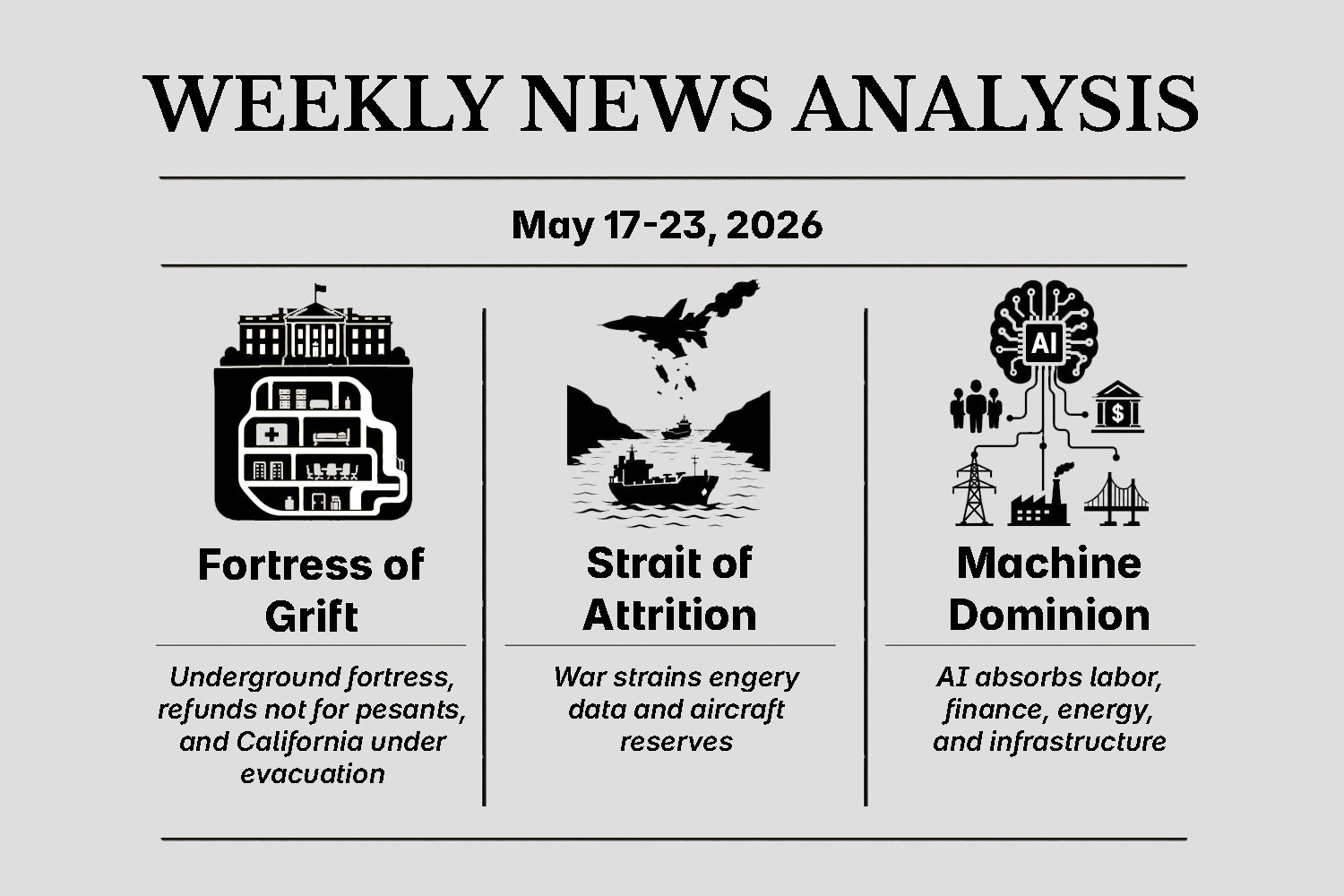
This week was not a string of unrelated emergencies. It exposed the machinery operating beneath public life: underground command infrastructure sold as ceremonial architecture, tariff policy marketed as national economic liberation while functioning as consumer extraction, chemical instability treated as a localized hazard while exposing industrial fragility, foreign war framed as victory while quietly draining aircraft and munitions, and artificial intelligence presented as unavoidable progress while reorganizing labor, energy, finance, infrastructure, and cybersecurity into one operating system.
The pattern remains familiar: crisis creates justification, justification authorizes construction, construction becomes permanent, and the public is left debating partisan branding while the control architecture hardens below the surface. The Trivium exposes the method. Grammar asks what is actually being built, funded, threatened, automated, or evacuated. Logic asks whether the official explanation matches the operational reality. Rhetoric asks why the story is framed as safety, efficiency, modernization, or peace when its practical effect is deeper dependence on centralized systems.
This is the lifecycle of government in accelerated form. The state identifies danger, then demands resources. It points to disorder, then builds command centers. It says war is almost won, then requests more weapons. It claims AI will empower humanity, then instructs workers not to resist their replacement. It says infrastructure must be protected, then turns public life over to private systems that cannot be meaningfully refused. The week’s three stories form a single system: the bunker, the battlefield, and the machine.
Fortress of Grift
The White House Ballroom Is A Deep Fortress In Disguise - The War Zone
Chemical Spill Orange County California - CNN
The White House ballroom story began as a matter of ceremony and security, but its rhetoric quickly collapsed under its own weight. What was presented as a ballroom became, by Trump’s own description, a deep underground complex with military hospital space, research facilities, meeting rooms, defensive hardening, drone-proofing, missile-proofing, sniper capacity, and a roof designed for military vantage over Washington, D.C. The War Zone reported that Trump described the underground portion as “far more complex than the upper” and said the structure goes about six stories deep. That is not the language of a reception hall. It is the language of continuity of government, command sheltering, protected medical operations, and internal wartime architecture hidden beneath a public-facing symbol of prestige.
The contradiction is difficult to miss. A ballroom does not need a military hospital. A ceremonial venue does not require underground research facilities. A public event space does not need missile-proofing and sniper-overwatch design unless planners are preparing for something more serious than a random shooter. The hidden premise is that the ruling class is not preparing for ordinary civic life. It is preparing for continuity in the event of a breakdown. The public receives the aesthetic explanation — elegance, security, presidential legacy — while the operational explanation remains underground. This is classic euphemistic framing: call it a ballroom, build a bunker; call it security, build command depth; call it a gift, then dispute who pays once the steel and excavation are already underway.
The project’s speed also exposes the fiction of spontaneity. Large federal-adjacent construction does not move from concept to deep excavation on emotional impulse. Secure underground construction requires design packages, engineering models, load calculations, blast considerations, environmental review, utility planning, access control, procurement, logistics, and coordination among agencies and contractors. The rhetorical maneuver is to narrate the project as a response to a recent need, even though advanced excavation and specialized design imply long-range planning. The issue is not whether a government facility can have legitimate protective functions. The issue is that the public narrative appears downstream from decisions already made. The public is not consenting; it is being presented with an accomplished fact.
This is where the framework of The Fallacious Belief in Government becomes structurally relevant. Government presents itself as protection and service while operating as a tool of control; the promise is safety, the mechanism is consolidation. The ballroom-fortress embodies that contradiction in concrete form. Above ground: ceremony, optics, patriotism, presidential branding. Below ground: military infrastructure, classified rooms, protected continuity, and surveillance-ready overwatch. The architecture itself becomes rhetoric. Its facade tells the public one story while its function tells another. This is the built-environment version of “for your safety”: a phrase that almost always precedes a transfer of power from the citizen to the institution.
The tariff refund story completes the economic side of the same pattern. Trump promised tariffs could replace income taxes, a claim that always rested on a hidden assumption: foreign exporters would absorb the cost rather than American consumers. Operational reality was different. Tariffs operate as taxes on imports, and under ordinary market transmission, much of that cost is passed through into consumer prices. When courts force refunds, the money does not naturally return to the households that paid higher prices at checkout. It moves through the legal and corporate channels that remitted the tariff payments. The citizen absorbs the pain; the corporation receives the recovery. That is not populist economics. It is an extraction dressed in nationalist language.
The rhetoric of tariff nationalism depends on a false heroic frame: the ruler is supposedly punishing foreign exploiters, defending workers, and replacing hated taxes with external tribute. But when prices rise at home, and refunds move toward corporate claimants, the policy reveals its real distributive structure. It becomes a two-step grift. First, consumers pay more under the banner of national strength. Second, corporations seek refunds under the banner of legal correction. The people receive neither lower income taxes nor direct restitution. They are turned into emotional investors in a policy whose benefits are routed elsewhere. The Independent reported that Trump complained about having to return money following the Supreme Court's tariff ruling, including a claim that he would have to repay $149 billion. The moral posture is one of victimhood, but the injured party was the consumer, already paying inflated prices.
The Orange County chemical emergency added the physical hazard layer to the same week of systemic exposure. Reports identified the incident as a failed tank at a Garden Grove aerospace facility containing roughly 6,000 to 7,000 gallons of methyl methacrylate, a volatile, highly flammable chemical used in plastics and aerospace manufacturing. Around 40,000 residents were ordered to evacuate across multiple cities, with officials warning that the tank could either spill or enter thermal runaway, potentially causing an explosion. Emergency crews used remote water systems to cool the tank while preparing containment measures. This was not merely a local industrial accident. It was a reminder that modern society depends on invisible chemical, logistical, and industrial systems most people never see until evacuation orders arrive.
If the tank exploded, the consequences would depend on combustion dynamics, wind, humidity, plume height, nearby tanks, containment failure, and whether the chemical burned cleanly or dispersed as vapor before ignition. The immediate dangers would include blast injuries near the facility, secondary fires, exposure to toxic or irritating vapors, respiratory distress, eye and skin irritation, runoff contamination, and cascading damage if adjacent tanks were compromised. ABC7 cited Orange County Fire Authority Division Chief Craig Covey, who warned that the two remaining outcomes were either a large spill or a thermal-runaway explosion affecting surrounding tanks containing fuel or chemicals. The larger meaning is not only environmental risk but also institutional opacity. The public discovers the fragility of industrial civilization only when officials begin ordering mass movement.
Together, the bunker, the tariff refund, and the chemical tank form a single grammar of collapse management. The ruling class builds protected depth for itself, financial policy extracts from the public while refund pathways favor corporations, and industrial risk forces residents to flee neighborhoods built around facilities they do not control. The rhetoric says security, prosperity, and emergency management. The logic says shelter the state, reimburse capital, and evacuate the population. That is the inversion: the people fund the system, absorb the costs, inhale the risks, and evacuate on command, while the machinery of power retreats underground and calls itself leadership.
Strait of Attrition
Iran US Progress Framework Diplomacy - CNN
Iran War Trump News Strait Hormuz Blockade Ceasefire Tensions May 23 - Fox News
Congressional Report Tallies 42 US Aircraft Lost Or Damaged In Operation Epic Fury - Military Times
The Odds Of Trump Attacking Cuba Are Going Up - Politico
The Iran story is a study in narrative contradiction. The public was told that American forces had dominated Iran, destroyed major defensive capacity, and crippled its ability to contest the Strait of Hormuz. Yet the same news cycle continued discussing Iran’s ability to keep the Strait functionally closed, threaten subsea cable leverage, pressure global energy flows, and force negotiations around reopening maritime movement. Either Iran was neutralized, or it remains capable of strategic disruption. Neither claim can be true in the same operational sense. The contradiction matters because war rhetoric thrives on maximal claims during attacks and minimized disclosures afterward. Victory language maintains morale while attrition data appears later in footnotes, reports, and quiet corrections.
The subsea cable threat is especially revealing because it shifts the conflict from an oil chokepoint to a data chokepoint. The Guardian reported that Iranian state-linked media floated proposals to charge foreign companies for cables crossing the Strait, require major technology firms to operate under Iranian legal terms, and monopolize cable maintenance. Experts called the legal theory doubtful and said actual extraction would depend on threats rather than ordinary law. At least seven cables reportedly lie beneath the Strait, many of which are important to Gulf connectivity and the broader AI buildout in the region. The strategic point is not simply whether Iran can legally tax cables. The point is that the modern empire now has two arteries threatened: energy and data.
That is why the Strait matters beyond ships. The old imperial chokepoint was oil. The new chokepoint is oil plus bandwidth. If energy powers the machine, data coordinates it. A disruption in the Strait can raise fuel prices, strain shipping, complicate military logistics, and threaten communications infrastructure that supports finance, cloud operations, artificial intelligence, and Gulf development. Experts noted that cutting these cables would be difficult and likely highly visible under U.S. patrol conditions, but even the threat of doing so changes behavior because repair ships do not operate under fire. The result is asymmetric leverage: a weaker state need not defeat the U.S. Navy outright if it can make insurance, logistics, repair, and energy markets price in the risk of prolonged danger.
The aircraft-loss report makes the official victory narrative harder to sustain. Military Times reported that a Congressional Research Service report tallied 42 U.S. aircraft lost or damaged during Operation Epic Fury, including F-15Es, KC-135 tankers, an F-35A damaged by ground fire, an E-3 Sentry damaged on the ground, and an A-10 lost during a search-and-rescue mission. The report also noted that its count may be revised due to classification, ongoing combat, and attribution uncertainty. This is the language of incomplete disclosure. If Iranian defensive infrastructure had truly been neutralized, why did the campaign produce such a costly aircraft damage profile? If the air war was so one-sided, why are tankers, surveillance aircraft, and rescue assets appearing in the losses?
The rhetorical trick is to separate “victory” from cost. Political language emphasizes dominance, courage, precision, and resolve. Operational reality records damaged aircraft, fuel-chain vulnerability, rescue missions, friendly-fire confusion, and degraded readiness. The fallacy is an appeal to patriotic emotion: because the war is framed as righteous, its cost must be interpreted as necessary rather than diagnostic. But cost is evidence. Attrition tells the truth propaganda tries to postpone. Every lost aircraft, damaged tanker, and depleted munition creates a future vulnerability. The public hears “peace through strength,” while the logistical ledger records a shrinking margin for the next theater.
The peace-talk reporting deepens the contradiction. The Gateway Pundit cited reporting that Trump said negotiators were “getting a lot closer” to an agreement, with proposals involving reopening the Strait, unfreezing some Iranian assets, continuing negotiations, and handling enriched uranium. That is not the posture of total victory. It is the posture of bargaining after escalation. The language of “I will only sign a deal where we get everything we want” functions as a rhetorical cover for the fact that war has created a negotiation space in which Iran still has leverage. Peace is being marketed as a triumph, but the fact that talks are ongoing shows that military action did not erase the political problem.
The Cuba reporting broadens the lens from a single war to the possibility of a protracted conflict. A president branded by supporters as a “Peace President” now sits inside a cycle of escalation: Iran, Strait of Hormuz, damaged U.S. aircraft, continued munitions pressure, and discussion of Cuba as a possible next target. This is the classic imperial feedback loop: foreign conflict produces domestic justification, domestic justification produces military spending, military spending produces new deployments, new deployments create new enemies, and new enemies justify further militarization. In The Fallacious Belief in Government, this is the lifecycle of government as it moves toward Tyranny through crisis, control, and coercive expansion. War abroad becomes discipline at home; the battlefield becomes the excuse for internal consolidation.
The most dangerous hidden premise is that the U.S. can burn through equipment, munitions, attention, debt capacity, and diplomatic credibility without strategic consequence. Russia and China do not need to match every U.S. action immediately. They can watch inventory depletion, map response patterns, test peripheral zones, harden alternative systems, and wait for overextension. Empires rarely collapse because they lose one battle. They decay because they confuse tactical explosions with strategic endurance. If the U.S. continues to fight simultaneous symbolic, resource, proxy, and infrastructure wars, adversaries may not need to defeat it directly. They may only need to let it exhaust itself while the public is told exhaustion is strength.
Machine Dominion
Don’t Fight AI HSBC CEO Tells Staff As Banks Begin Job Cuts - Reuters
China’s AI Just Mapped Its Entire Renewable Energy Grid - Artificial Intelligence News
Musk And Zuckerberg Convinced Trump To Scrap AI Executive Order - Artificial Intelligence News
Anthropic Will Pay xAI 1.25 Billion Per Month For Compute - TechCrunch
CrowdStrike Report Shows North Korea China Linked Threats - AI Magazine
Hitachi’s Industrial AI For Mission Critical Infrastructure - AI Magazine
The AI stories this week should not be read as technology news. They are governance, labor, energy, military, banking, and infrastructure news under a single technical banner. Reuters reported HSBC’s CEO telling staff not to fight AI as major banks began speaking more openly about job cuts tied to automation. Standard Chartered, according to the same Reuters report, planned to eliminate thousands of roles as it replaced what its CEO called “lower-value human capital.” The phrase is revealing. Humans are no longer described as workers, citizens, minds, families, or skilled participants. They are “capital,” and not even high-value capital. They are cost centers awaiting algorithmic replacement.
The rhetoric of AI adoption is almost always wrapped in inevitability. Do not resist. Adapt. Upskill. Become more productive. Accept the transition. But inevitability is not an argument; it is a command disguised as prophecy. The hidden premise is that corporate and institutional AI deployment is a natural force rather than a managerial decision shaped by incentives, power, capital concentration, and regulatory capture. When executives say AI will destroy some jobs and create others, they omit the distributional question: who loses income now, who owns the systems, who captures productivity gains, and who bears the social instability? This is the same pattern as with tariffs: the public bears the disruption while institutions capture the upside.
The China energy-grid mapping story shows the next layer. Artificial Intelligence News reported that China has used AI to map its renewable energy grid, offering what the article described as a “god’s-eye view” of infrastructure. The same report framed AI electricity consumption as a global grid problem, noting rising U.S. capacity market prices and data-center demand as major pressure points. This is not merely clean-energy planning. It is machine vision applied to the national infrastructure. A state or corporate system that can map, predict, optimize, and ration energy flows gains extraordinary leverage over industry, mobility, housing, data centers, and eventually households. Energy becomes not only a commodity but a programmable administrative layer.
The AI executive order story reveals the political-capture dimension. Artificial Intelligence News reported that Trump scrapped a planned AI executive order amid concerns about America’s competitive edge over China, with Musk and Zuckerberg reportedly influencing the decision. Whether framed as deregulation, innovation, or geopolitical necessity, the logic is clear: the largest technology actors are no longer merely regulated entities. They are treated as strategic partners whose preferences shape state policy. The state claims to govern technology, but the technology oligarchy increasingly governs the boundaries of state action. This is not free-market dynamism. It is a public-private technocracy in which national security language protects private accumulation. This is aligned with the United Nations and World Economic Forum’s Great Reset focus and plan.
The Anthropic-xAI compute deal exposes the infrastructure consolidation beneath the model race. TechCrunch reported that Anthropic would pay xAI $1.25 billion per month for compute tied to the Colossus 1 data center near Memphis, with the deal potentially bringing xAI more than $40 billion in revenue. The article framed xAI’s emerging role as a “neocloud,” where an AI company not only builds models but also sells excess compute infrastructure to competitors. This is a profound shift. Compute becomes the new oil field, the new rail network, the new banking reserve. Whoever owns the data centers, chips, power contracts, and cooling systems owns the gate through which intelligence itself must pass.
The CrowdStrike report adds the adversarial layer. AI Magazine reported that North Korea-linked and China-linked threat actors are using AI-generated identities, fake recruiters, synthetic video environments, and accelerated intrusion methods against financial institutions. CrowdStrike described AI as compressing the path from initial access to financial impact, forcing defenders to meet AI with AI. This is the security spiral: AI creates new attack capacity, which requires AI defense, which increases institutional dependency on AI vendors, which concentrates more data and access in the hands of fewer platforms. Finance becomes a battlefield where synthetic identity and algorithmic deception erode trust faster than legacy security can respond.
Hitachi’s industrial AI story carries the issue into the physical world. AI Magazine reported that industrial AI is being embedded into power grids, transportation systems, factories, and heavy equipment, where errors cannot be treated like chatbot mistakes. Hitachi leaders emphasized that these systems must be deterministic, auditable, resilient, and failsafe because hallucinations or adversarial manipulation could damage equipment, halt production, cause environmental harm, or endanger workers. This should be the center of the public debate, but it rarely is. Consumer AI can embarrass a company. Industrial AI can break civilization’s machinery. The risk is not only that AI becomes powerful. The risk is that fragile probabilistic systems are inserted into mission-critical infrastructure before society has consented to the dependency.
Taken together, these stories show AI becoming the operating system of the next social order. It replaces bank workers, maps energy systems, shapes executive policy, monetizes compute scarcity, accelerates cyberwar, and enters mission-critical infrastructure. The public is told this is progress, but the logic points toward digital feudalism: citizens dependent on systems they do not own, judged by models they cannot inspect, secured by platforms they cannot refuse, and governed by infrastructure that can be optimized against them. Humanity’s landscape is about to change forever because AI is not just a tool being adopted; it is a hierarchy of control being installed.
The Grid Closes
The week’s pattern is a warning. The fortress beneath the ballroom shows the state preparing for instability while offering the public spectacle. The tariff refund dispute shows economic injury declining while legal recovery increases. The chemical tank crisis shows how industrial civilization can force mass evacuation when hidden systems fail. The story of the Strait of Hormuz shows how war now targets both the energy and data arteries. The aircraft-loss report shows the gap between victory rhetoric and operational attrition. The AI stories show the next layer of governance being installed across labor, finance, energy, cybersecurity, and infrastructure.
The shared mechanism is a managed dependency. Citizens depend on state protection, corporate supply chains, centralized banking, global cables, military deterrence, chemical facilities, cloud computing, and AI-mediated infrastructure. Each dependency is sold as a source of convenience, safety, efficiency, or national strength. Each also becomes a point of leverage. When the system fails, people are told to evacuate, pay more, accept job loss, support war, trust the bunker, or adapt to the machine. Consent is not requested in any meaningful way. It is engineered through a crisis sequence.
The future being built is not merely authoritarian in the old sense. It is infrastructural. The new tyranny may not always arrive with boots and banners. It may arrive as evacuation zones, tariff pass-throughs, classified facilities, bandwidth chokepoints, depleted arsenals, AI compliance tools, synthetic identities, industrial control systems, and compute monopolies. Natural rights cannot survive as abstractions if the material systems of life are owned, mapped, priced, rationed, and automated by institutions beyond public control. The question is no longer whether the machine is coming. It is about whether humanity can still think clearly enough to refuse to be managed as its inventory.
Listen to this week's news in verse for a quick recap!