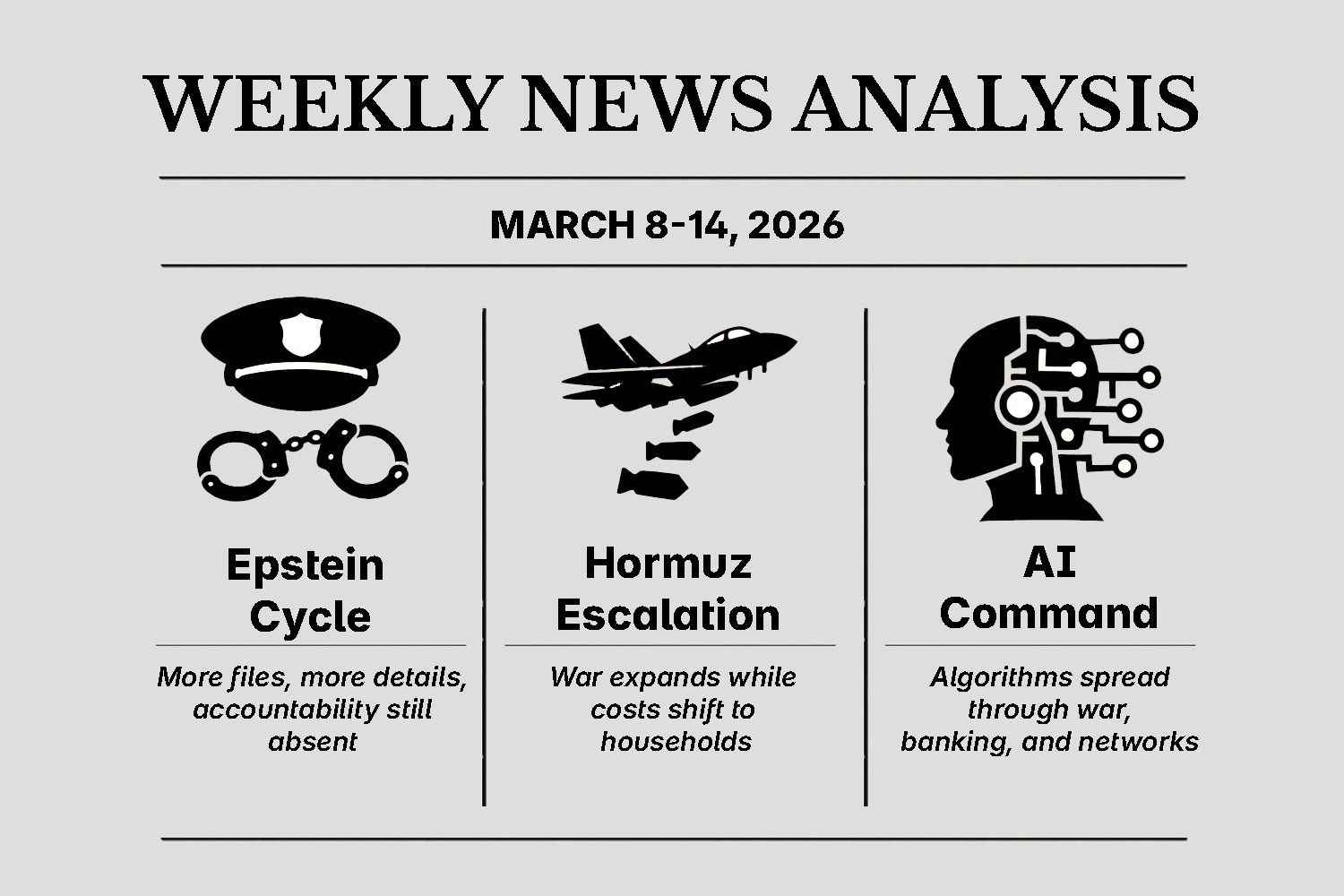
The week revealed a clear pattern: scandal, war, and automation now work together as a unified political system. When revealing elite misconduct becomes risky, attention moves upward to geopolitics. When war causes economic strain, the rhetoric of sacrifice becomes commonplace. As societal instability grows, AI is introduced not just as a tool but as an administrative layer designed to handle chaos. This progression is more meaningful than any single headline because it shows how modern power manages crises. Scandal becomes spectacle, war turns into moral theater, and software becomes the silent backbone of compliance. The discourse shifts from guilt to urgency, from accountability to necessity, and from consent to optimization. This process explains how public memory fragments without formal censorship.
The framework discussed this week also resonates with the recurring themes in the book The Fallacious Belief in Government, which discusses engineered consent and the government lifecycle. Engineered consent is roughly defined as selectively sharing limited facts and logical fallacy appeals to influence the public toward conclusions they might oppose if fully informed. The book further depicts late-stage government as exploiting chaos to gain more power and silence dissent. Regardless of whether one agrees with these views, the pattern this week is clear: revealing issues without offering solutions, ongoing conflicts without definitive endings, and AI developments lacking genuine democratic oversight.
Smoke Over the Ledger
Who Is Tova Noel? Jeffrey Epstein Prison Guard Asked to Testify to Congress - Newsweek
‘Playing with fire’: Epstein bankrolled a woman tied to Bill Gates—then asked to be repaid - Fortune
DOJ releases Epstein files containing sexual assault allegations against Trump - PBS
Trump administration set to receive $10 billion fee for brokering TikTok deal, WSJ reports - Reuters
The key insight of the Epstein cycle isn't its recurrence, but how it recurs. It reappears through familiar channels like depositions, document releases, televised outrage, and connections to elite figures—yet without any genuine institutional transformation. House Oversight now plans to hear from former guard Tova Noel, who was on duty when Epstein died, while the Justice Department continues to disclose millions of pages under the Epstein Files Transparency Act. This indicates movement. But appearances aside, real change isn't happening. The public sees a process, not closure, and this process itself is a political strategy. It keeps the scandal's emotional momentum alive without delivering the final shift of power. The scandal remains important because it remains unresolved.
The war frame then took center stage, shifting the focus. As U.S.-Israeli strikes on Iran and the contest over Hormuz intensified, the dominant emotional tone shifted from concerns about corruption and blackmail to themes of national emergency and oil instability. Even media outside the American party duopoly noted this abrupt change, and old Trump comments accusing Obama of potentially attacking Iran to boost his re-election or divert attention from domestic issues resurfaced, acting as a mirror to current concerns. Trump is now doing what he accused Obama of planning to do. This underscores the structural similarity between Trump’s past accusations and the pattern critics now see around him. The main point is that certainty about motives is less important than the fact that war always takes priority over scandal in media coverage, and politicians understand this. The bomb's loudness often outweighs the significance of the deposition transcript.
The phrase “political theater” is fitting, but only if used accurately. Here, "theater" doesn’t imply the facts are fake. The allegations are genuine. PBS reported that the new material includes interview summaries from a woman claiming she was assaulted by Trump as a minor, while Reuters reported that a leading Democrat accused the DOJ of withholding FBI interviews related to the accusation. The White House dismissed the claims as baseless, and PBS noted that they remain unverified, despite reports citing officials who reportedly found the accuser credible enough to conduct multiple interviews. This is precisely the kind of morally charged information that should be central to national debate in a system that supposedly values equal accountability. Instead, it’s divided into factional battles—one side shouts "cover-up," the other "hoax," and the core issues remain unaddressed.
The main strategy remains unchanged: minimizing systemic vulnerabilities to partisan influence. Once this is accomplished, a trans-partisan blackmail network is rebranded as another tribal weapon, leading to narrative laundering. The public no longer questions which institutions were protected, concealed, negotiated, or normalized; instead, they focus on which party suffers the most damage each week. This method is smaller, safer, and less threatening to the existing social structure amid scandals. The 2025 analysis in the uploaded Weekly News views Epstein not as an anomaly but as part of a broader system of leverage and compromise. Whether one agrees with the conclusions or not, this view underscores the main risk: when exposure is just another type of content, scandal ceases to be a tool for correction and becomes an ambient force. It hangs over everything, inducing little real change.
The Trump-specific layer emphasizes this by merging accusations, personal branding, and profit-making into a single category. Reports highlight a surfaced email where Epstein allegedly described Trump as "dangerous” and the worst person he had known. Coming from Epstein is very telling. Meanwhile, Reuters noted that, according to the Wall Street Journal, the Trump administration is likely to collect about $10 billion in fees from investors in the TikTok U.S. deal. This report pertains to business structures and deal specifics. Politically, however, it fits into the same moral framework: a presidency already under severe scrutiny, now linked to significant private gain, all while the nation approaches $38.9 trillion in debt. The rhetoric of sacrifice targets the public, whereas the language of leverage and fee extraction targets the ruling class.
This is where the book’s discussion of engineered consent becomes practically relevant. It’s not merely about censorship but about deliberate sequencing. The public isn’t necessarily kept from seeing the scandal; instead, they are exposed to a carefully crafted environment that disrupts understanding. A file release here, a hearing there, an email leak, a pundit feud, a military escalation, an oil crisis, or a new controversy involving an executive—these are pieces, not a complete picture. In The Fallacious Belief in Government, engineered consent is explained as the strategic presentation of selective facts and emotional appeals to influence opinion, without offering the full context needed for informed judgment. This is very similar to today’s media environment. The citizen isn’t actually uninformed—rather, they are overwhelmed and made politically powerless.
This scandal now unfolds similarly to war: swiftly, fragmentarily, and through substitution. The public is trained to react rather than connect the dots. That's why the old Trump claim about Obama and Iran holds symbolic significance, even if its deliberate repetition can't be confirmed now. It exposes a deeper truth about imperial politics: foreign escalation has been a long-standing tactic to avoid domestic accountability. When attention shifts to shipping lanes, deterrence, alliances, and national resolve, the evidence of elite misconduct becomes less convincing. The regime doesn't need to prove innocence; it just needs a louder crisis. That is the real scandal beneath the scandal.
Empire at the Strait
Trump Iran attack decision fallout - CNN
Trump calls allies to help secure Strait of Hormuz as Iran vows to step up retaliation - Reuters
Iran holds world energy hostage with ‘nightmare’ Strait of Hormuz sea mines - Fox News
US identifies six service members killed in Iraq - Reuters
US military spent millions on crab legs and lobster in months before Iran war - Independent
Trump administration set to receive $10 billion fee for brokering TikTok deal, WSJ reports - Reuters
The escalation in war rhetoric has gone beyond just justifying strikes to openly endorsing a wider conflict. Reuters reported that Trump threatened additional attacks on Iran’s Kharg Island, including remarks like “We may hit it a few more times just for fun,” while calling on allied nations to send warships to secure the Strait of Hormuz. This language is significant because it does more than describe warfare; it diminishes the seriousness of escalation. The phrase makes destruction sound like bravado, stripping away moral gravity and replacing it with showmanship. Rhetorically, it transforms force into confidence and views casualties as an acceptable consequence of presidential determination. Such language is deliberate; it conditions the public to see expanding violence as a form of control rather than mere drift. A ruler joking about a near catastrophe implies impunity as much as resolve.
The human cost is already too high to consider this a minor action. Reuters reported that since Israeli and U.S. air strikes on Iran began on February 28, over 2,000 people have been killed, mostly in Iran. It also noted that six U.S. airmen died in a KC-135 crash over Iraq while supporting attacks on Iran, showcasing the real losses involved. These facts challenge the detached language of strategic planning. The war is not just an abstract scenario drawn on maps and briefings; it is a growing reality marked by destroyed infrastructure, civilian casualties, military losses, embassy warnings, and regional retaliation. Despite this, public rhetoric continues to shift between “deterrence” and “energy security,” as if words can obscure the actual human toll. This is one of the oldest imperial tendencies: disguising bloodshed as stability.
The energy narrative shows how quickly military discourse can transform into an economic threat to ordinary people. Reuters reports that the conflict is causing the most significant disruption in oil supplies ever, with rising energy costs and attacks on UAE infrastructure. Kharg Island is crucial because it manages most of Iran’s oil exports, and the Strait of Hormuz remains a vital chokepoint for much of the world's crude. When that system becomes unstable, political commitments to affordability are at risk. The public is left to bear the downstream impacts through higher fuel prices, costly shipping, rising food costs, and renewed inflation. In essence, strategic military activities are socialized, with elites discussing mission goals while households face increased expenses.
This contradiction is even clearer when viewed alongside the fiscal data. As of March 12, 2026, the Treasury’s debt tracker showed around $38.9 trillion in U.S. debt. Reuters reported in December that the Pentagon had failed its eighth straight audit, with trillions of unaccounted for funding, revealing systemic weaknesses. This suggests that the government's urging the public to accept war-related inflation cannot even maintain proper financial accountability for the military funds. The Independent’s coverage of spending—regardless of tone—highlighted a larger issue: Washington’s budget culture still prioritizes spending over responsible control. Politicians talk about sacrifice, but govern through obscure accounting and excessive procurement. This isn’t austerity for the empire; it’s indulgence fueled by decline.
The underlying assumption of the pro-war argument is that suffering domestically is acceptable as long as elites justify the cause. Although rarely stated outright due to its potentially offensive nature, this belief manifests in subtler ways: disruptions, market shifts, higher costs for freedom, necessary hardship, and shared burdens. However, these burdens are never truly equitable. Reuters’ report on the TikTok deal reveals that the same government may now collect about $10 billion in fees from investors involved in the transaction, as per the Wall Street Journal. This is an alleged arrangement, not an official breach, but it exposes the stark imbalance. Ordinary households are told to accept rising gas prices and imported inflation, while the wealthy remain engaged in fee structures, deal arrangements, and wartime profiteering. Essentially, the public is expected to endure economic pain while the upper class continues to profit.
The lifecycle of government perspective emphasizes this point further. According to that view, the late-stage rule exploits instability to justify the expansion of authority, emotional appeals, and the normalization of force. Whether one agrees with the entire philosophical framework or not, the week clearly shows this trend: a crisis broadens executive power, foreign actions diminish domestic oversight, and emergency language replaces normal accountability. The contradiction is clear. A government that failed eight consecutive audits still expands military commitments. A president involved in a child sex trafficking scandal still claims the authority to escalate conflicts. A society burdened by debt is still told that increased risk, military posture, and market instability show seriousness. This is not strategic coherence; it’s a system draining its legitimacy to maintain its momentum.
If the war continues as it is, the future isn't just about "higher gas prices" but about broader inflation that affects freight, insurance, petrochemicals, food, manufacturing inputs, and daily essentials. Reuters has linked the conflict to serious oil supply disruptions, and even partial disruptions near Hormuz can ripple through industries dependent on transport and energy. Supply chains don't need to fully break down to cause political issues; ongoing friction is enough. This leads to delayed shipments, increased costs, and pressure for emergency measures that often centralize power rather than promote independence. Foreign war transforms into domestic technocratic tightening. Though the military conflict may be focused on the Gulf, its political effects will show through household shortages, executive decisions, and a cycle of controlled dependency.
Code in Every Sector
6G Is Coming. Here’s What to Expect From the Next Generation of Cellular Tech - WIRED
Palantir Demos Show How the Military Could Use AI Chatbots to Generate War Plans - WIRED
AI-driven ‘kill chain’ transforming how the US wages war - Financial Times
Welcome to the Era of the AI-Powered War Machine - The Nation
US Army Awards Anduril Contract Worth as Much as $20 billion - Bloomberg
E.SUN Bank and IBM build AI governance framework for banking - Artificial Intelligence News
AI is becoming a fundamental part of governance across areas such as warfare, banking, and communication infrastructure. When these sectors develop together, the focus shifts from isolated innovations to a shared operational logic: collecting more data, automating decisions, centralizing oversight, and limiting human discretion to system-approved workflows. This week’s mix highlights this trend. Military AI identifies targets and routes. Banking AI handles risk, compliance, and fraud. Telecom AI supports next-generation networks. The key isn’t that each use case is identical, but that all of them strengthen the legitimacy of machine-mediated authority. The algorithm becomes the trusted intermediary between institutions and individuals.
The military implications are the most clearly visible. WIRED reported that Palantir's demonstrations show how an AI Assistant, powered by third-party large language models such as Anthropic’s Claude, can assist a military analyst in interpreting battlefield data, creating three targeting options, analyzing the terrain, planning routes, and deploying jammers prior to troop deployment. In the demo, the system does not explicitly make kill decisions, which serves as public reassurance. However, this boundary can quickly become morally ambiguous. A chatbot that consolidates observations, options, route planning, and force deployment isn't just a neutral note-taking tool; it is already integrated into the kill chain as a recommendation engine. Over time, if its outputs become routine, human oversight may become merely a formality. This doesn’t even address the very real hallucination risk associated with all AI output.
The Anduril contract highlights the ambitious scope of that strategy. On March 13, the U.S. Army announced it awarded Anduril a 10-year enterprise contract worth up to $20 billion. This contract aims to streamline procurement and management of the company’s commercial technologies, including software platforms, integrated hardware, and data and compute infrastructure. While the language appears managerial, its intent is strategic: to standardize the stack, reduce transaction friction, expand deployment, and build reliance on a private defense-tech ecosystem. Once procurement consolidation becomes the focus, public debate over whether such systems should be foundational often lags behind. The architecture is already being implemented, even as discussions are still centered on a single product demo. This illustrates how modern infrastructural power grows — not through a single order, but through procurement.
The banking case demonstrates that this principle extends beyond wartime. Artificial Intelligence News highlighted that E.SUN Bank and IBM are developing an AI governance framework for banking. This framework aims to review models before deployment, monitor them during operation, categorize risks, and ensure compliance with standards such as the EU AI Act and ISO/IEC 42001. Although it appears cautious and responsible, it also serves to legitimize AI applications. It translates discomfort into structured procedures, reassuring institutions that AI can be used in lending, payments, fraud detection, and customer service, provided proper documentation and oversight are maintained. Essentially, governance serves as a bridge from pilot projects to sustained use. The concept of guardrails often facilitates growth rather than restrictions.
Telecommunications completes the triangle by embedding AI within the network infrastructure, beneath visible applications. WIRED noted that 6G development, which Trump attempted to nationalize 5G during his first term, increasingly involves AI, edge computing, and sensing technology, allowing networks to detect the presence, location, size, and movement of people and objects through radio signals reflected back to towers. The article emphasizes potential applications such as drones, vehicles, and third-party sensing systems, raising significant privacy issues. This shift is vital. Future discussions will go beyond which apps are used to focus instead on what the environment can sense. As the network transforms into a radar-like system, the boundary between communication and ambient surveillance blurs. Connectivity becomes not just about connection but about perception. All of this is discussed in the books COVID19 and The Fallacious Belief in Government.
This is why military theater is significant. War accelerates the process of normalization, making capabilities that might face resistance in civilian settings easier to justify when presented as urgent. When the public reads extensively about AI-assisted battlefield analysis, AI-driven counter-drone systems, and AI-enabled contract consolidation, they become more accepting of future technologies like banking oversight models and 6G sensing layers in less contentious environments. The emotional progression is key: first fear, then utility, and finally ubiquity. This mirrors warnings about crisis manufacturing and engineered consent—emergency situations increase public willingness to accept tools they would normally scrutinize. The government and vendors don't need to win every philosophical debate; they only need crises to outpace public reflection.
There is also a deeper issue related to social class. AI is frequently promoted as neutral and efficient, but it typically centralizes interpretive power within institutions that already possess advantages in terms of force, capital, or regulation. For example, a bank employs AI to assess your risk; a telecom company uses sensors to monitor your environment; a defense system relies on AI to support combat decisions. In each scenario, the institution gains increased speed, scale, and confidence, while the individual’s understanding of the process becomes more opaque. Most people lack access to details about model assumptions, training limitations, data sources, or error margins. Consequently, “AI governance” often results in institutions regulating the public rather than the other way around. Although the term sounds balanced, real power predominantly flows in one direction.
The core issue revolves around establishment rather than novelty. AI is no longer just entering various sectors; it is becoming the standard language that enables more extensive data analysis, faster decisions, and greater human intervention. War heightens the urgency, banking provides credibility, and telecom broadens connectivity. This development should be understood as a systemic transformation, not just isolated product releases. When software functions as a planner, monitor, recommender, and sensor simultaneously, politics risks being overshadowed by systems engineering. Citizens are increasingly seen not as rights-bearing participants but as data sources. As this perspective deepens, future crises become easier for those in power to manage and more difficult for the public to challenge or to tell apart real, completely fake, or a mix of both.
The Machine Learns
All three stories revolve around a core idea: when legitimacy diminishes, power doesn't retreat but transforms. In the first story, scandal isn't resolved through exoneration but is instead diffused via saturation and displacement. The second portrays war not as tragedy but as a strategic move, despite rising casualties and debt. The third presents AI not just as a limited tool but as the overarching layer managing conflict, finance, and communication. This shared pattern underscores the week's theme: exposure doesn't foster humility. Instability doesn't prompt restraint. Instead, disturbances lead to greater centralization, increased abstraction, and a wider gap between decision-makers and outcomes. As stakes escalate, the language becomes colder.
Together, the week shows a shift from persuasion to controlled acclimation. Society gets accustomed to incomplete scandals, ongoing brinkmanship, and software offering ever more significant suggestions, rankings, and decisions. This is how technocratic politics develops: not by openly establishing tyranny, but by framing each concession as temporary, practical, and inevitable. Consequently, language about natural rights feels outdated, accountability becomes infrequent, and autonomy is reduced to compliance dashboards and security language. The real risk is not just what individual administrations do but the infrastructure being built to serve all future ones. When war, scandals, and code frameworks combine, the empire no longer requires public coherence—only compliance at machine speed.
Listen to this week's news in verse for a quick recap!