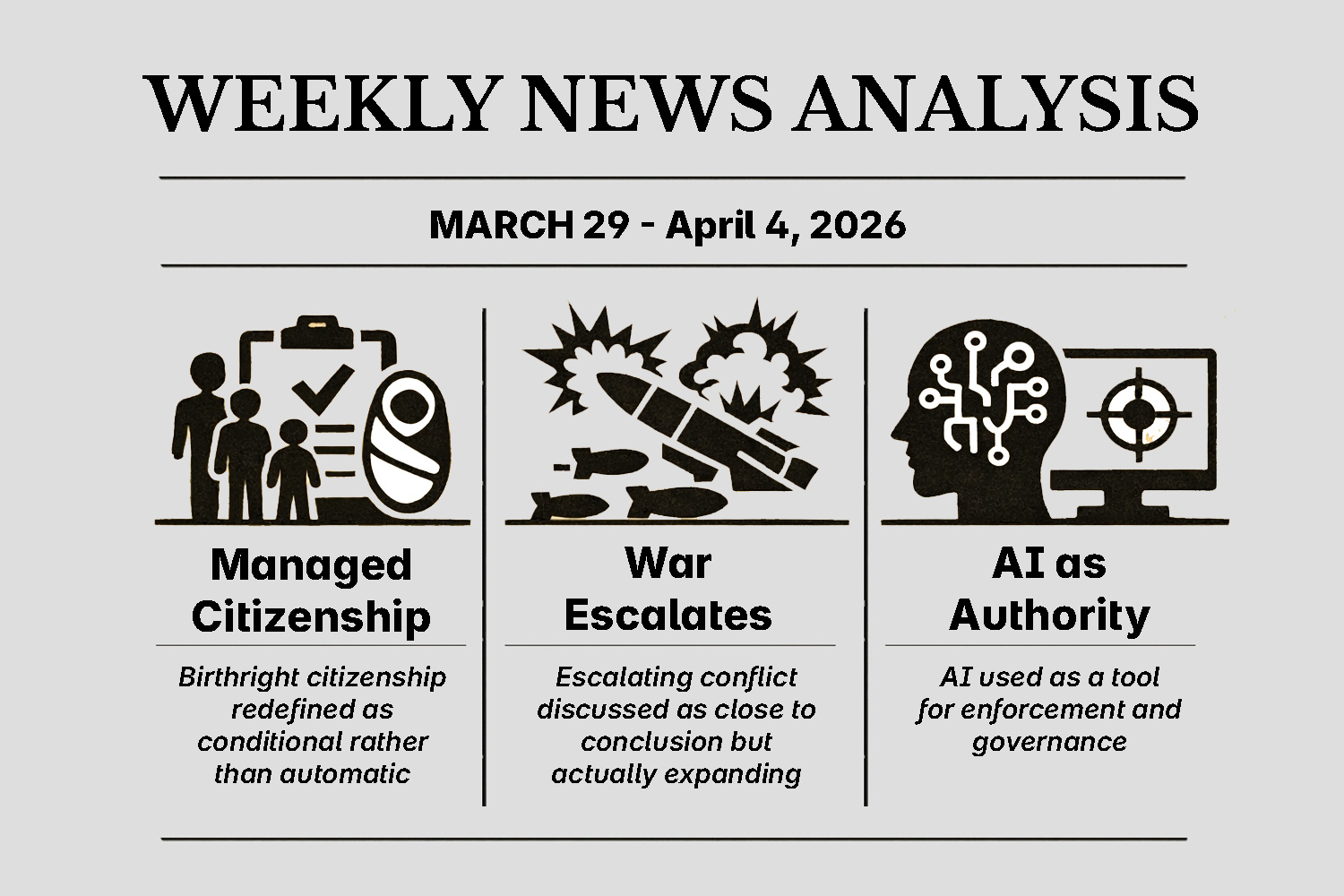
This week’s news highlighted classification more than conflict. Citizenship was redefined as conditionally granted rather than automatically at birth. Meanwhile, wartime language persisted, nearing resolution publicly but expanding operationally through downed aircraft, rescue operations, leadership changes, and emerging threats. Additionally, AI has advanced beyond consumer gadgets to become an integrated enforcement tool affecting tax audits, corporate governance, state planning, energy infrastructure, and multimodal model competition. The common thread is not just policy disagreements but a transformation where systems now determine status, risk, and permissions, limiting ordinary people's ability to challenge the framework.
The discussion around these three topics consistently follows a familiar pattern: first, an emergency is defined; then, the vocabulary is restricted to what is appropriate; afterward, decision-making shifts to institutions protected from democratic debate. Birthright citizenship is framed as an “integrity” issue; war escalation is portrayed as necessary for deterrence or as a response to a nearly completed operation; AI development is viewed as crucial for modernization, governance, or infrastructure. The choice of language is crucial. When a right is rhetorically transformed into an administrative privilege, a war into a limited corrective measure, and analytics capable of surveillance into neutral efficiency, the core argument shifts. The real question becomes not whether the state expands but which tools it selects for that purpose. This reflects the underlying structure of current debates and the lifecycle of government defined in The Fallacious Belief in Government.
Birth as Permission
Ensuring Citizenship Verification and Integrity in Federal Elections - The White House
Supreme Court appears likely to side against Trump on birthright citizenship - SCOTUSblog
Trump Supreme Court birthright citizenship - CNBC/a>
Supreme Court analysis Amy Coney Barrett birthright citizenship fail - Slate/a>
Birthright citizenship holds that anyone born on U.S. soil is, with limited exceptions, automatically a citizen. The constitutional provision states: “All persons born or naturalized in the United States, and subject to the jurisdiction thereof, are citizens of the United States.” Congress’s explanation notes that the exceptions are narrow—such as children of diplomats, children of hostile occupying forces, and certain tribal-law cases—but it does not include a broad exemption for children of resident aliens or visitors. According to SCOTUSblog, several justices considered this longstanding interpretation important, emphasizing the historical breadth of the citizenship clause and the significance of the 1898 case United States v. Wong Kim Ark.
Birthright citizenship is more than just an immigration rule; it serves as a constitutional safeguard against the creation of social castes. When a country declares that citizenship is determined by objective standards at birth, it restricts the government's ability to categorize newborns into different tiers based on parentage, documentation, political motives, or policy changes. SCOTUSblog notes that opponents describe this clause as a “fixed bright-line” rule, which is crucial because it should help prevent manipulation. This concept is more significant than it initially appears: a bright line limits arbitrary government discretion. Once this line is blurred, citizenship becomes something the administrative system grants, delays, disputes, denies, or revokes via records, databases, and bureaucracy. Politically, this transformation turns identity from a constitutional right into a form of controlled permission.
The White House has sought to reinterpret the phrase “subject to the jurisdiction thereof” in a more limited way. Trump’s order on January 20, 2025, stated that birthright citizenship does not apply when a child is born in the U.S. if the mother was unlawfully present and the father was not a citizen or lawful permanent resident, or if the mother was lawfully but temporarily present and the father lacked citizenship or permanent-resident status. Likewise, the March 31, 2026, election order ties federal election administration more directly to federal citizenship records, SAVE data, Social Security records, and a “State Citizenship List” provided to state officials before federal elections. The underlying message is clear: citizenship is being redefined from an inherent constitutional guarantee to a category that the executive branch seeks to verify, control, and transmit.
If birthright citizenship were actually revoked, the next logical question would be: how is citizenship determined now? The answer involves a combination of parentage, statutory naturalization procedures, residency requirements, documentary proof, and administrative approval. Congress already manages naturalization, and children born abroad to U.S. citizen parents can acquire citizenship under the law rather than the Fourteenth Amendment. However, shifting the process of domestic births to a parentage- and paperwork-based system would mean that the government, rather than the constitutional birth rule, becomes the primary gatekeeper. This shift would result in disputes over hospital records, visa classifications, legal status, permanent residency, paternity, deadlines, and documentation. Essentially, this would make the system more prone to litigation, more bureaucratic, and much more vulnerable to selective enforcement.
The impacts extend beyond immigration politics. A post-birthright approach would lead to a larger population whose legal status depends on proving their parents’ identity, not what the Constitution explicitly states. This sets up a permission-based society, likely causing delays in citizenship recognition, more administrative appeals, inconsistent state practices, and children living legally in limbo. Chief Justice Roberts’s questions during oral arguments reveal this clearly: even claims about “birth tourism” were examined for factual accuracy, with the Chief Justice expressing uncertainty about the scope and noting that such issues don’t directly influence the legal analysis. The core assumption in restrictionist arguments is that a strict constitutional rule should be relaxed in light of rare cases of abuse. This reflects a common shift from isolated incidents to calls for systemic change.
What would be required to permanently remove birthright citizenship? It's not just about an executive order. Article V sets a high bar: an amendment must be proposed by two-thirds of both houses of Congress or by a convention called by two-thirds of the state legislatures, and then ratified by three-fourths of the states. The National Archives states all 27 amendments have used the congressional route, which is intentionally challenging. This underscores the weakness of the current executive approach. The administration is attempting to reinterpret and non-recognize through administrative actions what the Constitution reserves for amendment if the nation truly wants to change its settled understanding. This legal strategy is bold and tests whether constitutional text can be bypassed administratively without a formal change.
This is where the contradiction becomes especially politically sensitive. The administration pushes to limit automatic citizenship at birth, while the Trump card website offers a program where foreigners can, for a $15,000 DHS processing fee and a $5 million donation, secure preferential immigration status. This status allows long-term U.S. residence without U.S. taxes on non-U.S. income. The site labels it the Trump Platinum Card and also mentions support for the Gold Card branding. The contrast is stark: birthright citizenship is seen as overly generous, automatic, and prone to misuse, whereas wealth-based entry is marketed as premium access. The message suggests that inherited constitutional rights are questionable, while bought privileges are modern and sophisticated. This is not merely policy inconsistency; it’s a moral inversion.
From a tyranny standpoint, the threat isn't limited to this particular citizenship dispute. The larger trend involves converting status into a form of database governance. Jeffrey Hann’s concept of engineered consent and the cycle of government, in The Fallacious Belief in Government, indicates that power expands by normalizing manipulative administrative systems and turning rights into managed procedures. In this framework, the right in question is membership itself. Once the government treats citizenship as a result of executive interpretation, data matching, and enforcement discretion, an individual’s constitutional identity becomes more reliant on the registry than on the republic. That’s why birthright citizenship is so vital. It’s not just about immigration; it’s about whether the state has the authority to tell a newborn, 'You exist here, but only after our systems acknowledge it.' What would you do if birthright citizenship were removed and the government came to you and said, “You are no longer a U.S. citizen and must be deported”?
War That Won't End
Second US Air Force plane crashed in Persian Gulf region, New York Times reports - Reuters
Iran war live Tehran downs 2 US warplanes Israel bombs Lebanon bridges - Al Jazeera
Tanvi Ratna Iran war isn’t distraction America’s problems lead - Fox News
Several incredible new details emerge on legendary rescue of 2nd F-15 pilot - The Gateway Pundit
Hegseth Army firings chief of stafft - TIME
The war rhetoric is built on an obvious contradiction. While public messaging suggests the conflict is close to ending or in a manageable final stage, the reality on the ground says otherwise. Reuters reported that on April 3, a second U.S. Air Force combat plane crashed in the Persian Gulf region, citing U.S. officials. TIME also reported that two U.S. warplanes were shot down within hours of each other: an F-15E over southern Iran and an A-10 near Kuwait, with pilots rescued amid ongoing search-and-rescue efforts. This pattern is not typical of a war winding down but indicates new vulnerabilities emerging concurrently with attempts to maintain a narrative of control.
What the aircraft losses reveal is even more destabilizing. TIME reported that the downings challenge claims of uncontested air dominance, showing Iran still maintains significant air-defense capabilities despite earlier assertions that its systems had been severely degraded. The report also noted that two Black Hawk helicopters were reportedly hit during a rescue attempt but still managed to withdraw. This indicates that, militarily, the battlespace is not as peaceful as political messaging suggests. Rhetorically, it suggests the public has been led to believe in a one-sided enforcement campaign, while on the ground, the situation appears more like an escalation trap. As rescue missions increase alongside strike operations, each “limited” action creates conditions for broader involvement. The war continues to evolve in response to the consequences of its own progression.
Trump’s rhetoric has contributed to the escalation of that dangerous cycle. Reuters and other media outlets reported new threats concerning the Strait of Hormuz, including promises of “Hell” and warnings against infrastructure if Iran refuses to comply. Reuters specifically mentioned renewed vows to target more Iranian infrastructure, while Al Jazeera highlighted attacks on bridges and the broader regional impact in Lebanon. This reasoning is revealing. Officials and supporters often treat infrastructure strikes as tactical moves intended to exert pressure; however, infrastructure is not merely an abstract concept. Power plants, bridges, water systems, and transportation hubs form the backbone of civilian life. When threats against these targets are normalized, the language of “pressure” becomes a euphemism for punishing entire populations to influence state behavior. This is the textbook definition of terrorism and constitutes escalation by undermining humanitarian considerations.
The shakeup in military command adds further instability. According to TIME, Defense Secretary Pete Hegseth dismissed Army Chief of Staff Gen. Randy George and two other generals, with Gen. Christopher LaNeve becoming acting Chief of Staff. TIME also noted that the Pentagon official did not explain the reasons behind the firings. This lack of explanation is significant. In wartime, unexplained removals often lead to speculation about disagreements over strategy, timing, or political loyalty. However, the key point is that the reports confirm the firings and replacements but do not validate the rumor that these officers were ousted for resisting ground troop deployment to Iran. Although the rumor exists, it remains unverified based on the current reporting.
Nonetheless, the absence of a confirmed motive does not render the event politically neutral. Wartime purges convey a message, intentionally or not: dissent at high levels may be declining, and the chain of command is being reshaped amid conflict. If these positions are filled with officers more prone to escalation, it could lead to a command culture more willing to accept the risks of deeper involvement. This does not confirm an imminent invasion; it’s an inference about institutional incentives. Wartime dismissals can promote conformity even without explicit policy changes. In this context, the significance goes beyond who was removed; it concerns what lesson the remaining command learns from these removals. In bureaucratic systems, fear often accomplishes what formal policies do not need to explicitly mandate.
The downed aircraft highlights the fragility of the “war is nearly over” narrative. Wars nearing their end usually don't require heroic recovery stories to lift spirits. However, what emerged was a rescue myth involving missing airmen, daring extraction efforts, helicopters under fire, and triumphant tales of battlefield improvisation. The Gateway Pundit portrayed the rescue as a cinematic triumph, emphasizing elements of CIA deception and miraculous recovery. Such storytelling aims to convert strategic uncertainty into emotional certainty, encouraging the audience to focus on heroism and recovery rather than question why losses are rising despite supposed decisive control. While heroism can be authentic, it also risks silencing critical scrutiny.
Fox’s framing of the opinion aligns with a similar domestic logic. The article suggests that the war in Iran isn't merely an external distraction from American issues but is interconnected with them. While this is partly true—foreign wars and domestic governance are often linked through debt, executive authority, surveillance, military contracts, and emergency rhetoric—the more insightful point is how war discourse now serves as a comprehensive narrative framework. Every institutional issue can be cast as part of the war, and any development in the conflict can be justified by domestic interests. As a result, foreign conflict becomes a tool for domestic purposes. The war no longer needs a true resolution; it only needs to perpetuate pressure, threats, and patriotic urgency to justify ongoing measures.
The imminent threat is evident. While a large-scale invasion hasn't been confirmed yet, and the most credible reports do not suggest an immediate U.S. ground attack, the conditions making one more plausible are increasing: air losses, rescue difficulties, repeated threats to infrastructure, regional spillover, dismissals of leadership, and a political rhetoric that increasingly disregards constraints. Wars are often sustained not by absolute truth but by repeatedly framing emergency reasons until the public accepts escalation as a natural progression. This cycle becomes self-perpetuating: intervention provokes resistance, resistance justifies further intervention, and the escalating conflict is portrayed as a necessary evil rather than a series of deliberate choices. This process turns limited wars into ongoing machinery and creates the potential to evolve into a full-scale World War III.
The Audit Machine
Documents reveal Palantir IRS contract fraud clean energy credits - Wired
IRS seeking increased use of Palantir’s AI and data tools to help decide who to audit - FindLaw
KiloClaw targets shadow AI autonomous agent governance - AI News
China’s Five-Year Plan details the targets for AI deployment - AI News
Microsoft takes on AI rivals with three new foundational models - TechCrunch
These AI stories are linked because they show AI evolving from just a product category to a vital component of civilization. WIRED reported that the IRS is turning to Palantir to modernize a complex case-selection system that integrates over 100 business systems and 700 different methods. The SNAP pilot project aims to pull important information from unstructured documents and flag potential issues in filings. FindLaw reports that the IRS has worked with Palantir for years, with government contracts accounting for about half of Palantir's revenue. Recently, the agency awarded up to $11.8 million for SNAP and related solutions. This isn’t about a chatbot; it’s about algorithmic systems becoming part of the process that determines eligibility for enforcement.
The official justification is predictable: the system is fragmented, workload is heavy, staff is thin, and machine help can free up human enforcement resources. While this may hold true at a narrow managerial level, the hidden assumption is that better selection is a neutral good. However, it isn't neutral for those flagged. As “smart audits” become commonplace, the debate shifts beyond correct application of tax law to questions of who designs the pattern-recognition algorithms, which data silos are visible, what proxies trigger suspicion, and how attractive these machine-driven pathways really are. Rhetoric about efficiency often overlooks the political fact that every scoring system subtly embeds a view of risk, deviance, and suspicion. The more concealed the scoring, the more difficult it is to challenge.
KiloClaw’s launch exemplifies a pattern seen within private institutions. Artificial Intelligence News describes it as a platform that manages autonomous agents and monitors “shadow AI,” in which employees use AI tools outside official channels. Although the language is corporate, the underlying process is broader, beginning with spontaneous adoption. Then, governance software is introduced to control decentralized use. What initially appears as liberation through automation quickly transforms into a compliance concern, adding supervisory layers. This cycle, common in modern technocracy, presents technology as empowerment, yet reorganizes it to increase observability. The initial message highlights freedom, but the scaled approach prioritizes enforcement.
China’s 15th Five-Year Plan defines the government's strategic approach. According to Artificial Intelligence News, AI is being integrated into national science policy alongside advancements in chips, model architectures, data sharing, and digital infrastructure like satellite systems, 5G+, and 6G. The key aspect is the planning timeline: this isn't about innovation through isolated startups but about embedding AI into a comprehensive national development plan through 2030. When state planning, computing expansion, telecom infrastructure, and model development are explicitly coordinated, AI shifts from a mere app economy to a governing framework. Even with differing political systems, the goals start to converge: data centralization, predictive abilities, infrastructure synergy, and a growing overlap between industrial policy and digital governance.
The energy sector completes the cycle because these systems require massive amounts of physical power. TechCrunch reports that Microsoft is partnering with Chevron and Engine No. 1 to develop a natural gas plant in West Texas capable of generating up to 5 gigawatts, while Google has confirmed collaboration with Crusoe on a 933-megawatt gas plant in North Texas. The same article highlights Meta’s expansion of gas generation tied to its Hyperion data center and warns about turbine shortages, long delivery times, and the risk that rising natural-gas demand for AI infrastructure could increase costs for others. This underscores the true foundation of the AI boom. The cloud has always relied on physical hardware; now, its energy needs are undeniable. Behind every governance system, audit engine, and model release is a literal extraction operation.
Microsoft’s release of three new foundational models for text, voice, and image generation completes the competitive landscape. TechCrunch reports that Microsoft AI introduced models that produce text, voice, and images, highlighting the race to develop a full multimodal stack even as Microsoft remains connected to OpenAI. This competition is important not only because models are becoming more advanced, but also because capability, infrastructure, and organizational integration have a multiplying effect. A company that controls models, cloud platforms, and enterprise relationships isn't just selling tools; it’s shaping the default ways institutions automate perception, transcription, classification, and decision-making. The fight is no longer about having the best chatbot; it’s about whose stack becomes the foundational operating system for modern institutions.
Placed side by side, these stories reveal the direction humanity is heading: a world where governance is increasingly driven by computation, consumes a lot of energy, and is preemptive. Tax authorities want machine-assisted targeting. Companies seek agent-governance platforms. Governments aim for five-year AI planning integrated into telecom and industrial policies. Tech giants pursue gas-fed compute campuses and native multimodal models. The ideological framing varies by sector—compliance, modernization, competitiveness, resilience—but the pattern shows convergence. Human discretion is not vanishing; it is being moved behind systems that limit what humans are allowed to see and decide. This makes power harder to pinpoint precisely because it becomes more spread out across contracts, models, databases, and infrastructure.
Modern control increasingly relies on shaping the conditions that make consent appear normal, while the actual decisions are made elsewhere. AI facilitates this shift by appearing helpful, yet reorganizing how visibility, prioritization, and reliance are managed. It can influence decisions such as who gets audited, which employee tools are permitted, which sectors receive computing priority, and which companies lead the next infrastructure layer. Humanity is heading toward a future where many decisions about individuals are made before they even reach formal appeal processes. This does not mark the end of politics; instead, it signifies politics embedded in code, contracts, and power.
Registry of Power
What unites these issues isn't just Trump, Iran, or AI, but the underlying administrative imagination shaping them. In the citizenship debate, the state seeks greater control over recognition from birth onward. In the Iran conflict, the aim is to keep rhetorical escalation in check, even as military realities expand the scope of risk. In AI development, both public and private institutions are rapidly creating systems that classify, prioritize, surveil, and enforce—capabilities that surpass ordinary civic processes. The common objective is a society where rights, threats, and compliance are increasingly understood through machine-readable categories and executive narratives rather than stable public boundaries.
While the specific forms—court battles, air campaigns, software agreements—change, the underlying logic stays consistent. It starts by reducing a principle to a management issue and then transforming management into a specialized field inaccessible to ordinary people. Next, the public is told that this system simply reflects realism. Birth is now a matter of documentation, war is a justified necessity, and AI is an inevitable modernization. This rhetoric of soft inevitability is a powerful tool of modern power because it persuades people that resisting is childish, while submitting signifies maturity. Often, the machine doesn't even ask for your belief; it only requires your adaptation and compliance.
The main warning here is that the new era of control may not arise from a single dramatic overthrow or a straightforward doctrine. Instead, it might develop from a mix of constitutional ambiguity, ongoing crises, and data-driven decision-making. Whether it’s a child’s status, a country’s military preparedness, or a taxpayer’s audit, they all follow a similar pattern: verify, score, target, manage. When this pattern becomes culturally ingrained, tyranny no longer needs to manifest as a visible force. It can operate quietly through dashboards, legal reinterpretations, intelligent selection tools, or emergency measures that claim to safeguard order. The empire’s rule shifts from spectacle to classification, subtly extending its control and power.
Listen to this week's news in verse for a quick recap!