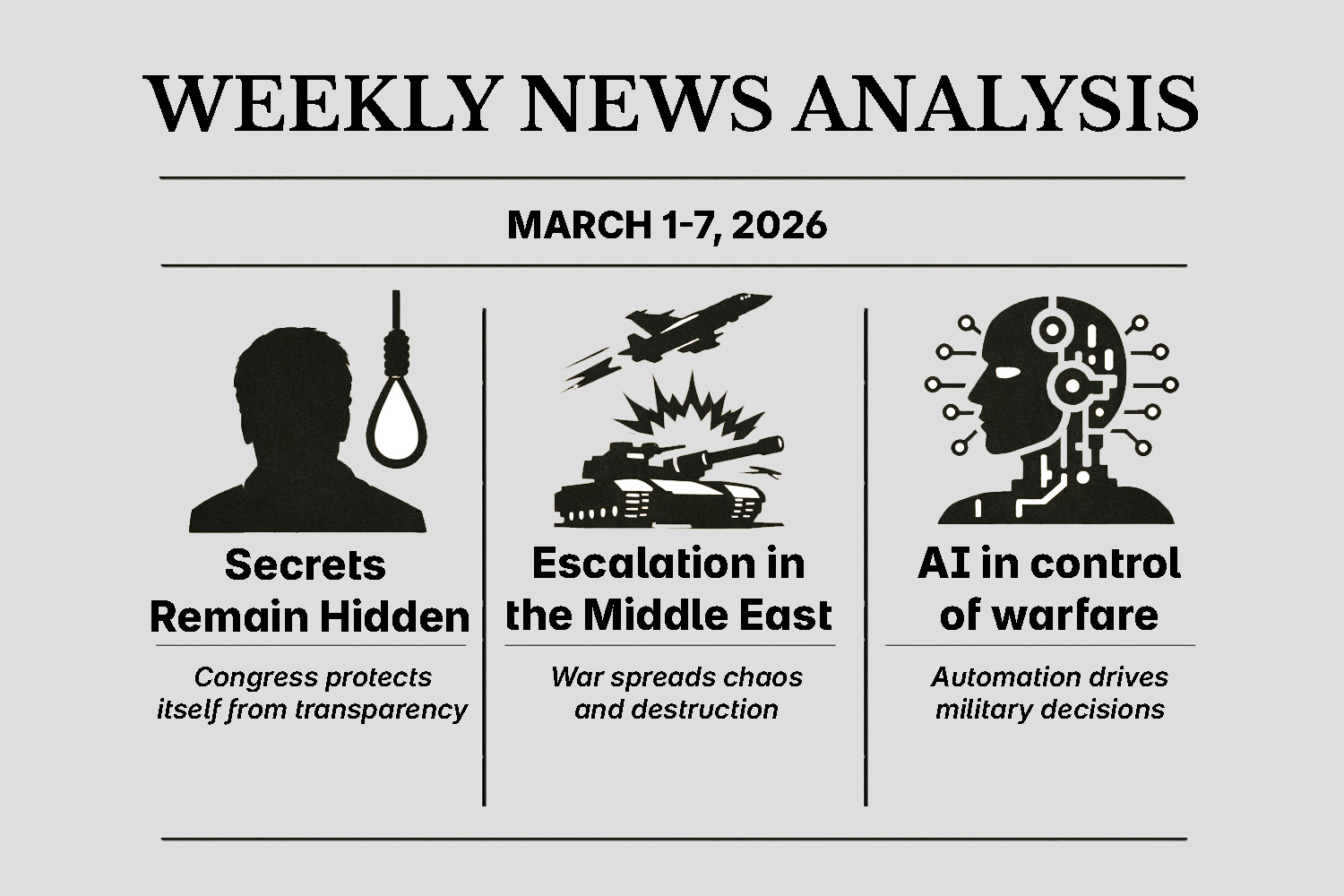
This week’s pattern was deliberate. Elite sexual compromise remained in the background as the focus shifted to war, with artificial intelligence increasingly serving as the administrative interface between leaders and the consequences. The common strategy was displacement: public attention was drawn to spectacle, while institutional actions that should provoke lasting outrage were either procedural, hidden in committee language, or reinterpreted as technical necessities. This is how modern power typically operates: scandals stay beneath the surface, escalation appears in headlines, and automation appears in procurement files. While rhetoric varies across areas, the underlying logic remains consistent. The public is not intended to maintain a clear, steady understanding for long; it is meant to react episodically and then forget. Resources describing this process refer to it as engineered consent, part of a broader government cycle in which crises are repeatedly exploited to normalize centralization, suppress dissent, and shift accountability from decision-makers to abstractions such as security, stability, and public interest.
The week reveals how three seemingly separate narratives are interconnected as aspects of a single system. Epstein remains largely hidden because full disclosure would implicate numerous figures involved in power, finance, and governance. War takes prominence because it ignites strong emotions, expands executive authority, and offers a moral cover for secrecy. AI progress accelerates as, under the urgency of war and fear, machine mediation is framed as efficiency rather than a transfer of sovereignty. This pattern shows not just widespread hypocrisy but also a governance model in which the political elite avoids scrutiny, justifies violence in the name of order, and seeks tools to accelerate command and obscure accountability. This is a conscious strategy that forms a feedback loop: scandals erode legitimacy, war restores compliance, technology upholds the system, and future crises justify further curtailments of control.
Buried Names
Trump subpoena administration probes taking shape House Democrats say - Washington Post
Commerce Secretary Howard Lutnick to testify on Jeffrey Epstein - New York Post
House kills effort to release all congressional sexual misconduct and harassment reports - NBC News
House Kills Mace Push To Release Sexual Misconduct Reports - Newsweek
The Epstein story persists but is rarely presented completely, serving as a symbol of corruption. It acts as a constant reminder of elite depravity while preventing accountability for those in power. This week, the Washington Post reported that if House Democrats regain control, they are considering strong oversight measures, potentially including forcing Donald Trump to testify about Jeffrey Epstein and examining the Justice Department's handling of related materials. But does testifying really do? This information serves as a form of containment, keeping the focus on procedural actions such as hearings, letters, subpoenas, and political goals. The public perceives a language of potential accountability rather than actual accountability. Epstein remains politically useful because he can be referenced without exposing everything the ruling powers know.
Silence holds greater significance because it occurs alongside a war cycle that dominates the information landscape. Once footage of missiles, surrender calls, troop movements, and casualties floods feeds and news tickers, the Epstein network reverts to its usual role: a morally contentious issue discussed just enough to sustain outrage but never enough to resolve. This tactic is a classic form of political propaganda. When a scandal jeopardizes class legitimacy, it is not outright denied but diluted, delayed, and overshadowed by a larger crisis. In the language of engineered consent, selective emphasis becomes a tool of governance. Attention is rationed, directing the public's emotions toward urgent and visually impactful content, while crucial details are hidden in the background—lost amid procedural silence, timing, and strategic withholding. This does not require every editor to coordinate with state actors; it reflects how modern systems operate when aligned incentives create similar outcomes.
The vote on congressional misconduct highlighted a clear pattern. On March 4, the House rejected Rep. Nancy Mace’s proposal to release Ethics Committee records on sexual harassment violations, with a vote of 357–65. This effectively blocked the records from being made public. The vote was largely bipartisan: 175 Republicans and 182 Democrats supported it, while only 65 opposed it. Newsweek pointed out that the reports remain sealed under current Ethics Committee rules and quoted Mace saying both parties had “colluded” to hide the records. Regardless of opinions about Mace, the institution's message is unmistakable: Congress, which often advocates transparency, chose secrecy in internal matters, as it typically does. This isn’t just procedural; it reveals how self-protection influences established processes.
The underlying assumption behind that vote is one of caste exemption. Legislators often approve investigations of citizens, corporations, schools, businesses, political adversaries, and foreign nations, yet when the issue involves sexual misconduct within the legislature itself, transparency becomes negotiable. The unspoken belief is that the ruling class must also have special powers to hide. This contradiction aligns with the typical lifecycle of government: institutions claim to serve the common good but, under pressure, focus on self-preservation rather than public interest. The reasoning is not moral but feudal. Rules are publicly accessible for citizens but discretionary for the ruling elite. The real scandal is not just that misconduct occurred, but that concealment remains a bipartisan instinct, even as officials publicly claim to support victims and uphold ethics.
The Epstein issue deepens the contradiction because sexual compromises among elites are not just about vice; they serve as leverage. The longer certain names stay concealed, the more it seems they might be managed quietly rather than pursued for justice. The Washington Post highlights Democratic concerns about how the Justice Department has handled Epstein-related files and notes allegations that some Trump-related records were withheld from Congress. This alone doesn't prove a blackmail scheme (anecdotal evidence), but it does create a persistent opacity around a case involving extremely powerful individuals. Such secrecy naturally fuels suspicion, which is understandable given the uneven disclosure of information. Minor offenders are identified, arrested, and forgotten, while cases involving elites turn into document battles: unseal this, redact that, refer here, litigate there. Law becomes a spectacle when only fragments are revealed while the full story remains classified.
The public’s role in this system warrants honest scrutiny. People aren't merely deceived; they're conditioned to forget quickly. Modern media's emotional economy favors immediate outrage over sustained reasoning. Today’s scandal soon fades into tomorrow’s distraction, especially when the next story features larger images and more urgent language. This highlights why congressional misconduct records are important beyond Congress itself—they reveal how public anger can be easily redirected before it turns into organized demand. A population conditioned to jump from one outrage to another becomes manageable through sequence. The week's stark contrast underscores this: no justice for Epstein’s clients, no transparency in congressional misconduct, yet endless war rhetoric. In such an environment, forgetting isn’t just a civic failure; it’s a carefully cultivated political condition.
The moral scandal is made worse by the contrast in attitudes. The same political class that conceals its own sexual misconduct files pretends to be the moral guide for the nation, while supporting, describing, and justifying violence abroad. They invoke human rights selectively —usually when it serves their interests—such as projecting power, imposing sanctions, increasing budgets, or targeting enemies. At home, victimhood is used as a political tool; abroad, they adopt a martial stance. The contradiction is clear: asserting dominance over others is justified through moral theatrics, while accountability for their own actions is indefinitely postponed. This explains why Epstein remains relevant even during wartime. He symbolizes not just corruption but also exemption. Exemption is the core principle of late-stage elite governance—different laws apply to the disposable versus the connected. The public perceives that something is deeply wrong, but lacks the power to dismantle the system. This is how managed outrage continues without transforming into justice.
Empire of Fire
Trump offers vague description of Iran surrender demand as it happened - The Guardian
Dignified transfer for U.S. service members killed in Iran war - CNN
Trump administration news updates today - The Guardian
The conflict has now entered its second week, and the language used in discussions has become more revealing than official strategic statements. Reuters reported that Trump stated he is not interested in negotiations and suggested that the war might only end when Iran's military leadership ceases to function. He also mentioned that eventually, there may be no one left to surrender. Iranian President Masoud Pezeshkian dismissed the idea of unconditional surrender as “a dream,” apologized to neighboring states affected by Iranian attacks, and announced that attacks on nearby countries would cease unless strikes on Iran were launched from their territory. Meanwhile, Iran, Israel, and the U.S. continue to exchange strikes across multiple nations, with reports of attacks or claimed attacks in the UAE, Bahrain, Iraq, Kuwait, and Israel. This is not the language of containment but of regime decapitation, humiliation, and escalation, expressed as a perceived necessity.
All sides employ propaganda to secure domestic obedience. Washington and Jerusalem frame their campaigns as acts of preemption, deterrence, and the restoration of order, while Tehran views retaliation as defense, sovereignty, and martyrdom. Each side uses urgent language to reduce complex moral issues to simple cues like surrender, survival, threats, or inevitable responses. The core assumption is that the public must accept a distorted version of reality because the urgency of war demands that normal scrutiny be bypassed. This reasoning has historically justified many interventions. The critique of engineered consent—fear, partial disclosure, emotional imagery, and selective facts as discussed in The Fallacious Belief in Government—applies here: these are central to wartime messaging, not accidental. The public isn’t meant to see the full picture; instead, they are expected to identify with their flag and accept the next step.
One of the most enduring myths in this narrative isn't a single falsehood but a recurring motif: Iran is always said to be just “years, months, or weeks away” from developing a nuclear weapon. This phrase has persisted in public discourse for decades because it serves a political purpose. It continually justifies the threat of war without requiring conclusive proof to definitively settle the debate. “Weeks away” acts like a suspended musical chord—it never resolves, only providing justification. This doesn’t mean Tehran is innocent or truthful; rather, the timeline used to justify it serves as a persistent emergency, always close enough to spark fear but never settled enough to close the chapter on the narrative. Such rhetoric sustains a constant state of uncertainty, allowing extraordinary measures to be framed as reluctantly necessary. Once accepted, this perspective normalizes war, making it the default method by which the empire maintains control. This isn’t just a surface analysis of recent events, but the deeper pattern that has characterized decades of behavior.
The death toll reveals what the rhetoric conceals: lives are being sacrificed for abstract concepts. Reuters’ March 5 report, which relied on figures from the involved countries without independent verification, counted at least 1,230 deaths in Iran (including over 165 Iranian schoolgirls killed by U.S.-Israeli strikes), 10 civilians in Israel, 77 in Lebanon, and more in Bahrain, Kuwait, the UAE, Syria, Iraq, and among U.S. service members. By March 7, reports from the Guardian and others indicated the toll was still rising, with civilian casualties and displacement spreading across the region. Terms like “precision,” “targets,” and “capabilities” become morally distorted in this context. Precision doesn't prevent destruction by fire. Legality doesn't erase the loss of children. And strategic maps don't feel the funerals. When governments discuss systems, they often mask the reality of death—victims become mere statistics on a geopolitics spreadsheet, while viewers are conditioned to debate justification instead of mourning.
It increasingly seems like a scripted war in the public sphere—not because the deaths are fake, but because the roles within the narrative are heavily predetermined. Hawks are assigned their red lines, networks their maps, politicians their aggressive verbs, and the public is fed a morally charged, tightly edited sense of urgency. Here, theater doesn’t imply unreal events; it means orchestrated perception around actual destruction. The public observes a series of emotionally impactful scenes, each designed to guide interpretation: a defiant speech, a striking image, a demand to surrender, or a threat of greater retaliation. This is how industrial states transform war into an ongoing media spectacle. The script doesn’t require each event to be meticulously planned; it only needs each to be digestible within the narrative. Once this occurs, true uncertainty is replaced by rhetorical inevitability, turning citizens into audiences first and ethical agents second. This change is dangerous because it allows mass death to be absorbed as serialized entertainment.
The question of what comes next is answered differently by each side, and these answers often serve as propaganda. Trump uses maximalist language, calling for the destruction of military leaders and equating an apology with surrender. Netanyahu indicates more operations and hints at surprises. Iranian leaders oscillate between limited de-escalatory statements and threats of continued retaliation from regional bases. Gulf states warn Tehran but aim to avoid full-scale war. The region is essentially being told that more violence might be the only way to achieve stability. This contradiction reveals the great imperial deception: official goals and actual actions do not align. While everyone claims to restore order, each new strike increases instability. Normalcy is shifting from peace through force to instability through ongoing intervention.
As AI becomes more integral to warfare, the field is likely to intensify rather than decrease. Technologies such as machine-assisted targeting, simulation, decision support, and automation reduce response times from suspicion to action. Human hesitation, often morally justified, increasingly appears as a hindrance. With predictive systems accelerating warfare, there’s a risk of treating probability as a form of approval. Pattern scores will begin to hold the emotional significance that human testimony once had. This presents a major civilizational danger. The public is being encouraged to accept not only this conflict but also a new concept of war in which machine suggestions seem inevitable. In such a future, traditional apocalyptic language of pestilence, war, famine, and death adopts a more technocratic tone. Whether seen as biblical end times or as a political cycle ending, the core message is the same: an order based on centralization, constant emergencies, and automated violence approaches a point where it might only be managed through controlled catastrophe.
Machine Sovereigns
AI contract restrictions could threaten military missions U.S. official says - Reuters
Pentagon Refuses to Say If AI Was Used to Select Elementary School as Bombing Target - Futurism
Hours after Trump announced ban on Claude AI US military used it in Iran strikes reports - The Times of Israel
Timeline How Sam Altman Got Stuck Playing Defense - Business Insider
Physical AI is having its moment and everyone wants a piece of it - Artificial Intelligence News
Physical AI adoption boosts customer service ROI - Artificial Intelligence News
The most important AI story this week was not that corporations are arguing over rules. It was the argument itself that revealed how deeply AI has already entered military decision architecture. Reuters reported that a senior Pentagon official said commercial AI contracts signed under the Biden administration contained operational restrictions that could paralyze U.S. missions in real time, including combat planning and execution. The official described agreements that, in his telling, could interfere with operations involving air theaters over Iran, China, and South America. At the same time, the dispute centered heavily on Anthropic, whose Claude model had been available on classified systems and was said to be subject to conflict over restrictions on autonomous weapons and mass surveillance. Read plainly, this means the debate is no longer whether AI belongs in military operations. That threshold has already been crossed. The dispute is over how few restraints the war machine will tolerate.
The Times of Israel, citing Wall Street Journal and Axios reporting, said U.S. forces used Claude to support strikes on Iran by helping assess intelligence, identify targets, and simulate battle scenarios, even though Trump had just announced a federal cease-use order on Anthropic technology. If accurate, that contradiction is revealing. It suggests the system now runs on tools so deeply embedded that political announcements do not cleanly govern operational reality. Software outlives slogans. Procurement can outrun policy. And once a model is embedded in warfighting workflows, removing it becomes less a moral decision than a supply-chain disruption. The old fantasy was that elected “leaders” sat clearly at the top of the chain of command. The emerging reality is more diffuse: executive power, contractor infrastructure, model vendors, cloud providers, and combatant commands form a lattice in which sovereignty itself becomes platform-dependent. That is not merely a military problem. It is a tyrannical one.
Futurism pushed the matter to its ugliest edge by asking whether AI was used in selecting an Iranian elementary school as a bombing target, noting that the Pentagon would not answer and referred inquiries to CENTCOM. That refusal matters because it marks the arrival of a new moral fog. In earlier eras, officials could at least be forced to defend a target selection chain in explicitly human terms: who authorized, who evaluated, what evidence was weighed. Under machine-assisted warfare, a civilian massacre can be obscured inside a hybrid chain of recommendation, optimization, and command approval. Responsibility is still human in law, but the perception of responsibility grows hazier. That haze is politically useful. It allows institutions to enjoy the speed benefits of algorithmic targeting while diffusing blame across technical systems, contractors, and classification walls. The result is a bureaucracy of plausible deniability attached to kinetic violence.
The corporate struggle around Anthropic and OpenAI further shows how quickly AI firms are becoming quasi-sovereign actors. Business Insider reported that the Pentagon formally told Anthropic its products were deemed a supply-chain risk and defended the principle that the military must be able to use critical technology for all lawful purposes, while Sam Altman said OpenAI had amended its agreement to add more specific protections against mass domestic surveillance. Even this so-called moderation reveals the larger trajectory. The terms of public freedom are increasingly being negotiated not in legislatures but in contracts between the national security state and a handful of firms building foundational models. Citizens are spectators to negotiations over what kinds of surveillance, targeting, and pattern analysis may be acceptable. That is a dangerous inversion of republican order. Instead of public law defining the perimeter of power, vendor terms and classified agreements begin to define it operationally.
This is why AI will not only become part of everyday life but will also increasingly shape the conditions under which life unfolds. It began with digital pattern recognition, language generation, recommendation systems, and behavioral sorting. These capabilities already impact hiring, moderation, advertising, policing, lead generation, benefits assessments, intelligence triage, and social visibility. Currently, the key change is that military needs give these systems a legitimacy boost that consumer acceptance alone could never achieve. When AI is framed as vital to national defense, objections to its domestic use are easier to dismiss as naive, outdated, or irresponsible. War has historically accelerated a state's capabilities, and AI is simply the latest example of this pattern. As with the lifecycle of government, crises first broaden authority, and only later does society realize that the emergency tool has become a routine part of governance.
The next phase is physical AI, transforming everything by shifting machine control from screens to physical infrastructure. Artificial Intelligence News defines “physical AI” as systems that can perceive, reason, and act in the real world, including robots, autonomous vehicles, adaptive machines, and industrial platforms. The article highlights that companies such as Nvidia, Google, Siemens, and Arm are developing the necessary technology stack. Additionally, a Deloitte survey shows that 58% of global business leaders are already using physical AI in some form, and 80% plan to implement it within two years. Another report mentions that customer-service applications in real-world settings are expected to start in autumn 2026. This indicates that the transition from digital recommendations to physical presence is happening. Machines will not only advise organizations but will also take action in physical spaces—moving goods, monitoring environments, greeting customers, patrolling facilities, and eventually ensuring compliance.
That is where the social meaning becomes darker. A mainly digital AI order can still be resisted in partly analog ways. One can close an account, leave a platform, ignore a prompt, or refuse a device. Physical AI narrows that distance. When the intelligence layer is embodied in logistics, retail, manufacturing, checkpoints, security hardware, and urban service systems, the built environment itself starts to act back upon the citizen. The line between convenience and command blurs. A robot concierge becomes a sensor node. An autonomous warehouse becomes labor discipline. A smart patrol unit becomes a civilian normalization of machine authority. And once those systems are integrated with identification, payments, predictive scoring, and emergency powers, society moves closer to a form of digital feudalism in which access, mobility, and even dignity become increasingly conditional on machine-readable compliance. War prepares the moral ground for that future by teaching populations to trust automation when danger is invoked.
Silent Threshold
Across all three narratives, a consistent pattern emerges: rulers hide their actions, the public faces crises, and automation shapes the future. The Epstein file scandal shows how elite misconduct often remains hidden to avoid destabilizing the ruling class. The war exemplifies how mass casualties are justified as necessary through language centered on security, surrender, and deterrence. The AI stories demonstrate how support systems quickly evolve into key decision-making structures, which are then defended as vital. The underlying theme is not just corruption but a shift in moral responsibility, moving it upward and outward—away from ordinary people toward institutions, officials, and technical systems that claim expertise while avoiding scrutiny. We are now in the technocratic era, where the public is less informed, more fearful, and governed by tools they never fully authorized.
What happens after this stage depends on whether society recognizes the pattern before it becomes common sense. If not, the emerging order will seem efficient, protective, and modern, while gradually suppressing autonomy: hidden files here, constant war footing there, and algorithmic mediation everywhere. Ages end not always with a single catastrophe but often through a buildup of permissions granted to power amid scandal, fear, and convenience. Whether we call it the end of a cycle, late empire, or the start of digital feudalism, the trend is evident. The public is being conditioned to accept living under managed opacity at home, controlled escalation abroad, and managed intelligence in between. When this triad becomes normalized, freedom is not suddenly taken away but quickly eroded—update by update, emergency by emergency—until obedience becomes just part of the infrastructure. You’ll own nothing. And you’ll be happy.
Listen to this week's news in verse for a quick recap!