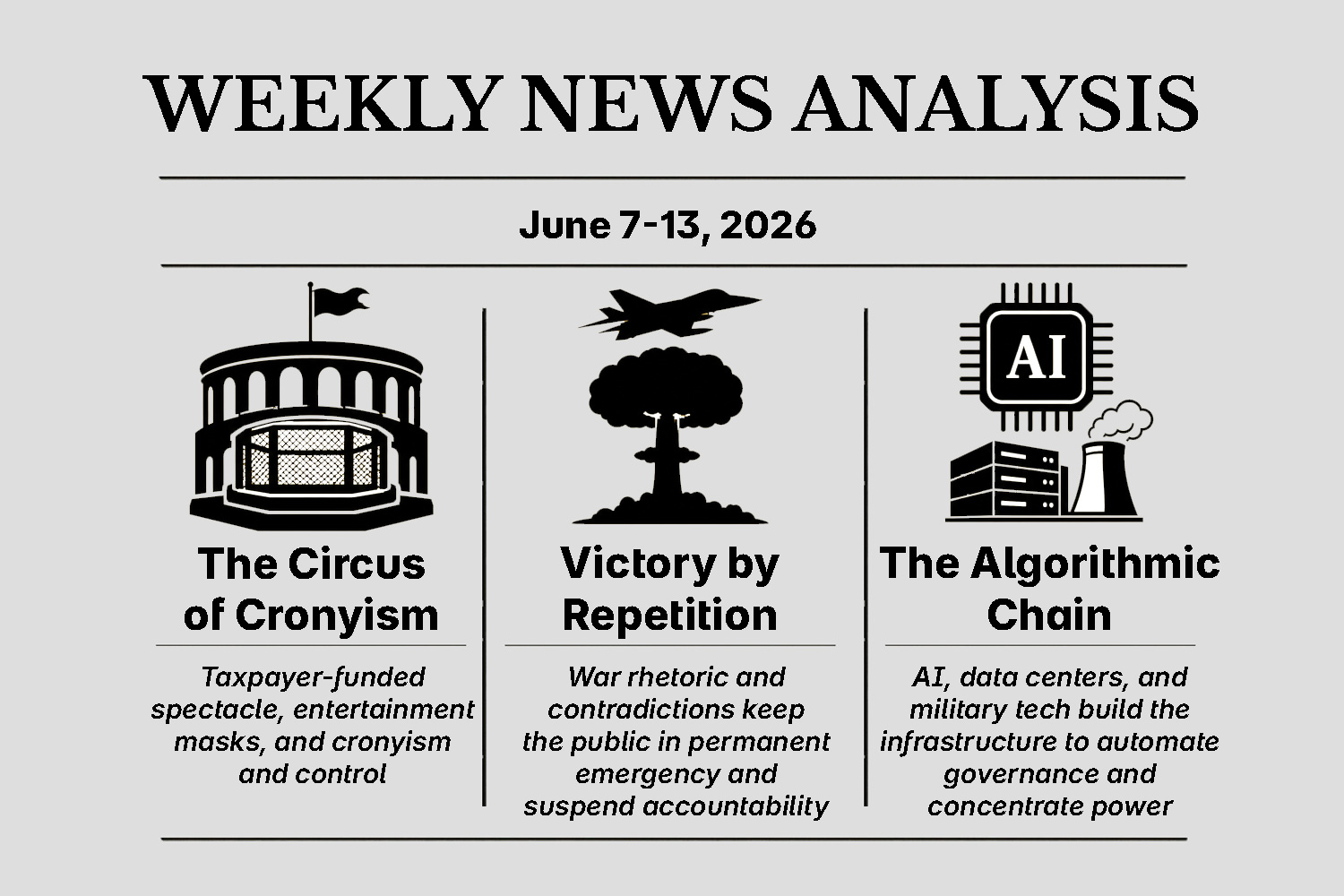
This week’s events revealed a coherent political system: spectacle occupied public attention, war rhetoric suspended the demand for consistency, and artificial intelligence accelerated the transfer of human judgment into centralized machines. Viewed in isolation, each arena appeared separate. A taxpayer-supported cage fight at the White House looked like entertainment. Contradictory declarations about Iran looked like the ordinary exaggerations of a political leader. Military memoranda, defective AI reports, data-center disputes, and experimental cooling systems appeared to belong to the technology pages. Taken together, however, they exposed the operational architecture of late-stage government: distract the population with symbolic performances, keep it psychologically mobilized through permanent emergency, and construct the computational infrastructure required to administer the resulting order.
The rhetorical sequence has become increasingly predictable. First, a ruler converts the state into a personal brand, presenting loyalty to himself as loyalty to the country. Second, every contradiction is absorbed into an emergency narrative in which yesterday’s failure becomes today’s secret victory. Third, the institutional machinery created during the emergency remains after the justification changes. The public is conditioned to experience politics as entertainment, foreign policy as episodic television, and automated governance as inevitable modernization. This is the crisis-to-consolidation cycle: spectacle creates emotional alignment, conflict creates obedience, and technology converts temporary obedience into permanent administrative capacity. The population is encouraged to debate personalities while the deeper system becomes more centralized, militarized, corporatized, and increasingly insulated from meaningful consent.
The Circus of Cronyism
The White House UFC Event Is Costing $60 Million - TIME
Big Update For Lindsey Graham Hours Before South Carolina Primary - Conservative Brief
Trump World Liberty Financial Crypto Alt5 Sigma - CNBC
From 10 Percent Chance of Success to 2 Trillion SpaceX Historic IPO - CNBC
Elon Musk and the Trillionaire Economy - BBC
The White House UFC event is more than an expensive celebration. It is the conversion of the executive residence into a colosseum, where political authority, commercial entertainment, military symbolism, and presidential branding become indistinguishable. A federal court filing stated that more than $60 million and tens of thousands of labor hours had been expended in preparation, while the administration maintained that UFC was paying the production costs and that government employees were merely performing their normal duties. That distinction may be rhetorically convenient, but it is economically incomplete. Federal labor, security coordination, aviation restrictions, agency planning, public-property use, and opportunity costs remain public resources even when an outside corporation pays for temporary structures. Underlying the argument is the premise that government labor becomes costless whenever an employee is already on the payroll. By that logic, any president could redirect enormous public capacity toward personal spectacle and declare that taxpayers paid nothing because the workers would have received salaries anyway.
The name Freedom 250 only deepens the contradiction. Freedom is being represented through a heavily secured cage fight staged on government property under executive sponsorship. The spectacle borrows imagery of rebellion, physical courage, and national independence, yet is administered by the same centralized authority from which independence was historically declared. The result is semantic inversion: freedom becomes an officially licensed event rather than the condition of being free from coercive authority. The Declaration of Independence is reduced from a philosophical indictment of political domination into branding material for televised combat. Bread and circuses worked in Rome not because citizens were incapable of recognizing decline, but because spectacle gave them an emotionally satisfying substitute for confronting it. The modern equivalent adds corporate sponsorship, influencer culture, military pageantry, social-media amplification, and executive personality worship to the old imperial formula. Including bots and “influencers” spreading scripted rhetoric further amplifies the effect of propaganda.
The event’s political function becomes clearer in light of Trump’s attacks on Republican dissenters and his continued support for Senator Lindsey Graham. Graham’s campaign framed the South Carolina primary as a choice between Republicans loyal to Trump and a faction associated with Thomas Massie and Marjorie Taylor Greene. Such language reduces ideological evaluation to personal allegiance. Graham’s long record of interventionism, support for surveillance, military spending, and institutional continuity becomes secondary to his usefulness within the current hierarchy. Meanwhile, Republicans who challenge presidential policy can be treated as enemies regardless of their voting records or stated principles. This is the appeal-to-person fallacy institutionalized as party discipline: the ruler becomes the standard by which every position is judged, meaning the same policy can be patriotic when supported by Trump and treacherous when opposed by him.
Graham’s history further demonstrates how the rhetoric of dismantling the establishment can coexist with the preservation of its most dependable operators. During the later phase of the COVID19 crisis, Graham publicly discussed restoring American funding to the World Health Organization under the leadership associated with Bill Gates. Whether one interprets that proposal as pragmatic global-health policy or institutional surrender, it was not the language of anti-establishment decentralization. Gates occupied an extraordinarily influential position across vaccine development, global health financing, media grants, pandemic policy, and international organizations despite never holding elected office. Trump’s continued political protection of Graham therefore complicates the claim that his administration represents a comprehensive assault on entrenched networks. This contradiction is not peripheral. Controlled opposition functions by attacking selected symbols of the system while preserving the deeper personnel, funding channels, emergency structures, and public-private partnerships through which the system operates.
A similar contradiction surrounds Robert F. Kennedy Jr. and the Make America Healthy Again movement. Kennedy entered government carrying the expectations of people who wanted pharmaceutical accountability, institutional transparency, food reform, vaccine scrutiny, and a fundamental challenge to the public-health bureaucracy. Rumors that he may leave his position remain unconfirmed until an official announcement; nevertheless, their political significance lies in how quickly the movement’s transformative expectations collided with institutional constraints. A reform campaign centered on a heroic appointee is structurally fragile because the bureaucracy, appropriations system, corporate lobbying apparatus, regulatory framework, and executive hierarchy remain intact. Even a sincere official becomes contained within machinery designed to absorb personnel changes without surrendering control. MAHA was therefore always at risk of becoming a branding layer placed over the same centralized health-management architecture developed during COVID19.
This pattern corresponds to the government lifecycle described in The Fallacious Belief in Government. Late-stage systems do not necessarily eliminate dissent; they incorporate it. Populist personalities are permitted to condemn bureaucrats, globalists, pharmaceutical companies, intelligence agencies, or establishment Republicans so long as the institutional direction continues toward greater executive power, larger budgets, expanded data collection, and tighter public-private integration. The public gains catharsis when familiar enemies are insulted, removed, or renamed. Yet the machinery persists beneath the turnover. Trump’s political theater can therefore contain genuine disagreements with parts of the establishment while still producing outcomes that reinforce the broader system. Controlled opposition does not require every action to be fraudulent. It requires channeling the opposition’s energy into a structure that survives and expands regardless of who claims victory.
The World Liberty Financial and Alt5 Sigma episode carries the same analysis from political capital into financial capital. Reports that the Trump family generated approximately $500 million through the crypto venture, while securities associated with the arrangement later collapsed by more than 90 percent, illustrate the dangers created when presidential influence, speculative finance, administrative policy, and family enrichment occupy the same ecosystem. Investors were not merely evaluating code, cash flow, or technological utility. They were purchasing proximity to political power and the implied value of a presidential brand. What appears as market enthusiasm is moral hazard. When the government simultaneously shapes cryptocurrency enforcement, banking access, securities treatment, reserve policy, and industry legitimacy, a venture associated with the president’s family cannot be treated as an ordinary private enterprise operating independently of public authority.
Defending such arrangements usually depends on compartmentalization. Supporters are told to evaluate the president as a political ruler while ignoring the commercial network around him, then evaluate the commercial network as private enterprise while ignoring the regulatory power of his administration. Yet that separation is artificial. Political access increases market visibility; market visibility produces investment; investment enriches politically connected participants; and that enrichment finances further influence. The Art of the Deal becomes the art of the grift when the seller benefits from controlling the environment in which the deal is valued. Those left holding depreciating assets are encouraged to blame market volatility, hostile regulators, disloyal insiders, or media sabotage rather than the fundamental conflict that arises when state power and personal branding merge.
Elon Musk’s rise, as reported in the SpaceX public offering, completes this oligarchic picture. SpaceX’s valuation reportedly approached $2 trillion, potentially making Musk the first person whose net worth crossed the trillion-dollar threshold. The conventional story presents an entrepreneur who overcame overwhelming odds through private ingenuity. What this account omits includes NASA contracts, Defense Department relationships, launch procurement, classified payloads, satellite communications agreements, subsidies, tax incentives, regulatory accommodations, and the government’s strategic dependence on Starlink and SpaceX infrastructure. None of this negates the engineering achievements involved. It does negate the mythology of the isolated free-market hero. Musk’s empire emerged through a fusion of private ownership and public risk, in which taxpayers finance foundational demand while ownership gains remain extraordinarily concentrated.
This is crony capitalism moving toward technological feudalism. Public institutions transfer money, contracts, data, and strategic dependency to private corporations; those corporations accumulate infrastructure powerful enough to influence governments; and their owners are then celebrated as evidence that markets operate independently of the state. Musk’s expanding role in government AI, defense, communications, transportation, and space systems means his wealth is not merely financial. It represents control over critical infrastructure that citizens financed but do not own. Accordingly, the widening gap between ordinary households and the emerging trillionaire class is not simply the result of differences in talent or consumer preferences. It is produced by monetary inflation, asset appreciation, public contracting, concentrated ownership, and a regulatory order that socializes risk while privatizing extraordinary gains.
Trump’s favorable comments about inflation expose the final inversion. Inflation benefits debtors with appreciating assets, governments that repay obligations in devalued currency, corporations with pricing power, and wealthy investors positioned in equities, real estate, commodities, or politically favored ventures. It punishes wage earners, savers, renters, retirees, and households whose income adjusts more slowly than prices. Celebrating inflation while claiming to represent working families exposes the class structure beneath populist rhetoric. Nationalist branding does not change the redistributive mechanism. The poor lose purchasing power, the middle class liquidates savings to maintain living standards, and asset owners watch nominal valuations rise. The circus distracts from that transfer by turning political identity into entertainment and oligarchs into cultural heroes.
Victory by Repetition
UAE Denies False Reports of Fund Transfer to Iran - CNBC
US Iran Deal Will Be Signed Tomorrow Trump Says - Fox News
Trump Iran Deal and Strait of Hormuz - CNBC
Trump Says I Love the Inflation and Claims US Is Taking Iranian Oil - AP News
US Offers to Loan Up to 40 Million Barrels of Oil From Strategic Petroleum Reserve - Reuters
The Iran war has created a language environment in which repetition is expected to substitute for verification. A running tally circulated this week attributed dozens of statements to Trump declaring that Iran had been defeated, its military capability obliterated, an agreement imminent, and the Strait of Hormuz open or on the verge of reopening. The precise total depends on how repeated statements and variations are counted, but the analytical point does not require accepting every number without examination. These declarations are interdependent claims that should yield observable outcomes. A defeated military should not retain substantial operational capacity. An obliterated enemy should not continue downing aircraft or disrupting shipping lanes. An imminent agreement should eventually become a signed agreement. An open shipping lane should function without extraordinary military intervention, insurance disruption, emergency reserve releases, or recurring promises that normal movement will resume tomorrow.
Here, the moving-goalpost fallacy becomes a war-communications doctrine. Each prediction receives a short expiration date, but when the promised event fails to materialize, the statement is not treated as falsified. Instead, the deadline moves, the definition changes, or a new hidden success is announced. “Defeated” may come to mean degraded. “Obliterated” may mean temporarily disrupted. “Open” may mean that some vessels passed under military protection. “Deal tomorrow” may mean talks are continuing. The political audience is conditioned to remember the emotional conclusion while forgetting the measurable claim. Victory becomes a mood rather than a condition, and the president’s confidence becomes evidence of success even when the battlefield, oil market, and diplomatic record remain inconsistent with his assertions.
The claim that the United States was taking millions of barrels of Iranian oil every night compounds the problem. Such a transfer would be enormous, physically traceable, commercially consequential, and diplomatically explosive. It would require tankers, terminals, storage, accounting, military control, and a legal theory for confiscating another country’s resources. Yet the statement was presented more like a boast than a documented logistical operation. Its appeal lies in cinematic simplicity: the enemy is humiliated, America takes the prize, and the ruler reveals that Iran discovered the theft only after it was too late. This is the rhetoric of imperial plunder packaged as strategic brilliance. It asks the audience to admire domination while avoiding questions about legality, escalation, retaliation, shipping capacity, and the claim's materiality.
The Strategic Petroleum Reserve lays bare the contradiction between triumphal rhetoric and operational reality. The Department of Energy offered to loan energy companies up to 40 million barrels from the reserve to help suppress fuel prices. That offer formed part of a broader 172-million-barrel release arrangement, with approximately 133 million barrels already loaned. The reserve reportedly stood near 349 million barrels, its lowest level since August 2023. Officials argued that companies would return the oil with premiums, potentially increasing future inventories. Even if that mechanism is accepted, the immediate fact remains: a reserve designed for severe supply emergencies was being used to manage a price shock created after the U.S. and Israel entered war with Iran. The government broke the window, then presented the emergency withdrawal as evidence of responsible repair.
This is Bastiat’s broken-window fallacy applied to geopolitics. War disrupts energy markets, raises transportation costs, increases insurance premiums, strains supply chains, and threatens household purchasing power. The government then intervenes by releasing strategic oil, subsidizing affected sectors, deploying military escorts, and negotiating emergency arrangements. Each intervention is offered as proof of competent leadership, even as the original decision that created the disruption is removed from the causal chain. Economic activity generated by destruction is counted as response, investment, mobilization, or resilience. The resources consumed in repairing the disruption are not available for productive purposes elsewhere. The public pays for the war, pays higher prices because of it, and then pays for measures advertised as relief from its consequences.
Trump's statement, “I love the inflation,” is revealing because it momentarily abandons the language normally used to conceal the distributional effects of war. Inflation is often described as temporary pressure, supply adjustment, market volatility, or the unavoidable price of national security. Those euphemisms conceal who gains and who loses. Oil producers, defense contractors, commodity traders, holders of leveraged assets, and governments that collect higher nominal revenues can benefit. Families buying food, fuel, housing, and electricity cannot afford to. War inflation functions as an undeclared tax that requires no legislative vote and arrives without an itemized bill. The citizen experiences reduced purchasing power while political rulers convert the resulting hardship into another justification for intervention, subsidies, price management, or emergency authority.
The administration’s messaging also rests on the false dilemma that skepticism toward its claims amounts to support for Iran. This is a standard wartime mechanism. The public is offered two identities: loyal citizen or enemy sympathizer, strength or surrender, victory or humiliation. Missing is the possibility that opposing the Iranian government and opposing an American war can coexist. Missing is the question of whether Israel’s strategic objectives align with the natural rights, financial interests, and security of Americans. Missing is an accounting of the executive authority used to initiate and continue hostilities. When policy criticism is conflated with disloyalty, the government shifts the debate from evidence to tribal identity. Once that shift occurs, contradictions become loyalty tests rather than analytical problems.
Reports that the United Arab Emirates denied transferring funds to Iran illustrate how rapidly information warfare expands around conventional war. Financial claims can be used to suggest betrayal, secret alliances, sanctions evasion, or imminent diplomatic realignment before the underlying transaction is verified. Governments, intelligence services, markets, anonymous officials, partisan media, and online accounts all have incentives to inject narratives into the information space. A false report can move oil prices, shape negotiations, justify retaliation, or test public response even after it is corrected. Grammar becomes unstable because the basic facts are contested, delayed, classified, or strategically leaked. In those conditions, rhetoric overtakes the process before logic can evaluate the evidence.
The cultic dimension emerges when followers revise their beliefs in real time to preserve the ruler’s infallibility. If the war ends, Trump forced peace through strength. If it continues, the enemy proves more treacherous than expected. If oil prices rise, foreign actors are responsible. If reserves are released, Trump is protecting consumers. If a promised agreement fails, he is strategically deceiving the enemy. Every outcome confirms the same conclusion. The result is unfalsifiable reasoning, a closed belief system in which contrary evidence becomes further proof of hidden genius; 42D chess. The psychological reward is certainty. Admitting that the ruler miscalculated would threaten not merely a policy preference but an identity built around the belief that he alone sees through the system.
A broader danger is that repeated declarations of false victory degrade the distinction between diplomacy, propaganda, and command. Military personnel, allied governments, shipping companies, investors, and opposing states must determine whether presidential statements describe actual policy or improvised performance. Strategic ambiguity can sometimes deter an enemy, but constant contradiction can also produce catastrophic miscalculation. An adversary may interpret a boast as preparation for escalation, an ally may act on a promise that does not exist, or markets may price in an agreement that collapses hours later. The ruler who treats every communication as a sales pitch eventually destroys the informational reliability required to govern. At that point, the state is doing more than lying to the population. It loses the capacity to communicate credibly with itself.
Precisely these conditions accelerate the government lifecycle. External conflict expands executive authority, strengthens security agencies, rewards military contractors, suppresses dissent, and creates public dependency on official information. The ruler presents himself as the only figure capable of resolving the crisis he helped create. Each failed promise becomes justification for more force, and each use of force produces new instability requiring additional intervention. Crisis leads to mobilization, mobilization to consolidation, consolidation to resistance, and resistance to a new crisis. The Iranian war, therefore, is more than a foreign-policy event. It is an engine for domestic political transformation theater, monetary extraction, institutional expansion, and habituation to government by emergency.
The Algorithmic Chain
Trump Orders Military to Accelerate Use of Artificial Intelligence - Fox 9
Anthropic Says US Government Ordered It to Shut Down Mythos Models - Wired
China Did Not Make Americans Hate Data Centers - Wired
Amazon CEO Reportedly Raised Anthropic Model Concerns Before Government Crackdown - TechCrunch
KPMG Pulls Report on AI Usage Due to Apparent Hallucinations - TechCrunch
Nuclear Inspired Cooling System Could Make Data Centers More Sustainable - MIT
The Crucial Human Component in Computing and AI - MIT
Trump’s directive ordering the military and national security apparatus to accelerate AI adoption opens with reassuring language. The systems are to respect the chain of command, protect warfighters, improve precision, reduce civilian harm, and maintain technological superiority. These phrases establish a moral frame before the public can examine the operational details. “Deliberate adoption” suggests caution while the actual order demands acceleration. “Human chain of command” suggests accountability without defining how much meaningful comprehension or intervention remains once machine-generated recommendations operate at battlefield speed. “Precision” implies ethical improvement even though a precisely selected target can still be based on corrupted data, false identification, biased training, defective sensors, or an unlawful mission. The rhetoric presents the technology as constrained by the very institutions seeking to deploy it more quickly.
Autonomous weapons produce an especially severe accountability gap. A traditional chain of command is legible because orders can, in theory, be traced through identifiable individuals. AI inserts probabilistic models, data pipelines, software vendors, model weights, classified prompts, sensor fusion, and automated recommendations into that chain. When an algorithm misidentifies a civilian vehicle as a threat, responsibility can be distributed until it disappears. The commander relied on the system. The developer did not control deployment. The contractor trained the model on government-provided data. The intelligence agency classified the evidence. The model itself has no moral agency and cannot be punished. Such fragmentation is not merely an accidental weakness. It is politically useful because institutions can obtain machine-speed violence while preserving plausible deniability when the output becomes indefensible.
The Anthropic controversy shows that government is not merely purchasing AI products; it is asserting authority over which models may remain available. Anthropic announced that it was taking models offline after a government order tied to security concerns. Reporting indicated that Amazon CEO Andy Jassy may have raised concerns that contributed to the crackdown. The result is a triangular power structure involving the state, a dominant cloud provider, and an AI developer financially dependent on that provider. The public debate may be framed as national security versus corporate irresponsibility, but the deeper question concerns control over computational speech. When the government can compel the global withdrawal of models and hyperscale infrastructure owners can shape which concerns reach the government, access to advanced cognition becomes contingent on relationships among a handful of institutions.
The episode also exposes the instability of the claim that private AI corporations will restrain government misuse through internal ethics policies. A company may establish safety principles, refuse certain military applications, or publish constitutional constraints, but its models depend on cloud infrastructure, semiconductor supply chains, energy contracts, government procurement, export licenses, and legal permission to operate. Ethical independence becomes difficult when the state is simultaneously a regulator, a customer, a security authority, and a potential coercive adversary. The public is invited to trust corporate governance as a counterweight to state power, then trust state power as a counterweight to corporate danger. Each side justifies its authority by citing the risks created by the other, while the combined public-private system becomes more concentrated.
The KPMG hallucination scandal shows why accelerated institutional reliance is premature. KPMG removed a report about agentic AI after organizations disputed claims attributed to them. GPTZero reportedly identified inaccuracies consistent with AI hallucinations, raising the absurd yet instructive possibility that AI fabricated evidence in a report promoting AI adoption. KPMG responded by emphasizing guidelines requiring human oversight and source verification. That reassurance inadvertently conceded the central problem: the output had apparently passed through a prestigious professional services organization without sufficient validation. If a public report can contain invented institutional claims, the same failure mode can corrupt legal research, intelligence assessments, compliance reviews, financial audits, health recommendations, targeting packages, or automated threat classifications.
Prestige amplifies rather than neutralizes the danger. Readers may scrutinize an anonymous chatbot response, but they are less likely to challenge a polished report carrying the logo of a global accounting and consulting firm. Institutional authority launders probabilistic text into presumed fact. The hallucination is no longer merely an error generated by software; it becomes an officially formatted claim that can enter board presentations, policy documents, procurement decisions, news coverage, and academic citations. This is the process by which machine error becomes systemic reality. Once copied across enough authoritative documents, the original fabrication becomes difficult to locate, while each institution cites the others as apparent confirmation. AI therefore industrializes not only information production but circular sourcing.
The dispute over data centers introduces another layer of narrative control. Politicians, technology investors, and AI companies have suggested that Chinese influence is helping drive American opposition to data-center construction. WIRED’s reporting found a more complicated picture: foreign actors may amplify disputes, but local communities also hold legitimate concerns about electricity prices, water consumption, land use, noise, tax incentives, grid reliability, and corporate secrecy. Labeling those objections a foreign influence operation serves two functions. It delegitimizes local dissent without addressing its substance, and it reframes corporate infrastructure expansion as a patriotic obligation. Residents who question a hyperscale facility can then be portrayed not as property owners or ratepayers defending local interests, but as unwitting participants in an adversary’s campaign.
This is an association fallacy carrying national security consequences. A foreign government’s amplification of an argument does not make the argument false. China could circulate accurate reports about American data-center water use for strategic reasons, just as American institutions circulate accurate reports about Chinese pollution or surveillance. Logic requires that the evidence be evaluated independently of the messenger. Propaganda instead asks the audience to reject a claim because an enemy may benefit from it. The tactic is especially dangerous when applied to infrastructure because it converts democratic opposition into a security problem. Once dissent is securitized, surveillance, censorship, investigation, and emergency permitting become easier to justify.
The resource burden, however, cannot be dismissed as foreign disinformation. MIT reported projections that data centers could consume between 9 and 17 percent of total United States electricity by the end of the decade, with roughly one-third of current data-center electricity devoted to cooling. Ferveret’s nuclear-engineering-inspired immersion system seeks to reduce that burden by cooling servers without water and using less electricity. Its adaptive phase cooling reportedly improved computational power efficiency and could generate more AI tokens from the same energy supply. The engineering is meaningful, but efficiency does not automatically reduce total consumption. Jevons paradox warns that making a resource-intensive process cheaper can increase overall use as expanded demand overwhelms per-unit savings.
The nuclear analogy further exposes how the industry narrates sustainability. Nuclear-inspired cooling is not the same as powering data centers with nuclear reactors, yet both concepts are increasingly presented as technical solutions to AI’s energy appetite. The framing assumes that continued exponential expansion is non-negotiable and that environmental policy must adapt around it. Debate is narrowed to how to cool more chips, generate more electricity, secure more land, and process more tokens—not whether every proposed application justifies its material cost. Technology is treated as destiny, while democratic choices about allocation disappear. Communities are expected to surrender power, water, tax revenue, and land because the expansion of computation has been declared strategically necessary.
MIT’s examination of the human component in AI reaches the central governance problem. Human-machine teams can fail when the machine’s internal model and strategy are not understandable to the person expected to take over. A chess engine may perform beyond human capability, yet leave its human partner unable to comprehend the position when control suddenly transfers. Across military, medical, infrastructure, or emergency settings, that handoff problem can be fatal. “Human in the loop” becomes ceremonial when the human cannot reconstruct how the system reached its conclusion, lacks time to challenge it, or has been conditioned to defer to machine authority because the model statistically outperforms people in aggregate.
Automation bias will deepen as institutions punish workers for overruling correct systems more visibly than for following incorrect ones. An analyst who rejects an AI recommendation and proves wrong may face direct blame. An analyst who accepts the recommendation can point to the approved process. Bureaucratic incentives consequently turn the human overseer into a liability absorber rather than an independent decision-maker. The human remains nominally present to preserve the appearance of accountability, even as operational control shifts toward the machine. This is moral outsourcing: responsibility is rhetorically assigned to a person who is structurally discouraged from exercising it.
Taken together, the trajectory points to AI control rather than merely AI adoption. Military systems receive accelerated authority. The government determines which models may exist. Cloud oligopolies influence security decisions. Consulting firms publish machine-generated analysis. Infrastructure opponents are associated with foreign interference. Energy and cooling technologies are being redesigned to meet ever-growing computational demand. Human participation is retained as a legal and rhetorical safeguard even as comprehension declines. Each development can be defended on the grounds of security, innovation, efficiency, or safety. Together, they establish algorithmic governance: an order in which machines generate recommendations, corporations own the infrastructure, government supplies coercive authority, and humans are expected to ratify outputs they cannot fully inspect.
The Automated Colosseum
The cage, battlefield, and data center are different stages within the same political theater. The cage transforms freedom into executive entertainment. The battlefield transforms contradiction into patriotic certainty. The data center transforms administrative judgment into proprietary computation. Every stage distances citizens from direct control over the institutions governing them. They are spectators at the White House, audiences for presidential war narration, and data subjects inside systems they cannot audit. The ruling structure does not demand informed consent because emotional participation is sufficient. Cheer for the fight, trust the victory announcement, accept the algorithm, and treat every objection as evidence of disloyalty, ignorance, or foreign influence.
This is the movement from oligarchy toward the technocratic tyranny described by the government lifecycle in The Fallacious Belief in Government. Wealth concentrates around politically connected families, defense corporations, cloud providers, cryptocurrency ventures, and infrastructure monopolies. Executive power expands through emergency, war, and national security classification. Public resources are redirected toward spectacle and private accumulation while inflation erodes the independence of ordinary households. AI then supplies the administrative layer capable of monitoring, predicting, ranking, restricting, and targeting the population at a scale no historical ruler could achieve. Technology alone does not produce this tyranny. It emerges when centralized authority combines technology with coercion, secrecy, dependency, and the presumption that institutions may act without individual consent.
Natural rights cannot survive as ceremonial language attached to systems that violate them in substance. Freedom is not a government-sponsored festival. Security is not a permanent war. Accountability is not a human signature beneath a machine-generated decision. Private property is not meaningful when currency devaluation, taxation, regulatory favoritism, and public contracting continuously transfer wealth upward. Reversing this trajectory requires more than replacing one president, reforming one agency, or installing a supposedly ethical model. It requires decentralizing infrastructure, restoring human-scale accountability, rejecting government by emergency, and withdrawing moral legitimacy from institutions that convert crisis into control. Without that break, the future will resemble the White House colosseum; Idiocracy becoming a prophetic documentary: a captive audience celebrating freedom inside a cage built by power.
Listen to this week's news in verse for a quick recap!