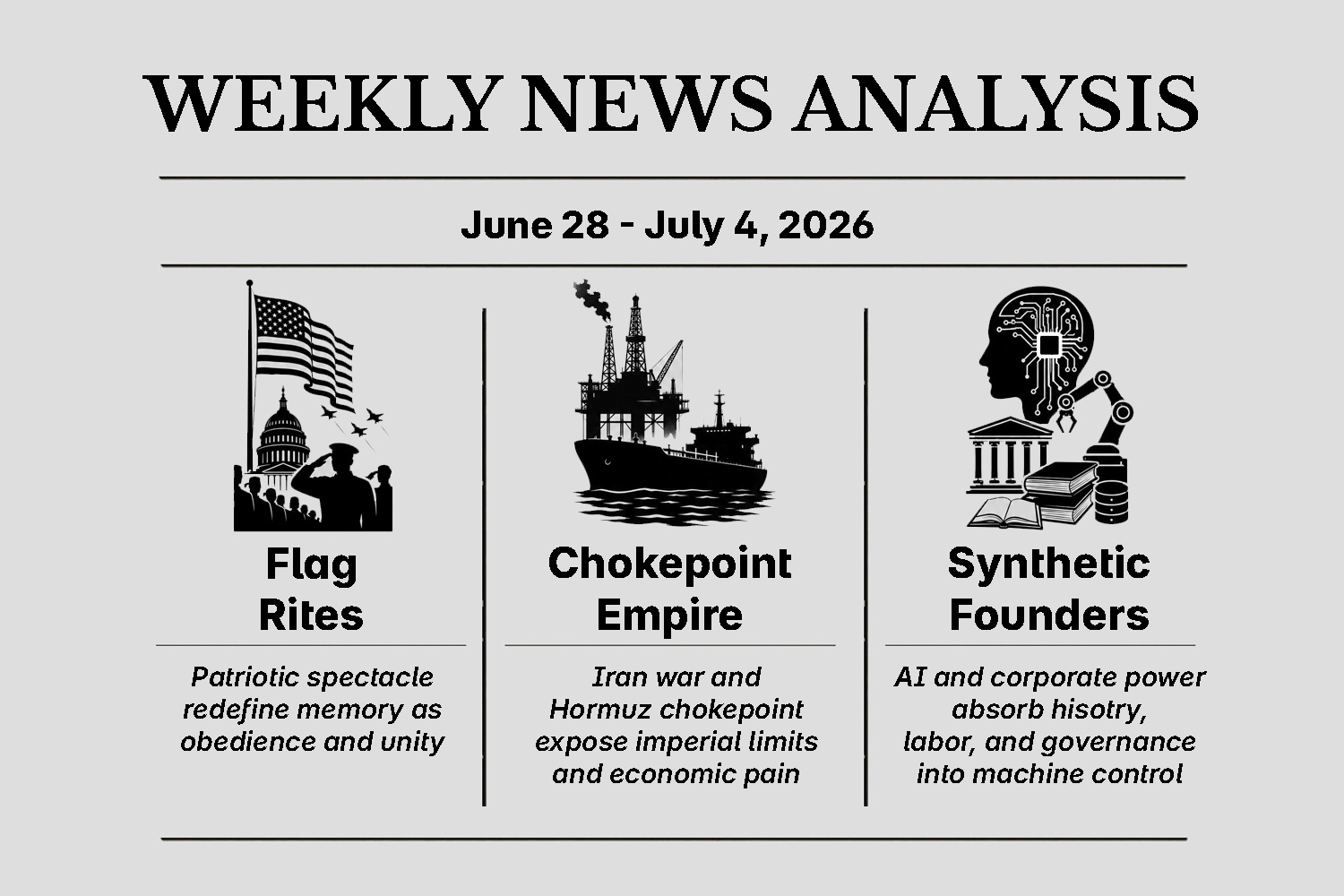
This week did more than celebrate 250 years of American independence. It staged the contradiction at the center of the American myth: a population told to salute freedom while living under an expanding architecture of surveillance, war management, economic extraction, synthetic history, and public-private control. The anniversary was packaged as unity, memory, and patriotic renewal, yet the machinery underneath told a sharper story. The flag became a screen. The classroom became a loyalty chamber. The Strait of Hormuz became an economic pressure valve. Artificial intelligence became the new priesthood of memory, policy, labor, and institutional authorship.
The pattern was not accidental. It followed the same cycle that late-stage government always follows: crisis, spectacle, subsidy, militarization, dependency, and narrative repair. Government creates or intensifies disorder, presents itself as the necessary manager of that disorder, then demands public gratitude for the rescue. In this cycle, freedom is not removed all at once. It is redefined. Patriotism becomes obedience. Savings become state-branded financial dependency. War defeat becomes “strategic success.” Artificial memory becomes national heritage. Corporate ownership becomes a public partnership. Every contradiction is resolved not by truth, but by rhetoric.
The week’s three stories formed one coherent system. The 250-year celebration converted independence into state pageantry. The Iran war and Hormuz crisis exposed the limits of imperial power while pushing economic pain back into American households. The AI stories revealed a future in which founding documents, historical portraits, robots, corporate equity, and national labor plans are absorbed into machine-managed governance. The result is not a republic renewing itself. It is a managed society being trained to confuse spectacle for liberty, inflation for prosperity, and algorithmic administration for progress.
Flag Rites
July 4 Trump Speech America 250 Live Updates - CNN
Trump to Mark US 250th Anniversary With Campaign Style Rally - CNBC
America’s Next 250 Years Begin in the Classroom - Fox News
Trump Accounts Launch July 4 - CNBC
Iran US Trump Khamenei Funeral July 4 Live Updates - Fox News
SPLC Is Back Fed Group Patriot Front Marches - The Gateway Pundit
The 250-year celebration was sold as a national birthday, but it functioned more like a loyalty audit. The official grammar was “freedom,” “founding,” “heritage,” and “future.” The operational logic was fencing, staging, military display, political branding, corporate sponsorship, and curated historical memory. Reuters described the anniversary event as a political rally on a fenced-off National Mall, with Patriot Front also arriving in Washington and with the celebration itself widely viewed as politicized. The same reporting noted that Freedom 250 had largely sidelined the older nonpartisan commission created to handle the semiquincentennial, while the event blended patriotic displays with conservative groups, defense contractors, a Ferris wheel, faith rallies, and sports spectacle. From the movie Idiocracy, it is what plants crave. That is the grammar of bread and circuses: symbols for the crowd, power for the managers, and attention captured before contradiction can mature into analysis.
The word patriot is the key to the week’s deception. In The Fallacious Belief in Government, Jeffrey Hann uses root definitions, context, and historical themes to separate two meanings that modern propaganda intentionally conflates. One meaning of patriot points toward the fellow-countryman, the supporter of the landmass controlled by the government, which in practice becomes the supporter of the governing order. Another 18th-century usage describes the patriot as a factious disturber of government, the dissenter standing against tyranny. The American Revolution was not carried out by polite flag-wavers asking the crown for better administrative customer service. It was carried out by those who became enemies of the ruling order. The modern inversion is that the state now sells obedience to its own symbols as revolutionary patriotism, while actual resistance to government control is framed as extremism, instability, domestic threat, and terrorism.
That inversion is what redcoatism means in the American context. Redcoatism is not merely loyalty to Britain; it is loyalty to the uniformed enforcement of centralized authority, regardless of which flag flies above it. Public education has long served as the nursery of this inversion. Fox News framed America’s next 250 years as beginning in the classroom, arguing that young Americans must learn founding principles, individual liberty, free enterprise, responsibility, and civic inheritance. On the surface, this sounds like civic education. Beneath the rhetoric, the question is who defines the inheritance, which contradictions are excluded, and whether children are taught to think critically or to attach moral reverence to state-approved symbols. A classroom can cultivate free minds, but government-run schooling too often cultivates manageable citizens who know the anthem before they know logic.
The American flag becomes central here because it does not float above government as a neutral abstraction. Symbolically, it functions as the state’s heraldic identity, the coat of arms for the U.S. governing order. The government has convinced the masses that the flag represents freedom, family, sacrifice, and the ordinary citizen, but its official use is attached to courthouses, agencies, uniforms, wars, embassies, police, executive offices, and military occupations. This does not mean individuals cannot attach personal meaning to it. It means the symbol has been rhetorically laundered. The same banner used to sanctify independence is also used to sanctify taxation, surveillance, foreign bombing, domestic enforcement, and debt-financed empire. When a symbol can represent both rebellion against tyranny and obedience to the institutions that now exercise tyranny, sophistry has captured the symbol to hide its real meaning.
Trump’s role in the spectacle was not an exception to this system. It was the system performing through a charismatic mask. The event was billed as the most spectacular rally of all, and the surrounding celebration blurred the line between official commemoration and campaign-style politics. That showmanship matters because late-stage government survives by replacing moral legitimacy with constant performance. The ruler must be everywhere: on the stage, in the fireworks, on the account app, in the speech, in the school lesson, in the crisis update, in the military flyover. The public is placed inside a total environment of attention. The ancient Romans did not invent bread and circuses because the empire was strong; they perfected it because the empire needed distraction from rot. The more brittle the system becomes, the louder the ceremonies become.
The launch of Trump Accounts on July 4 sharpened the contradiction. The official Trump Accounts site presents the program as a tax-advantaged investment account for minors, offering $1,000 for children born between January 1, 2025, and December 31, 2028, with optional annual contributions and automatic investment in American corporations. Functionally, it introduces a state-seeded financial identity for children at birth, placing them into a government-branded investment structure before they can understand consent, markets, debt, citizenship, or dependency. The IRS says the accounts were established under the One Big Beautiful Bill, with the $1,000 federal seed contribution available to eligible children and contributions beginning July 4, 2026. The rhetoric is financial independence. The logic is a state-branded dependency tied directly to the anniversary of independence. A government account bearing the ruler’s name, funded by public money, routed through market instruments, and wrapped in patriotic symbolism is not free-market liberty. It is nationalist social democracy wearing a red hat and waving a flag.
This is why Trump’s posture is best understood not as anti-globalist liberation, but as managed nationalist theater inside the same global control grid. The public is trained to see him as the enemy of socialism and communism, while his administration attaches children to state-seeded investment accounts, floats public stakes in corporations, expands emergency war powers, and binds citizens more deeply into public-private financial systems. The same logic applies geopolitically. Trump and Netanyahu both operate as theatrical heads of larger power arrangements, each presenting strength while serving deeper strategic designs that ordinary citizens never voted on. When rulers speak in boss language, domination becomes entertainment. The crowd cheers hierarchy because it has been trained to confuse humiliation of enemies with freedom for itself.
Patriot Front’s appearance in Washington completed the psychological tableau. Reuters reported that the white nationalist organization arrived in the capital with hundreds of uniformed members on D.C. Metro trains, while local police reported no violence. The Gateway Pundit framed the group as a suspected federal-backed operation and connected its public marches to a broader theory of manufactured extremism. The unresolved question is sponsorship and operational purpose. Yet even without proving every allegation, the function of such spectacles is obvious: masked uniforms, synchronized movement, extremist branding, left-right provocation, media oxygen, fear activation, and justification for future crackdowns. A government does not need to create every extremist group to benefit from extremist imagery. It only needs the public to associate dissent with danger, and then ask for more control.
The deeper trick is that the public is never meant to resolve the contradiction. It is meant to be emotionally inhabited. Salute the flag. Trust the school. Fear the extremists. Worship the founders. Ignore the surveillance. Praise the account. Cheer the rally. Support the troops. Believe the war is won. Repeat the anthem until the machinery underneath becomes invisible. That is the rhetoric of late-stage government: not a coherent argument, but an environment of symbolic saturation. The distinction between the redcoat patriot and the factious disturber of tyranny cuts through the fog. A real patriot, in the revolutionary sense, does not worship the government’s coat of arms. They recognize when the coat of arms has become the mask of tyranny and seek something better.
Chokepoint Empire
Fertilizer Shortage Food Prices - NPR
US Iran Deal Could Revive Trump’s Trade War - The National
Iran US War Strait of Hormuz July 1 2026 - AP
Iran Warns Ships Forceful Response US Backed Hormuz Route - Fox News
Is the Strait of Hormuz Open - Straits
Iran Was the Most Successful Failure in US Airpower History - Breaking Defense
The second story of the week showed the empire’s contradiction in military form. Trump’s rhetoric insists on total victory, settlement, dominance, and control of the clock. Fox News reported Trump saying Iran was “dying to settle,” while also describing the talks as paused during Khamenei’s funeral ceremonies and the Strait of Hormuz as remaining under ceasefire tension. The surface story is triumph. The operational story is negotiation under constraint. If a defeated enemy can still shape maritime traffic, delay talks, demand control of routes, influence oil and fertilizer markets, and force the empire into mediated discussions through Qatar and Pakistan, then “total defeat” is not an apt description. It is a morale slogan. Government speaks in absolutes precisely when reality has become conditional.
The Strait of Hormuz remains the clearest test of the claim. Straits.live stated bluntly on July 4 that the strait was not open to commercial shipping, describing it as effectively closed, with commercial transits far below pre-crisis levels, throughput at roughly one-third of typical capacity, elevated war-risk insurance premiums, and major container carriers rerouting. AP’s reporting described an initial agreement to open the strait and extend a shaky ceasefire, but also emphasized that differences over the strait remained large, Iran insisted on control over vessel routes and future fees, and warnings from Iran’s Revolutionary Guard continued. In other words, the official language of reopening collided with the commercial reality of restriction. The war was not over because the chokepoint was not normalized.
This is where Breaking Defense’s analysis is useful (if you believe it). The U.S. may have won the high-altitude air war of destruction, but Iran appears to have won the low-altitude war of disruption. The report argued that the U.S. achieved conventional airpower successes over Iran, yet failed to reopen the chokepoint that mattered most. Cheap drones, missiles, low-altitude pressure, insurance risk, port disruption, and persistent uncertainty imposed economic costs that stealth aircraft and precision strikes could not erase. This is a major imperial failure because empires are not measured only by targets destroyed. They are measured by whether trade routes remain obedient. The U.S. could strike Iran from the sky, but it could not guarantee commercial confidence through a narrow maritime artery.
The hidden premise behind Trump’s rhetoric is that destruction equals control. This is a classic military fallacy. Destroying assets does not necessarily destroy leverage, especially when the adversary’s leverage is geographic, asymmetric, and economic. Iran did not need to defeat the U.S. in a cinematic sense on a battlefield. It needed to make the victory costly, ambiguous, and politically inconvenient. That is the logic of disruption. A cheap drone does not need to win an air superiority contest; it only needs to make an insurer, shipper, port operator, or energy trader hesitate. Once hesitation becomes systemic, the global market becomes the battlefield. The empire’s aircraft can dominate the sky while losing sight of the route below.
The economic consequences are now entering the grocery aisle. Reporting on fertilizer shortages has pointed to the disruption of the Hormuz as a major source of price pressure, with fertilizer supply routes affected by the war and farmers warning that fuel and input costs could be passed on to consumer food prices. USDA-related reporting also described emergency funding and domestic fertilizer expansion efforts as responses to soaring global prices following the war in Iran, while broader food price outlooks already show pressure across several sectors. This is the Broken Window Fallacy in wartime form. Government creates or joins a destructive crisis, then announces funding, subsidies, exemptions, and emergency programs as if the intervention is economic leadership rather than damage control.
The National’s analysis sharpened the tariff dimension. It argued that any U.S.-Iran deal could revive Trump’s trade war only if oil prices remain low enough to leave room for new tariffs. If oil rises again, inflation and borrowing costs become constraints on political ambition. The article also noted that more than 1,200 cargo ships carrying an estimated $125 billion in goods were stranded during the blockade and that firms dependent on Gulf supplies of helium, fertilizer, or LNG are unlikely to return immediately to old assumptions. That means the war’s legacy is not limited to the battlefield. It changes procurement, inventories, shipping routes, investment timing, and the psychology of business risk. Individuals with this degree of control and timing awareness consistently gather money, power, and resources.
This exposes another contradiction. Trump’s public persona sells inflation as strength when it benefits asset holders, financiers, contractors, and politically connected industries, but inflation becomes a public burden when it enters food, fertilizer, fuel, housing, and debt service. A ruler who can profit from asset inflation has little reason to experience inflation as ordinary people do. For households, inflation is a silent tax. For the politically connected, it can become balance-sheet expansion. For the state, it is a mechanism of extraction because debt is diluted while dependency grows. The public is told the war is about security, the tariffs are about strength, the subsidies are about farmers, and the price increases are unfortunate side effects. The logic is always inverted: citizens pay for the crisis twice, first through taxes and debt, then through prices.
This is late-stage government moving through tyranny, not a temporary policy mistake. Tyranny is not only secret police and prison camps. It is the stage in which government power expands through emergency, debt, militarization, dependency, and managed scarcity, while still preserving ceremonial language about freedom. The American public is watching a chokepoint war become an affordability crisis, then watching the same government that helped produce the crisis offer itself as fertilizer savior, tariff manager, shipping guarantor, and diplomatic rescuer. That is the feedback loop: crisis, intervention, damage, subsidy, dependency, new crisis. The end of the lifecycle is not reached when politicians admit collapse. It is reached when collapse becomes normal administration.
The U.S. will most likely emerge weaker from this conflict regardless of the final wording of any agreement. If Iran gains route leverage, fee discussions, frozen-asset concessions, or recognition of chokepoint control, then the empire lost the war. If the U.S. resumes bombing, it risks proving that the first campaign failed to achieve political objectives. If it accepts a deal, it confirms that destruction did not remove Iranian leverage. If it keeps subsidizing farmers and managing prices, it reveals that foreign policy failure has become domestic economic policy. This is how decline looks before formal collapse: not one dramatic fall, but a series of official victories that leave citizens poorer, trade more fragile, and government more powerful.
Synthetic Founders
Freedom 250 AI Founding Fathers Portraits - CNN
New Google Commercial Imagines a Declaration of Independence Written With Help From AI - TechCrunch
LLMs Help Robots Understand Vague Instructions and Focus on Key Details - MIT News
OpenAI’s Sam Altman Wants to Negotiate 5 Stake in Company for US - Fox News
OpenAI Proposed Donating 5 of Its Equity to a US Sovereign Wealth Fund - TechCrunch
Japan AI Robots 2040 National AI Model - AI News
The third story of the week revealed the synthetic capture of memory, language, labor, and ownership. AI is no longer being framed only as a productivity tool. It is being invited into founding mythology, government commemoration, classroom history, robotics, sovereign wealth proposals, and national industrial strategy. The danger is not simply that AI makes mistakes. The danger is that institutions will use AI outputs as narrative instruments while pretending the machine is neutral. A large language model does not produce truth from nothing. It produces probabilistic output from training data, system prompts, user input, retrieval context, guardrails, and model behavior. Whoever controls those inputs controls the machine's acceptable memory.
Google’s July 4 commercial captured this shift perfectly. TechCrunch reported that the ad imagines the Founding Fathers using Google Workspace, with Google Docs edits, Calendar scheduling, Google Meet collaboration, Gemini taking notes, and AI visualization tools used around national symbols. The article noted that the ad does not quite claim AI would improve the Declaration’s text, but the premise still places AI inside the sacred scene of authorship. The rhetoric is playful. The deeper implication is not. Once the public accepts artificial assistance in the theater of founding, it becomes easier to accept artificial assistance in law, policy, public education, governance, and institutional memory. Again, the issue is who controls the tool being used, not necessarily the tool itself. The machine is introduced as a joke before it becomes infrastructure.
Freedom 250’s AI controversy showed the same danger from another angle. Historians criticized AI avatars and generated founding-era materials for creating synthetic historical narratives, with Inside Higher Ed reporting that some Freedom 250 content appeared to include narratives from Americans who could not be verified and that AI-generated founders were made to speak lines they never actually spoke. This is not a harmless branding issue. It is the corruption of historical grammar. If the first step of critical thinking is gathering accurate data, then synthetic founders and fabricated civic voices poison the input layer. Once the grammar is corrupted, logic is forced to process fiction, and rhetoric becomes propaganda dressed as heritage.
This matters because vague instructions and incomplete context are not minor AI problems. MIT’s robotics work highlighted how ambiguity affects machine behavior, showing a system in which one LLM clarifies vague human instructions and another filters out irrelevant details, enabling robots to act more safely and effectively. The research is valuable, but it also reveals the core issue: machines do not inherently understand human intention. They infer, elaborate, mask, prioritize, and execute based on design choices. In robotics, a vague request can mean the difference between safely moving a cup around a laptop and colliding with the environment. In civic history or law, a vague prompt can mean hallucinated founders, distorted legal reasoning, or artificial narratives that sound authoritative while smuggling in the assumptions of their operators.
The solution is not blind technophobia. It is guardrails, auditability, provenance, constrained use cases, adversarial testing, and human-in-the-loop control. LLMs require structured inputs, verified sources, transparent prompting, clear uncertainty handling, and strict separation between generated simulation and historical fact. When those controls are absent, hallucination becomes institutional mythology. This is especially dangerous when AI is used by governments, schools, media organizations, courts, defense contractors, or political campaigns. The public does not merely consume content; it absorbs authority cues. A founder avatar speaking confidently on a government-linked platform can carry more emotional authority than a footnoted archive. That is how synthetic rhetoric bypasses logic and goes directly to belief.
The OpenAI equity proposal adds the ownership layer. TechCrunch reported that Sam Altman proposed giving 5% of OpenAI’s equity to a U.S. sovereign wealth fund, with similar stakes from other AI corporations under discussion, while Fox News framed the proposal around negotiations for a government stake if competitors agreed to a key provision. TechCrunch also reported that OpenAI’s policy thinking includes a public wealth fund that could invest directly in AI labs and corporations deploying the technology. The rhetoric is about citizens' benefits. The structure is a fusion of state and corporate interests. The public is informed that they can benefit from AI prosperity, but the key strategy is for the government to integrate financially with the corporations creating the cognitive infrastructure of the future. By holding a stake in these corporations, the government can exert more effective control over their vast data-generating capabilities.
This is the same nationalist-social democratic pattern seen in Trump Accounts: private markets wrapped in state branding, public money routed through corporate structures, and citizens invited to feel like shareholders in systems they do not control. The state does not need to nationalize everything in old-fashioned fashion to become socialist in function. It can take stakes, create funds, direct procurement, regulate access, subsidize winners, punish dissenters, and call the arrangement a public benefit. In the AI sector, this is especially dangerous because the asset is not merely money. It is cognition, labor replacement, surveillance capacity, military automation, educational content, language mediation, and behavioral prediction. Government ownership in AI is not like owning shares in a steel mill. Partial ownership of the machinery increasingly shapes reality.
Japan’s robot strategy showed where this is heading physically. AI News reported that Japan has formally moved toward a national strategy to deploy 10 million AI-powered robots across 18 industries by 2040, backed by up to 1 trillion yen (close to $6.2 billion) over five years, with Noetra and AIST developing a multimodal “physical AI” model that can interpret language, images, video, and sensor data. The stated reasons are a labor shortage, an aging population, and national competitiveness. The deeper trajectory is the normalization of AI-controlled physical presence across restaurants, factories, medical care, elder care, logistics, and public life. Once AI leaves the screen and enters the room, the question becomes who governs the model, who owns the training data, who audits the action layer, and who is liable when machine judgment harms people.
The historical analogy is the Industrial Revolution, but with one essential difference. Industrial machines amplified human muscle under visible ownership structures. AI robots amplify institutional intention through opaque cognitive systems. A factory owner could be seen. A machine could be inspected. A manager could be confronted. But a multimodal AI model governing a fleet of robots introduces distributed agency, delegated judgment, and technical opacity. That makes accountability easier to evade. The robot “misunderstood.” The model “prioritized incorrectly.” The dataset “underrepresented edge cases.” The vendor “patched the system.” The government “reviewed the matter.” This is how responsibility dissolves into technical fog while control becomes more intimate and physical.
Across all these AI stories, the same cycle repeats: synthetic memory, synthetic labor, synthetic ownership, synthetic consent. AI is introduced as convenience, then becomes infrastructure, then becomes dependency, then becomes governance. The public is not asked whether it wants founding memory regenerated through machines, whether children should learn history through ideological avatars, whether the government should own stakes in AI corporations, or whether physical robots should enter social life under a national industrial strategy. The public is shown a commercial, given an app, offered a patriotic story, and told that the future is inevitable. That is not democratic consent. It is engineered consent, updated for the intelligence age.
Managed Republic
The week’s synthesis is stark. America celebrated independence while institutional dependency deepened. The flag was used to sanctify state power. Trump Accounts converted public money and market dependency into patriotic branding. The Iran war exposed the limits of imperial force, while inflationary pressures shifted toward fertilizer, food, fuel, and household budgets. AI entered the sacred archive of founding memory, the corporate ownership structure of sovereign wealth, and the physical labor strategy of robotized society. These are not separate developments. They are parts of one managed republic, where government and corporate power merge through symbols, crises, accounts, algorithms, and war.
The Trivium exposes the mechanism. Grammar is corrupted when words like patriot, freedom, independence, security, and innovation are detached from their meanings. Logic is broken when the public is asked to believe that a fenced political rally represents unity, that a state-branded investment account represents independence, that a failed chokepoint war represents victory, and that AI-generated founding memory represents education. Rhetoric then becomes the weapon that holds the contradictions together. The result is a population trained to respond emotionally before it reasons structurally. That is how propaganda survives: not by convincing everyone of every claim, but by exhausting the public’s ability to connect the claims before more information is presented.
The trajectory points toward digital feudalism wrapped in patriotic color. Natural rights are not openly abolished; they are rendered irrelevant. Freedom becomes access. Property becomes managed account participation. Speech becomes a platform permission. History becomes synthetic content. Labor becomes robotic deployment. War becomes economic normalization. Patriotism becomes obedience to the coat of arms of the very system that claims authority over the innocent. The next crisis will not arrive as an interruption to this system. It will arrive as its fuel. The only meaningful resistance is defining the words, exposing the fallacies, rejecting the symbols of obedience, and recovering the difference between a true patriot and a redcoat wearing the flag.
Listen to this week's news in verse for a quick recap!