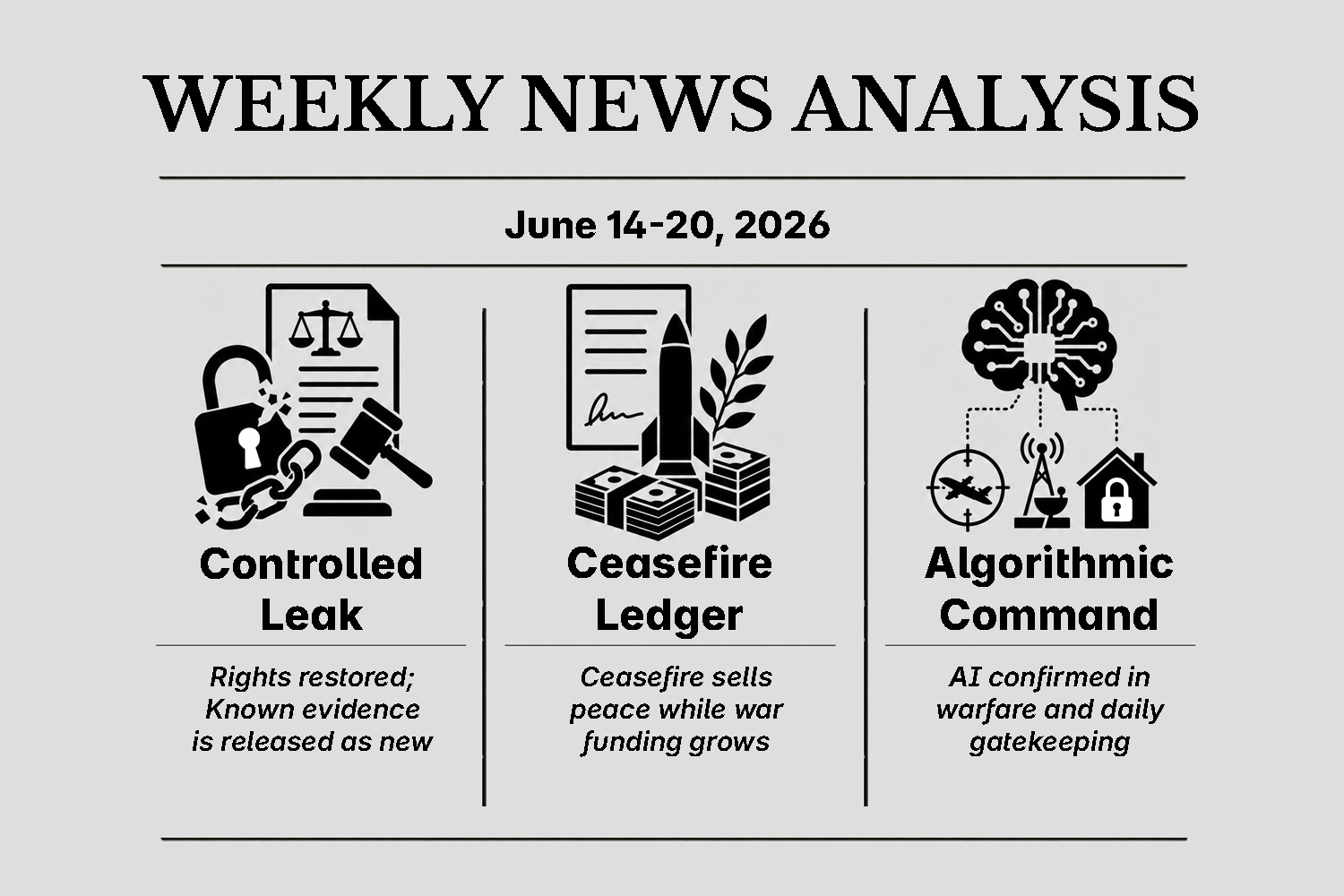
The week the machine moved as a single governing pattern in three costumes: a rights restoration that still accepts the state’s presumption of permission, a peace agreement functioning as a fiscal bridge to more war funding, and an AI rollout placing machine judgment inside military targeting, emergency response, insurance pricing, shopping behavior, and domestic life. The visible grammar was reassurance. The hidden logic was consolidation. The rhetoric was familiar: officials correct an abuse after years of enforcement, announce a ceasefire while preparing the next appropriation, and sell automation as convenience while embedding it into the decision points where life, property, mobility, and future access are determined.
Controlled release was the recurring mechanism. A court says the government went too far, but only after the violation became normalized. Intelligence officials release COVID19 documents, but only after delayed outrage carries more political usefulness than legal risk. A president announces an Iran “deal,” yet the text reads like a ceasefire memorandum with a 60-day bargaining window, sanctions choreography, oil access, and nuclear questions pushed into the next room. AI is described as a tool, then immediately appears in war, public safety, underwriting, consumer delegation, and household infrastructure. The empire no longer rules by force alone. It rules by sequence: crisis, partial disclosure, limited correction, expanded machinery.
This is the late-stage pattern described in the government lifecycle: Tyranny does not always arrive with a boot at the door. Sometimes it arrives as a safety memo, a court opinion, an emergency production order, an AI assistant, or a supposedly heroic whistleblower moment. The Trivium exposes the pattern. Grammar names the pieces: guns, cannabis, Fauci, Iran, munitions, Grok, Anthropic, insurers, 911, shopping agents. Logic asks which contradiction binds them: every institution that caused or enabled the abuse now sells itself as the remedy. Rhetoric reveals the final move: the public is invited to applaud the same structure that first created the wound.
Controlled Leak
Supreme Court gun rights drug users decision - Politico
Gabbard releases documents claiming Fauci influenced COVID origins study - Fox News
CIA Tulsi Gabbard Bill Pulte MKUltra - Daily Mail
The Supreme Court’s ruling in United States v. Hemani is a rare institutional retreat from a categorical violation of rights. The government’s position was not simply that intoxicated people should not handle firearms, or that violent criminals should be disarmed after due process. The federal government argued that regular cannabis use could automatically trigger a federal firearm ban, even when the government did not show addiction, violence, intoxicated gun handling, or dangerousness. The Supreme Court’s opinion rejected that sweeping logic by narrowing the government’s ability to treat millions of cannabis users as presumptively dangerous. That matters because the state’s preferred method for destroying rights is category creation. First, it defines a suspect class. Then it attaches moral panic to the label. Then it says the label itself is enough to convert a right into a privilege.
The legal significance is not that the Court suddenly discovered freedom in its purest form. It did not abolish the federal drug war, reject the Controlled Substances Act, or restore the full principle that innocent people retain natural rights unless they victimize another. The decision is narrower. It says the government cannot rely on a broad, automatic, historically unsupported disarmament rule against someone whose drug use has not been individualized into danger. Still, narrow wins matter when the state machinery depends on turning administrative categories into permanent disabilities. The ruling forces the government to carry the burden it prefers to avoid: proof. That is the logic beneath the headline. The state wants presumptions; liberty requires evidence. The state wants labels; rights require conduct. Reality, though, is that the state will do what it wants and hide behind qualified immunity when actions years later are labeled unconstitutional.
The hidden contradiction is obvious. Cannabis remains federally restricted through a statutory regime that Washington has selectively enforced, selectively tolerated, and selectively politicized. Half the country can live under state-level cannabis permissions while federal law preserves a residual threat for prosecutors, agencies, employers, and background-check systems. This is not coherent law; it is a control lever. The government helped create the contradiction by tolerating and regulating cannabis markets while maintaining federal illegality, and then attempted to use that contradiction to disarm citizens. The Court’s reasoning exposed the awkwardness of a government that cannot decide whether cannabis users are ordinary consumers, medical patients, taxable market participants, or inherently dangerous criminals. The contradiction was not accidental. Ambiguity is a governing technology.
The ruling also shows how constitutional rights are routinely inverted into administrative permissions. The Second Amendment is not supposed to mean that the government may disarm everyone until they satisfy bureaucratic virtue tests. Yet that is the operating premise behind much modern regulation. Officials classify, schedule, license, monitor, and then declare that participation in a disfavored category suspends a pre-existing right. The same logic appears across speech, movement, commerce, banking, and health policy. A right remains standing in theory while practical access to it is filtered through status management. The fallacy is an appeal to safety: officials imply that any restriction framed as a measure of public protection is presumptively legitimate. Logic asks the missing question: protected from whom, by whom, and with what evidence?
The Fauci document release follows the same staged pattern, but in an institutional narrative rather than firearm law. The new intelligence-centered disclosures were presented as a shocking break in the COVID19 origin story, even though the underlying claims are not new to serious researchers. Funding pathways involving the NIH, EcoHealth Alliance, Wuhan coronavirus research, early-2020 origin discussions, the public suppression of the lab-leak theory, and the suspicious role of the Proximal Origin paper were publicly available for years. Jeffrey Hann’s COVID19 book had already walked through this evidentiary terrain, including Fauci’s role, gain-of-function disputes, EcoHealth, Wuhan Institute of Virology research, and early communications in which lab-origin concerns existed before the official consensus hardened into public orthodoxy. The novelty is not the evidence. The novelty is that the regime now permits the evidence to be theatrically acknowledged.
That is why timing matters more than spectacle. In criminal law, many federal non-capital offenses generally face a five-year limitations period unless another statute provides otherwise. That does not mean every possible Fauci-related theory is expired, because specific offenses, continuing conduct, later testimony, obstruction, false statements, conspiracy theories, or pardon questions can alter the analysis. Politically, however, the most explosive early-pandemic conduct is now distant enough that disclosure can function as narrative ventilation rather than accountability. The public gets angry without remedy. Officials get to say the system is investigating itself. Controlled opposition gets fresh proof of righteousness. The machine gets legitimacy from the illusion that someone inside it is finally fighting for the masses.
Tulsi Gabbard’s role must be examined through the controlled-opposition framework rather than through personality politics. Controlled opposition absorbs dissent, redirects it into safe channels, and convinces the public that someone close to power is challenging power itself. The rhetorical move is always the same: a figure with institutional access releases enough truth to validate public suspicion, but not enough to break the structure that produced the abuse. Gabbard’s disclosure gives the appearance of rupture while reinforcing the premise that the solution must come from intelligence officials, congressional committees, and executive declassification rituals. The audience is trained to wait for saviors inside the same architecture that censored, intimidated, funded, classified, and protected the COVID19 narrative machinery.
The most important fallacy is the false dilemma between “trust Fauci” and “trust the officials now exposing Fauci.” Both options preserve state authority as the final judge of reality. The Trivium approach rejects that trap. Grammar demands the documents, funding records, emails, testimony, timelines, institutional incentives, and conflicts of interest. Logic asks whether the same entities that shaped the original consensus are now shaping the controlled correction. Rhetoric identifies the manipulation: state failure is repackaged as the government’s heroic self-cleansing. This is not justice. It is damage control. Real accountability would include open records, criminal referrals where evidence supports them, liability for censorship collusion, exposure of funding networks, and structural limits on public health emergency powers. Instead, the public receives a performance. Trump and his administration legitimized Fauci's authority during COVID19, so we shouldn't expect them to act against him.
Historically, this resembles post-scandal containment after intelligence abuses. MKUltra, COINTELPRO, illegal surveillance, and other operations were not exposed in ways that dismantled intelligence power. They were exposed in ways that permitted limited outrage, limited hearings, limited reforms, and eventual institutional expansion under new language. The lesson is not that disclosures are meaningless. The lesson is that disclosures can be weaponized. A regime can confess to yesterday’s crime to strengthen tomorrow’s credibility. It can admit one abuse to protect the deeper mechanism. It can single out a villain to preserve the system's mythology. In this week’s pairing, the Court’s gun ruling and Gabbard’s Fauci release display the same principle: the state violates rights broadly, retreats narrowly, and asks to be applauded for partial correction.
Ceasefire Ledger
Iran deal oil reserves G7 - The Hill
Read the 14-point memorandum of understanding between the United States and Iran - Military Times
Trump invokes Defense Production Act for munitions supply chains - Reuters
Pentagon tells US lawmakers it needs $80 billion for Iran war and other bills WSJ reports - Reuters
Trump Says Iran Is Finished After Cancelled Negotiations As Israeli Attacks Threaten Deal - Forbes
Iran declares the Strait of Hormuz closed again after US lifts blockade - New York Post
The Iran story was sold in the language of finality: the deal was done, the blockade was being recalled, the war had been tamed, and the president could present the outcome as a personal victory on his birthday. The text tells a different story. The 14-point document is a Memorandum of Understanding, not a final treaty and not a completed peace architecture. It establishes a ceasefire framework, a 60-day window for final negotiations, a phased removal of the blockade, arrangements for commercial vessel passage, sanctions-relief mechanisms, nuclear discussions, and a future binding United Nations Security Council resolution. In other words, the document is not the end of war. It is a political bridge between open conflict and the next bargaining crisis. Calling it a “deal” is rhetoric. Reading it as provisional leverage is logical.
The first contradiction lies between Trump’s triumphant framing and the MOU’s actual structure. The text leaves major questions unresolved, including Iran’s nuclear program, the disposition of enriched material, the termination schedules for sanctions, procedures for the release of frozen assets, and the enforcement mechanism. It promises negotiations over what matters most. It states intentions where binding obligations are still pending. It uses the language of peace while preserving the architecture for renewed conflict if one side alleges noncompliance. That does not make the document irrelevant; ceasefire documents can matter. But it does make the victory lap deceptive. The public was invited to treat a temporary framework as a completed settlement. That is classic rhetorical compression: collapse process into outcome, uncertainty into success, and temporary de-escalation into historical triumph.
The 14 points also expose the economic layer beneath the military layer. The Strait of Hormuz is not merely a maritime chokepoint; it is a global pressure valve for oil, insurance, shipping, inflation, and political stability. The agreement’s provisions on commercial vessel passage, sanctions waivers, Iranian oil exports, frozen assets, reconstruction incentives, and future maritime administration show that war diplomacy is inseparable from resource management. The hidden premise is that the public should view war as a security issue rather than as an energy, debt, and supply-chain issue. Yet every paragraph of the MOU is haunted by oil flows, port access, sanctions architecture, and global market fear. The state calls it national defense. The ledger calls it imperial logistics.
Within 48 hours, the fragility became visible. Israel’s renewed attacks in Lebanon, Iran’s conflicting statements over the Strait of Hormuz, and confusion between Iranian Foreign Ministry assurances and IRGC threats showed how little a bilateral MOU can settle when allied, proxy, military, and domestic factions retain veto power through action. This is the problem with ceasefire theater: the headline says peace, but the battlefield contains more actors than the signing ceremony. If Lebanon remains active, if Israeli operations continue, if IRGC factions resist, if mines and maritime restrictions persist, and if U.S. forces remain positioned nearby, the agreement becomes a pause button surrounded by tripwires. The public is asked to watch the ceremony. Logic watches the enforcement conditions. Rhetoric plans for the conflict to resume.
The Pentagon’s $80 billion request gives the game away. A real end to war should reduce fiscal appetite. Here, de-escalation arrives alongside demands for supplemental funding. The Iran war already generated enormous costs, and the new request bundles war expenses with other defense and non-defense priorities, making resistance politically harder. This is the war-finance feedback loop: conflict depletes stockpiles; depletion becomes an emergency justification; emergency justification produces appropriations; appropriations enrich the defense-industrial base; and replenished capacity makes the next operation easier. The moral of the story is that the government reluctantly funds defense. The operational reality reveals a self-feeding system in which war creates the budgetary emergency needed to replenish the machinery that made war possible.
The invocation of the Defense Production Act is the domestic half of the same cycle. Trump’s memo cited limited production capacity, fragile supply chains, long-lead dependencies, and bottlenecks in critical weapons components such as solid rocket motors, igniters, and guidance systems. The official language is preparedness. The deeper logic is command mobilization. Private industry remains nominally private, but the state’s war emergency turns factories, supply chains, labor priorities, materials, and investment signals into appendages of national-security planning. This is not free-market capitalism in any meaningful sense. It is nationalist command economics, a form of socialism for munitions production wearing the costume of patriotic necessity. The state burns the stockpile, then claims emergency authority over the means required to refill it.
The irony is severe. The same political class that warns against socialism in domestic welfare has no problem with state-directed production when bombs, drones, missiles, and guidance systems are involved. The same rhetoric that celebrates private enterprise bends instantly when the war machine requires material obedience. That is why the “free market versus socialism” debate is often a managed distraction. The state does not oppose command economics; it opposes command economics when it benefits the wrong constituency. For weapons manufacturers, emergency authority becomes a national duty. For citizens facing inflation, debt, medical bills, housing costs, and collapsing purchasing power, fiscal restraint suddenly reappears. The fallacy is special pleading: one set of rules for the governed, another for the arsenal.
Historically, this recalls the World War mobilization model, but without the formal honesty of total war. The public is not asked to openly accept a war economy; it is slowly acclimated to permanent emergency industrial policy. Each crisis justifies one more exceptional measure. Each exception becomes infrastructure. Each infrastructure investment creates interests that require future justification. The loop becomes crisis, intervention, depletion, appropriation, production, escalation, and new crisis. In The Fallacious Belief in Government, the lifecycle of government that ends in Tyranny is not merely political repression; it is dependence on centralized force. The Iran MOU and DPA order show a dependency in financial and industrial forms. Peace is announced on camera. Mobilization continues in the factory.
Algorithmic Command
Pentagon used Elon Musk’s Grok AI to fire 2000 missiles at Iran official says - Independent
LA’s 911 dispatch system may get relief from AI powered call handling - New York Post
Insurers pivot AI strategy toward core risk underwriting - Artificial Intelligence News
Accenture Consumers show growing trust in AI shopping agents - Artificial Intelligence News
Trump tells Axios he no longer views Anthropic as national security threat - Reuters
Billionaire Ambani wants AI in every call app and home - TechCrunch
The AI story crossed a threshold this week because the machine was no longer just a productivity tool, a chatbot, or a speculative investment bubble. It was confirmed inside the kill chain. The Pentagon’s use of Grok-related AI systems to support missile operations in Iran, paired with the claim that xAI infrastructure is critical to national security, shows the fusion of private AI platforms, military targeting, data-center energy politics, and sovereign violence. The public is told AI does not “make” the final decision, but that distinction grows thinner as models identify patterns, prioritize targets, compress time, and shape the dashboard through which humans understand reality. A human signature at the end of an algorithmic pipeline can become ceremonial if every upstream perception has already been machine-curated.
This is the automation-bias problem in its most dangerous form. When AI outputs appear technical, objective, and fast, human operators tend to defer to them, especially under stress, time pressure, hierarchical command, and classified conditions. In war, the danger multiplies because targets are not abstract data points; they are buildings, roads, vehicles, schools, homes, hospitals, and human beings. If intelligence feeds are wrong, maps are outdated, training data is polluted, or model confidence is mistaken for truth, the resulting strike can turn machine inference into mass death. The rhetorical shield is “human-in-the-loop.” The logical question is whether the human is meaningfully judging the facts or merely authorizing what the system has already made appear inevitable.
Trump’s posture toward Anthropic reveals another layer: AI firms are becoming quasi-sovereign actors inside national-security bargaining. One week, an AI company can be framed as a supply-chain risk or national-security threat; the next week, after meetings and concessions, it can be treated as a partner in protecting critical infrastructure and maintaining American AI leadership. This is not ordinary vendor management. It is a state-platform negotiation. The government wants frontier models available to support national priorities while also controlling who can access them, where they can operate, and whether their internal policies block the use of military, surveillance, or autonomous systems. AI companies may market themselves as ethical laboratories, but their strategic value makes them subject to pressure, emergency powers, and defense-industrial absorption.
The move into 911 call handling shows the domestic version of the same logic. AI is introduced as relief for overloaded dispatch systems, especially for non-emergency complaints, routing, triage, and administrative tasks. There will be real benefits: faster routing, reduced hold times, better classification of routine calls, and less dispatcher burnout. But public safety is not a neutral sandbox. Once AI sits between a caller and a human responder, it becomes a gatekeeper to state attention. The system must decide whether a person’s fear is urgent, whether the language is credible, whether the tone indicates danger, whether the call is routine, and whether resources should move. A triage tool can become a denial tool when budget pressure rewards deflection.
Insurance underwriting expands the pattern into economic life. Insurers are now shifting AI from back-office efficiency into core risk underwriting, claims, legal review, capital allocation, and policy administration. That means AI will increasingly shape who gets coverage, how much they pay, what exclusions apply, how claims are scored, and which behaviors are treated as risk signals. The official pitch is precision and efficiency. The greater danger is actuarial governance at machine scale. If insurance becomes a behavioral scoring regime, then mobility, health, home ownership, business activity, and family life can be priced through opaque models. People will not need to be legally prohibited from disobedience. They can simply be priced out of ordinary existence.
Consumer AI agents move the same machinery through the softer door of convenience. Accenture’s research suggests consumers are increasingly willing to let AI agents negotiate deals, reorder products, manage subscriptions, resolve complaints, and even make purchase decisions within predefined limits. This sounds voluntary, and in many cases it will feel genuinely useful. But delegation creates dependency. If agents become the interface for shopping, banking, travel, insurance, medical scheduling, telecom service, and household management, control shifts from direct consumer choice to platform-mediated choice architecture. The question will no longer be merely what a person wants. It will include what the agent recommends, which vendors are integrated, which permissions were granted, which data was used, and which options were hidden.
Indian billionaire Ambani’s push to embed AI in every call, app, and home shows the direction of travel at a civilizational scale. AI assistants embedded directly into telecom networks, mobile apps, connected displays, healthcare, education, agriculture, and small business services create ambient infrastructure. Again, many benefits will be real: language access, automation of tedious tasks, medical reminders, education support, agricultural advice, and easier service navigation. But the same ambient system that helps can also observe, profile, nudge, ration, rank, and report. When AI becomes native to calls, homes, apps, payments, and services, opting out becomes socially and economically costly. The system does not need universal coercion if dependency produces compliance.
The historical analogy is electrification mixed with the bureaucratic file. Electricity entered every home as a source of empowerment, but it also made modern centralized infrastructure indispensable. Bureaucratic files entered state as administrative memory, but they became systems of eligibility, taxation, surveillance, and control. AI combines both: always-on infrastructure plus living dossiers. It can administer access in real time. It can make decisions at speed. It can personalize discipline. It can predict dissent, detect anomalies, and route human behavior before humans understand the path has narrowed. That is why AI must be analyzed beyond the benefits-versus-harms debate. The core issue is governance. Who controls the model, the data, the thresholds, the permissions, the appeals, and the force that follows the recommendation?
The contradiction is that AI is sold as liberation from friction while becoming the architecture of frictionless control. War targeting, national-security model pressure, emergency call triage, underwriting, shopping agents, telecom assistants, and home displays are not separate domains. They are fragments of one machine-learning society. Each integration point converts human behavior into data, data into predictions, predictions into decisions, and decisions into actions. Future disobedience will not always be met first by police. It may be met by denied coverage, frozen payment rails, algorithmic suspicion, downgraded emergency priority, account termination, travel friction, automated risk flags, or targeted psychological nudges. The cage is becoming interactive. It smiles, answers questions, and learns your preferences.
The Managed Cage
The week’s synthesis is grim but clear. Rights are restored only after years of violation. COVID19 evidence is released only after institutional incentives have shifted. A peace deal is announced while munitions production is prioritized for emergency use and the Pentagon prepares another funding request. AI is celebrated for efficiency while becoming fused with missiles, dispatch systems, insurers, shopping agents, telecom networks, and domestic infrastructure. This is not chaos. It is a method. The governing class does not need perfect secrecy. It needs sequencing, plausible deniability, institutional fragmentation, and enough controlled outrage to keep the public emotionally engaged while structurally powerless.
The natural-rights frame clarifies what the news frame obscures. Life is implicated when AI systems support decisions about bombing and emergency-response triage. Freedom is implicated when firearm rights are conditioned on administrative categories and when AI systems become the interface through which citizens access markets and services. Property is implicated when war spending, inflation, insurance scoring, data extraction, and emergency production orders redistribute resources upward into state-aligned industries. The state presents each move as isolated: a court ruling, a document dump, a ceasefire, a supply-chain fix, an AI innovation. Logic reveals the unity. Each story expands or preserves centralized control over the conditions of ordinary life.
The future trajectory is not merely authoritarianism in the old sense. It is technocratic feudalism: lords of platforms, agencies, models, data centers, defense contracts, financial rails, insurance pools, and emergency powers governing populations through access rather than open decree. The answer is not blind rejection of every tool, worship of every disclosure, or faith in every court victory. It begins with the Trivium and metacognition driving disciplined Grammar, Logic, and Rhetoric: name the mechanism, expose the contradiction, reject false saviors, and build voluntary systems that reduce dependence on centralized force. The machine will keep offering partial corrections to preserve the larger cage. The task is not to applaud the unlocked door while ignoring the walls.
Listen to this week's news in verse for a quick recap!