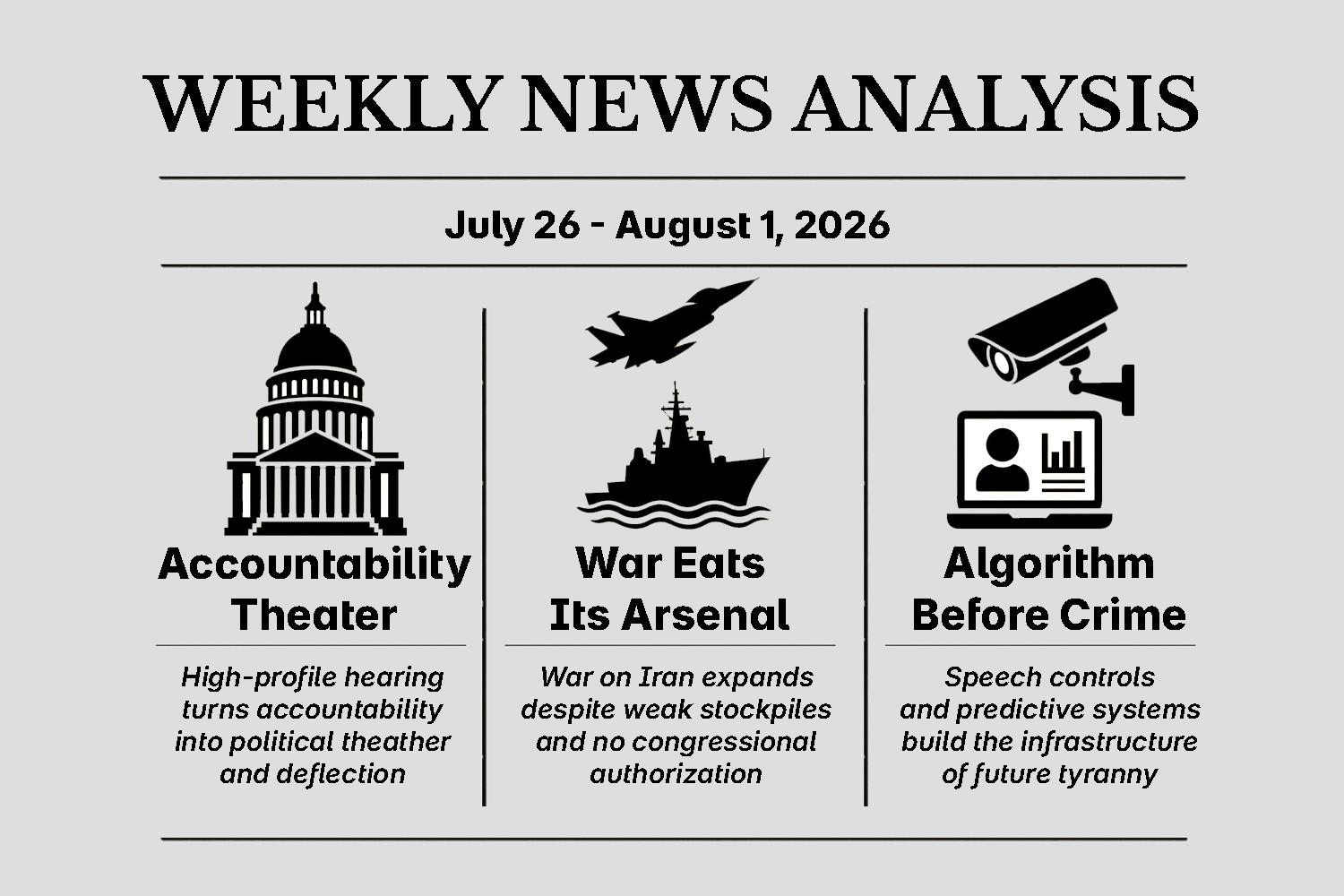
Three distinct performances this week reveal a government machine attempting to manufacture its own legitimacy. In Washington, Anthony Fauci’s invocation of the Fifth Amendment was presented as proof that the political system is finally confronting the institutional failures and deceptions of the COVID19 era. Across the Middle East, continuing attacks on Iran were wrapped in the language of victory, necessity, and endurance, even as military stockpiles declined and the conflict widened into shipping lanes and neighboring countries. In Argentina and the U.S., political figures who market themselves as enemies of globalism advanced systems that classify speech, predict criminality, collect behavioral data, and expand algorithmic control. These events appear separate only at the surface. Beneath them operates the same mechanism: government creates or exploits a crisis, promises accountability or protection, expands its authority, and then presents that expansion as evidence that the institution remains necessary.
The Trivium exposes the machinery beneath the performance. Grammar begins by identifying what occurred rather than accepting the labels placed over it: Fauci answered questions by refusing to answer them; Congress threatened consequences while confronting the boundaries created by an extraordinarily broad presidential pardon; Trump spoke of winning a war that Congress never formally authorized; Milei defended liberty while issuing an emergency decree permitting punishment for undefined speech; and the FBI pursued technology intended to identify threats before any crime had occurred. Logic then reveals the contradiction between the stated justification and the operational result. Rhetoric completes the cycle by recasting institutional self-protection as “accountability,” endless warfare as “victory,” surveillance as “safety,” and censorship as “defense of the nation.” What remains is not three isolated controversies but a single governing philosophy: authority must be trusted to investigate itself, restrain itself, and determine which innocent people may be treated as future threats.
Accountability Theater
Anthony Fauci COVID Wuhan lab leak revelations - Daily Mail
Dr Fauci refuses COVID19 questions and invokes the Fifth Amendment - Daily Mail
Can Dr Fauci still be held accountable - The Gateway Pundit
Gavi funding restored after thimerosal agreement - POLITICO
The Senate hearing examined Fauci’s COVID19-era communications, the origins of SARS-CoV-2 (COVDI19), federal funding connected to coronavirus research, the drafting and promotion of the natural-origin narrative, and the influence Fauci exercised over lockdowns and school closures. Senator Rand Paul also cited entries from Fauci’s newly released diary to challenge discrepancies between his private observations and prior public testimony. Instead of resolving those questions, Fauci invoked the Fifth Amendment repeatedly—reportedly more than one hundred times—while dismissing Paul’s investigation as an “unhinged obsession.” The spectacle proved politically useful because every participant could resume a familiar role: Paul became the relentless investigator, Fauci the persecuted scientific authority, and the Senate the stage upon which accountability supposedly occurs. Yet refusing to testify does not establish guilt, just as convening a congressional hearing does not establish that justice will follow. What the hearing produced was suspicion, confrontation, and televised conflict—not a conclusive determination of the virus’s origin or criminal responsibility.
Much of the information promoted as newly explosive already belonged to the evidentiary record described in COVID19 – Short Path to 'You’ll Own Nothing. And You’ll Be Happy.', published in February 2023. The book examined February 2020 communications in which scientists advising Fauci expressed concern that features of the virus appeared inconsistent with ordinary natural evolution. It also addressed the later publication of The Proximal Origin of SARS-CoV-2, Fauci’s public support for a natural spillover explanation, Peter Daszak’s correspondence thanking Fauci for countering the laboratory-origin theory, National Institutes of Health funding routed through EcoHealth Alliance, and earlier coronavirus experiments involving Ralph Baric and Shi Zhengli. The diary disclosures and hearing testimony did not suddenly create the laboratory-origin question. Instead, they granted official permission to discuss a question that had been censored, stigmatized, and labeled misinformation when examining it carried a much higher political cost. The revelation is not that the evidence suddenly became new, but that the permissible boundaries of public discussion have moved.
Journalistic Revolution has maintained since December 2019 that the available circumstances pointed toward a man-made virus and a research-related incident rather than an ordinary animal-to-human jump. From the beginning, the absence of a confirmed intermediate host, the outbreak’s proximity to a laboratory conducting coronavirus research, documented interest in manipulating spike proteins, and the private doubts expressed by scientists made the laboratory hypothesis legitimate. Critical analysis, however, still requires separating a strongly supported hypothesis from a conclusively proven event. The hearing produced no laboratory sample, complete chain of custody, authenticated incident report, or direct testimony establishing precisely how SARS-CoV-2 emerged. Ignoring that distinction would repeat the same appeal-to-certainty once used by officials who treated natural origin as settled fact. The deeper indictment is the suppression of inquiry: officials and media institutions attempted to transform uncertainty into orthodoxy, then treated dissent from that orthodoxy as a moral and social offense. The manipulation operated not only through what was asserted, but through what the public was forbidden to question.
The likelihood of Fauci facing meaningful punishment remains low. President Joe Biden’s January 2025 pardon covered potential federal offenses arising from Fauci’s public service between January 1, 2014, and January 19, 2025. That protection does not necessarily immunize state offenses, conduct outside the specified period, or a new act such as lying under oath after the pardon. Congress may pursue contempt proceedings, while legislation introduced after the hearing would attempt to bar officials who obstruct congressional investigations or commit perjury from future federal employment. These measures, however, are narrow beside the institutional questions being raised. A lifetime federal employment ban imposed on a retired official would operate mainly as a symbolic sanction, and a contempt referral would still rely on federal prosecutors and courts embedded within the same system under examination. The pardon does not render every conceivable prosecution legally impossible, but it makes broad federal accountability for Fauci’s COVID19-era conduct extraordinarily difficult.
This is the architecture of a limited hangout. The institution releases selected information, stages visible conflict, surrenders part of the official narrative, and uses the performance to restore confidence in itself. The public is encouraged to believe the system works because a senator asked hostile questions, documents were released, and legislation was introduced. Beneath that conclusion rests an unproven premise: the same political structure that financed the research, protected pharmaceutical corporations, imposed mandates, censored dissent, and pardoned central officials can independently judge its own conduct. A hearing may expose genuine contradictions, but exposure without enforceable consequences becomes another instrument of management. Public anger is channeled into congressional theater while the agencies, funding mechanisms, liability protections, emergency authorities, and public-private partnerships that made the COVID19 response possible remain intact. Government restores legitimacy by prosecuting one face of the system while preserving the powers beneath it.
Fauci’s earlier record during the HIV and AIDS crisis deepens the controversy because the COVID19 dispute did not arise in a historical vacuum. Hann’s book examined Fauci’s support for aggressive antiretroviral policies, including the use of azidothymidine, or AZT, and cited research identifying cellular toxicity at therapeutic concentrations. It also described the anger of AIDS activists who accused federal health authorities of controlling access to treatment, privileging pharmaceutical approaches, and treating desperate patients as subjects within a bureaucratic research regime. The book places those policies inside a broader pattern in which public funding, pharmaceutical patents, royalties, regulatory authority, and claims of scientific necessity reinforce one another. Assigning a precise number of deaths personally and exclusively to Fauci would require causal evidence beyond what the hearing established, and estimates asserting that he directly caused tens of thousands of deaths remain contested. The defensible charge is structural: policies promoted under his authority affected millions, carried grave risks, and were insulated from ordinary accountability by institutional prestige and emergency rhetoric.
Donald Trump’s attempt to separate himself from Fauci depends on political amnesia. Fauci did not independently seize control of the federal COVID19 response. Trump appointed him to the White House Coronavirus Task Force, repeatedly praised his expertise, amplified his recommendations, and made him one of the most recognizable representatives of federal pandemic policy. Trump also launched Operation Warp Speed, directed enormous public resources toward accelerated vaccine development and distribution, and continues to describe the program as one of his administration’s greatest achievements. Whatever disagreements later emerged over reopening, therapeutics, mandates, or public messaging, Fauci operated within an executive structure Trump created and empowered. Scapegoating Fauci permits Trump to preserve the heroic narrative of Warp Speed while transferring responsibility for lockdowns, school closures, censorship, and medical coercion to unelected bureaucrats. Personality-driven supporters accept the contradiction because political loyalty reverses the burden of proof: actions condemned under an opposing administration become excusable when performed by the favored ruler.
The Gavi funding agreement supplied a second performance of accountability. The Trump administration released approximately $600 million in previously withheld taxpayer funding after Gavi said it would transition away from vaccines containing thimerosal, a preservative that contains ethylmercury. The public side of the exchange was immediate and enforceable—the money was released—while Gavi’s concession remained a future transition with no clearly reported deadline, penalty schedule, restitution requirement, or automatic repayment mechanism. That asymmetry matters regardless of the scientific debate over thimerosal, which has largely been removed from routine childhood vaccines in the U.S. Officials exchanged real taxpayer money for a verbal commitment, then presented the transaction as a victory without constructing meaningful accountability. The agreement also leaves unresolved the separate concerns surrounding mRNA technology, informed consent, adverse-event transparency, liability protection, and the use of emergency authority to pressure medical compliance.
The final connection is surveillance. Flock Safety’s automated license-plate readers existed before COVID19, but the pandemic accelerated the normalization and public financing of systems capable of continuously tracking movement. Local governments and police departments used federal COVID relief money to purchase surveillance equipment, including automated plate readers, converting emergency health spending into permanent law-enforcement infrastructure. Flock’s expanding network can generate alerts, search historical vehicle movements, and share information across jurisdictions, while documented inaccuracies and wrongful identifications reveal that algorithmic certainty is frequently an illusion. In a future pandemic, infrastructure used today to search for stolen vehicles could be repurposed to enforce quarantines, identify travel outside approved zones, track gatherings, or locate individuals designated as public-health threats. The danger is not the camera by itself, but the merger of ubiquitous collection, centralized databases, artificial intelligence, and emergency authority. As The Fallacious Belief in Government warns, technology sold as security can become an enforcement mechanism that reduces accountability and attacks Life, Freedom, and Property.
War Eats Its Arsenal
Trump warns Iran fighting is not over as he vows the US will win - Fox News
Weapons stockpile shortages impacting military strategy in the Mideast - Fox News
Senate rejects effort to restrict Trump’s Iran war powers - The Guardian
US launches another round of attacks on Iran - Al Jazeera
Iran strikes tankers under US escort in Hormuz as Trump gathers cabinet - The Guardian
Trump’s promise that the U.S. will “win” against Iran demonstrates the elasticity of political rhetoric. Victory has been given no measurable definition, geographical boundary, political endpoint, or public cost ceiling. Trump told Americans to expect continued fighting while predicting that Iran would eventually “peter out,” presenting escalation and exhaustion as evidence of strategic control. The hidden premise is that military superiority automatically yields a stable political outcome. Iraq, Afghanistan, Libya, Syria, and decades of intervention demonstrate otherwise. A state can destroy command centers, air defenses, naval assets, and civilian infrastructure without producing surrender or lasting peace. Once victory remains undefined, every additional attack can be called progress, and every retaliation becomes proof that more force is necessary. The war thus protects itself from falsification: if Iran resists, the U.S. must strike harder; if Iran weakens, the strikes are working; and if negotiations fail, Iran is blamed for making further attacks unavoidable.
This week’s attacks widened the operational geography of the conflict. After a temporary pause, the U.S. launched another heavy wave of strikes targeting military facilities, missile and drone infrastructure, coastal defenses, and maritime capabilities. Iran continued missile and drone attacks as the war increasingly drew in Jordan, Kuwait, Gulf shipping, and other regional actors whose territory, bases, or airspace became part of the conflict. Civilian casualties and damage were reported beside military targets, while every government described its own actions as defensive retaliation. This is how regional wars metastasize: each participant claims to be responding to an earlier aggression, transforming events into an endless chain without an acknowledged initiator or stopping point. The language of retaliation outsources moral responsibility because leaders no longer need to defend war as a deliberate choice. They need only insist that the enemy made the next attack unavoidable, even as each supposed defensive measure expands the battlefield and creates new targets for retaliation.
The Senate’s 49–50 rejection of a War Powers resolution exposed the constitutional theater beneath the military theater. The resolution would have required the withdrawal of US forces from hostilities not authorized by Congress, yet the majority needed to restrain the executive branch never appeared. The conflict had already continued for approximately five months, far beyond early predictions that the military phase would last only a few weeks. Eighteen American service members had reportedly died, hundreds had been wounded, and the Pentagon was seeking tens of billions of dollars beyond the enormous cost already accumulated. Congress formally retains the power to declare war, control appropriations, and limit executive action, but legislators repeatedly surrender those powers once hostilities begin. They then conduct votes designed to display concern without stopping the operation. The executive initiates violence, Congress finances it, and both branches later claim that the momentum of war has narrowed their available choices.
The depletion of American interceptor stockpiles reveals another contradiction. Military planners have depended heavily on Patriot and Terminal High Altitude Area Defense systems to counter Iranian missiles and drones, yet estimated inventories have fallen sharply. Reporting based on military analysis suggested Patriot availability had declined by roughly 65 percent and THAAD availability by approximately 38 percent, forcing planners to ration interceptors, accept greater risk, or allow weapons judged unlikely to strike critical targets to pass without engagement. The Pentagon publicly insists that the U.S. retains robust capabilities while simultaneously seeking enormous replenishment packages and long-term production increases. Both claims may be technically true—the military can remain powerful while consuming scarce systems faster than industry can replace them—but the rhetoric conceals the strategic tradeoff. Every interceptor fired in the Middle East becomes unavailable for Europe, the Pacific, or homeland defense, turning one regional war into a constraint upon every other military commitment.
Shortages weaken national readiness differently than they weaken the military-industrial system. Depletion supplies the political justification for larger contracts, expanded factories, multiyear procurement, emergency appropriations, and looser oversight. A reported multibillion-dollar effort to increase Patriot missile production demonstrates how destruction becomes an industrial demand signal. This is the Broken Window Fallacy applied to war: weapons are expended, inventories contract, factories receive new orders, employment and corporate revenue rise, and politicians describe replacement spending as economic strength. Yet the resources used to rebuild the arsenal cannot simultaneously repair bridges, reduce public debt, improve water infrastructure, or remain with the people who earned them. A destroyed interceptor does not create wealth merely because another corporation is paid to replace it. War transfers wealth from taxpayers to contractors while manufacturing the appearance of economic activity, and every depleted stockpile becomes an argument for sustaining the conflict economy that depleted it.
The attacks in the Strait of Hormuz introduced a more direct form of economic coercion. Iran said it struck two tankers traveling under American escort, while competing accounts disputed the routes, damage, and responsibility. The factual details remain contested, but the strategic vulnerability does not. A substantial portion of globally traded oil and liquefied natural gas ordinarily passes through the narrow passage, making even a partial disruption capable of affecting markets far beyond the immediate war zone. Military escorts cannot eliminate the danger; they place commercial ships inside a contested battlespace and multiply the opportunities for miscalculation. A radar anomaly, drone sighting, warning shot, mechanical failure, or misunderstood maneuver can be interpreted as an attack. Once merchant shipping becomes an instrument of war, insurers raise premiums, crews demand additional compensation, shipping firms reroute vessels, and governments deploy more forces to protect the traffic their own escalation helped endanger.
Consumers encounter the war through prices long before they encounter it through official casualty reports. Higher crude prices increase the cost of gasoline, diesel, aviation, plastics, fertilizer, and manufacturing. Rising marine insurance and longer shipping routes add further expense to imported goods. Trucking and agricultural operations push fuel costs through supply chains until they appear in grocery bills and household necessities. The burden is regressive because lower-income households devote a larger share of their income to energy, transportation, and food. Meanwhile, major oil producers can collect windfall profits from the scarcity and uncertainty the conflict creates. The public therefore pays twice: first through taxes that finance military operations and weapons replacement, and again through higher market prices generated by the instability. Political rulers speak of protecting commerce and energy security, yet the operational result is a war that increases insecurity while directing revenue toward defense contractors, energy corporations, financial intermediaries, and insurers.
Iranian resistance justifies more strikes. More strikes deplete American stockpiles. Depletion justifies extraordinary defense spending. Attacks on shipping justify a larger naval presence. That larger military presence creates more targets and more opportunities for confrontation. Congress’s failure to impose a binding limit allows the executive branch to administer war as routine policy rather than treat it as the most consequential act government can undertake. “Winning” ceases to be a destination and becomes a permanent authorization. The state need not prove that war has improved the lives of ordinary Americans; it need only persuade them that stopping would dishonor those already killed, reward the enemy, or reveal weakness. This is the sunk-cost fallacy transformed into foreign policy, where every failure becomes justification to continue.
Algorithm Before Crime
FBI pursues AI system to predict domestic threats - International Business Times UK
Sweeping cyberattack targets US water systems - CNN
Hackers targeted municipal water systems in seven states FBI says - NBC News
Trump weighs tighter AI controls and warns against falling behind China - Fox Business
Javier Milei’s emergency decree authorizes Argentina to deny entry to or expel foreign nationals accused of inciting hatred, encouraging discrimination or violence against the Argentine people, or insulting national symbols. This follows Milei's establishment of the Artificial Intelligence Applied to Security Unit in July 2024 to use machine learning algorithms for the explicit purpose of predicting future crimes. The new emergency decree took effect before ordinary legislative approval and reportedly established no clear evidentiary standard for deciding which statements qualify. That ambiguity is not merely a drafting defect attached to the policy; it is the source of the policy’s power. A precise prohibition confines government discretion, while an undefined category permits the ruler to move the boundary according to political need. Milei has cultivated the image of an uncompromising libertarian who defends private property, free markets, and individual rights against socialist and globalist institutions. Yet the decree places freedom of movement and speech beneath executive interpretation, permitting government to decide that a foreigner’s ideas are offensive enough to justify exclusion or expulsion. The ruler promising to dismantle the state is using emergency power to enlarge its authority over expression.
The phrase “hate speech” performs essential rhetorical work by merging an emotion, an expression, and a harmful act into one politically useful category. Hatred is a subjective internal state. Speech is communication. Violence is an act that violates another person’s rights. Treating the three as interchangeable creates a false equivalence through which government can punish expression as though an injury has already occurred. From a natural-rights framework, speech does not lose protection because it is insulting, hostile, offensive, or directed against a government-approved symbol. A direct threat, solicitation of violence, fraud, harassment, or conspiracy may involve an identifiable victim and an actionable violation, but “hatred” alone possesses no objective legal boundary. Once the state claims authority to infer a speaker’s emotional condition and predict the social consequence of words, it no longer adjudicates conduct; it adjudicates consciousness. Freedom then becomes conditional upon whether an official, algorithm, or political faction approves the meaning assigned to a person’s expression.
Milei’s contradiction demonstrates why political branding cannot substitute for consistent principles. Supporters routinely excuse authoritarian measures when the politician imposing them speaks in anti-establishment language, attacks familiar enemies, or belongs to the preferred ideological tribe. This becomes controlled opposition at the level of behavior even without proving a hidden command structure: the politician channels resistance against global governance while implementing compatible mechanisms of executive centralization, digital identification, border control, speech classification, and automated administration. These policies survive because followers judge the ruler by his declared identity rather than by the powers being established. Trump benefits from the same cognitive mechanism. A surveillance system described by a Democrat may be denounced as globalist tyranny, while an equivalent system described by Trump as national security is celebrated as strength. Governing infrastructure advances through alternating partisan justifications, training citizens to oppose only the political faction temporarily operating it.
The FBI’s reported pursuit of an artificial-intelligence system capable of identifying domestic threats before a crime occurs gives that logic an explicit technological form. Procurement materials reportedly describe predictive modeling, threat screening, traceable data lineage, and the integration of vast bodies of government and commercially acquired information. The existing watchlist system already contains approximately two million identities, while federal agencies have increasingly purchased location histories and other personal information from data brokers that would be more difficult to obtain directly without judicial process. AI does not simply accelerate a human investigation after evidence of a crime appears. Its promised value lies in finding patterns among people who have not yet committed one. The legal and moral presumption therefore shifts from innocence until evidence demonstrates guilt to conditional innocence until a model assigns an acceptable risk score. The subject may never learn which association, purchase, location, opinion, or mistaken data point produced the classification.
Predictive threat systems commit a category error by treating probability as culpability. Statistical correlation may estimate that people with certain characteristics are more likely to engage in a behavior, but it cannot prove that a particular person intends to commit a particular act. In this context, false positives are not minor technical inconveniences. They can produce surveillance, travel restrictions, employment consequences, armed police encounters, placement on a watchlist that is difficult to challenge, or death. There is no law too small that the government won’t murder over. Removing or weakening bias-testing requirements compounds the danger because historical enforcement data carries the priorities and prejudices of the institutions that created it. An algorithm trained on selectively targeted populations will learn that those populations are inherently suspicious, then return that institutional choice as supposedly neutral mathematics. The appeal to AI becomes an appeal to authority disguised as computation: officials claim the machine found the threat while concealing the human decisions that selected the data, defined the categories, assigned the weights, and determined the consequences.
Trump’s discussion of tighter AI controls contains a second strategic contradiction. He argues that safeguards are necessary to prevent dangerous systems while warning that excessive restrictions could allow China to dominate the technology. The “race with China” framing converts every civil-liberties restraint into a possible national-security disadvantage. Oversight becomes weakness, speed becomes survival, and the absence of Chinese restraints becomes justification for reducing American restraints. Yet the pre-crime systems under consideration reproduce the central logic associated with China’s broader surveillance state: aggregate behavioral data, identify disfavored patterns, assign risk, and intervene before ordinary due process would allow action. The U.S. need not replicate a single Chinese social-credit score to construct the same functional architecture. It can emerge through separate watchlists, financial data, license-plate records, facial recognition, online speech analysis, travel history, and threat-ranking models. A distributed network of interoperable scores can exert more control than one visible national score because citizens cannot easily determine where the judgment occurred.
The cyberattacks on municipal water systems in at least seven states supplied the crisis atmosphere needed to accelerate this infrastructure. More than thirty systems in Minnesota were reportedly affected during a concentrated period, with additional incidents identified elsewhere. Attackers altered programmable logic controller settings, changed account credentials, disrupted pressure controls, and caused localized operational problems, although officials said drinking-water safety was not compromised and affected systems were restored through manual intervention. Attribution remained under investigation. Officials examined possible connections to Iranian actors but had not established a public conclusion. That uncertainty matters. Cyber incidents are especially useful for propaganda because technical complexity prevents most citizens from independently evaluating attribution, while officials can invoke classified intelligence to avoid presenting evidence. A responsible response would harden systems, segment networks, eliminate default credentials, maintain offline controls, and improve staffing—not convert unverified attribution into automatic authorization for foreign retaliation or expanded domestic surveillance.
The vulnerability was not newly discovered. Federal risk assessments and industrial-control reporting had documented the exposure of internet-connected water, energy, and manufacturing systems for years. A federal strategic assessment citing 2012 incident data recorded 197 cyber incidents involving industrial-control systems and warned that internet-facing SCADA equipment, unpatched software, stolen credentials, malware, and lateral network movement were creating expanding opportunities for attack. Government knew that small utilities frequently lacked cybersecurity staff, network segmentation, current hardware, and secure remote-access practices. Permitting those weaknesses to persist, then reacting to predictable attacks as unprecedented emergencies, repeats the same crisis cycle found elsewhere. Neglect creates vulnerability; vulnerability produces crisis; crisis justifies centralized monitoring, AI threat detection, new funding, and broader information collection. The public is then asked to surrender more privacy to compensate for institutional failures officials had years to correct.
The merger of Milei’s speech decree, FBI pre-crime analytics, Flock vehicle tracking, Trump’s AI competition policy, and cyber-infrastructure monitoring establishes the foundation of algorithmic governance. Each component can be defended separately as immigration control, crime prevention, traffic enforcement, economic competition, or infrastructure protection. The danger appears only when the systems are examined together. A future emergency could permit government to identify a dissident’s speech, associate it with a threat category, locate the person’s vehicle, reconstruct travel, examine purchases and communications, restrict movement, and justify intervention through a model whose internal reasoning remains hidden behind national-security claims. The machine would not need to prove that a right had been violated. It would act because officials claimed that a violation might occur. This is pre-crime in its mature form: not one omnipotent computer, but a federation of databases that transforms ordinary life into evidence and treats disobedience as a predictive variable.
Machine Governs Crisis
Fauci’s hearing, the Iran war, and the expansion of pre-crime technology depend upon the same inversion. Government presents itself as the remedy for consequences created or intensified by governmental power. Agencies involved in pandemic research and policy investigate the origins and administration of the pandemic. Political branches that enabled an unauthorized war debate whether to limit it only after the conflict has consumed lives and resources. Institutions that failed to secure basic infrastructure demand more data and predictive authority after vulnerable systems are attacked. Accountability becomes a performance intended to preserve authority rather than restrain it. The public is invited to choose which ruler, party, scientist, or agency should operate the machinery, while the machinery itself—emergency declarations, surveillance networks, military appropriations, executive decrees, public-private data exchange, and liability protection—continues expanding regardless of electoral branding.
Natural rights expose the moral contradiction. Life cannot be protected by policies that treat human beings as expendable inputs within pharmaceutical, military, or technological systems. Freedom cannot coexist with rulers who classify lawful speech as a precursor to removal, use movement data to manufacture suspicion, or permit predictive models to intervene before a victim exists. Property cannot remain secure while endless war, inflation, taxation, and emergency spending transfer wealth toward institutions that profit from instability. The Fallacious Belief in Government describes the lifecycle through which centralized systems exploit fear, promise order, consolidate authority, suppress opposition, and move toward Tyranny. Artificial intelligence does not interrupt that lifecycle; it accelerates it, allowing control to operate continuously, invisibly, and at a scale no human bureaucracy could administer alone.
Breaking the pattern begins by rejecting the rhetoric that asks citizens to judge power according to the identity of the person exercising it. Fauci should not be presumed innocent because he represented “science,” nor presumed guilty merely because he invoked a constitutional right. Trump’s wars and surveillance policies do not become compatible with freedom because he “attacks globalists.” Milei’s restrictions do not become libertarian because he condemns socialism. The Trivium demands a more exacting standard: define the act, identify the evidence, test the premises, expose contradictions, and measure every policy against Life, Freedom, and Property. A government that investigates itself, finances both sides of a crisis, pardons its officials, predicts crimes before they occur, and records movement without individualized suspicion is not retreating from tyranny. It is automating it. Welcome to the new Age of Tyranny.
Listen to this week's news in verse for a quick recap!