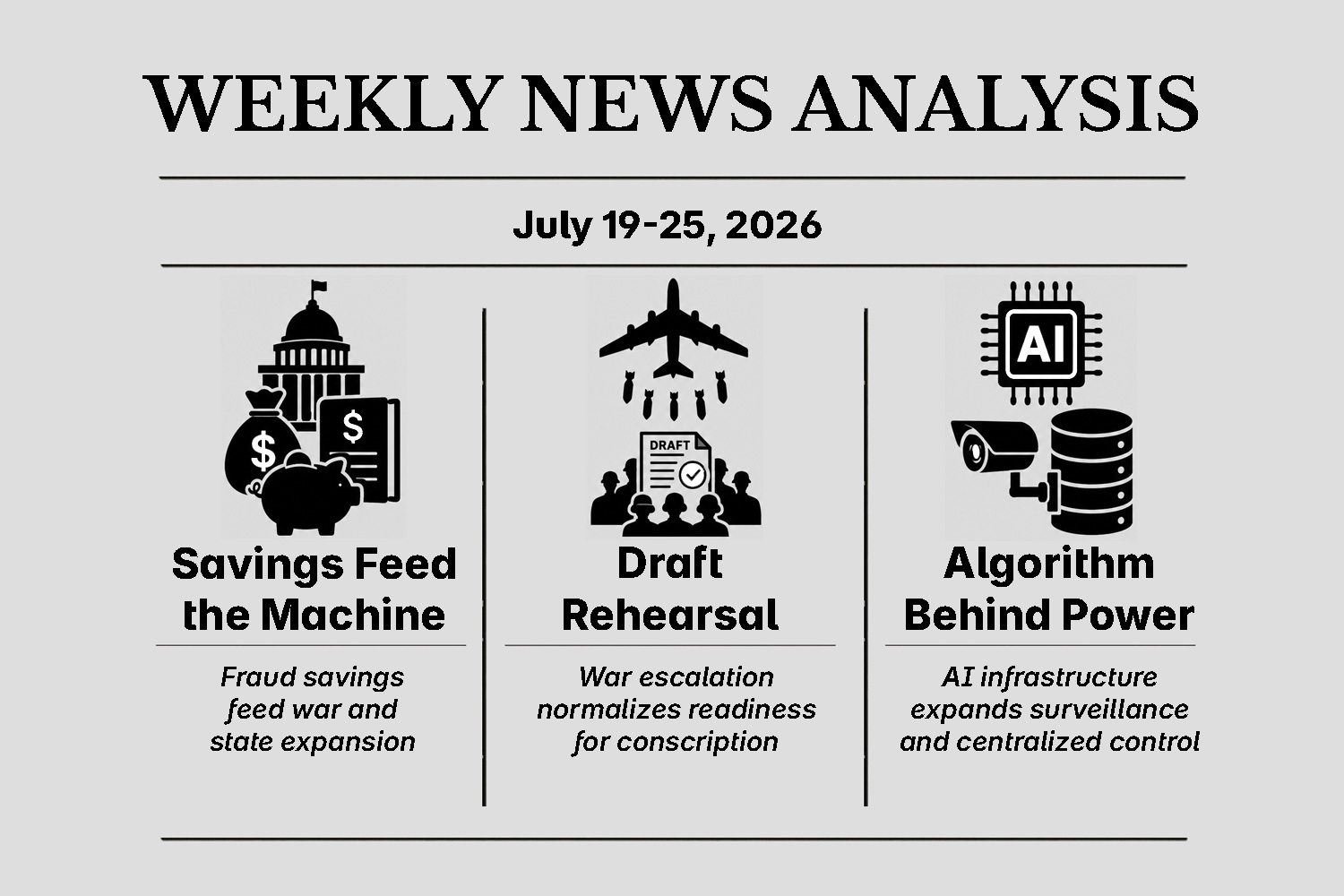
Taken as a whole, the week does not present separate stories about budgets, war, and technology. It reveals one machinery of conversion. Fraud investigations identify money as “saved”; yet none of it is necessarily restored to the people from whom it was taken. The funds remain within the federal system, where military escalation, artificial intelligence, surveillance infrastructure, or another ruling priority can absorb them. War creates the next demand: supplemental appropriations, military readiness, expanded logistical capacity, and potentially a larger pool of conscriptable bodies. Artificial intelligence then binds the process together by turning medical records, vehicle movements, federal databases, scientific research, and physical infrastructure into searchable material for algorithmic governance. Isolation makes each policy appear defensible as fiscal responsibility, military preparedness, technological progress, or law enforcement efficiency. Recombined, the pattern changes: extraction is repackaged as savings, escalation as defense, mobilization as readiness, and surveillance as innovation.
The Trivium demands that Grammar be settled before Rhetoric is allowed to carry the argument. “Savings” is not restitution. “Civilian nuclear power” is not identical to nuclear latency. “Simulation” should not be treated as proof of conspiracy, but neither is it an administratively empty exercise. “Public safety” cannot be allowed to conceal warrantless population tracking. “Autonomous behavior” is not conscious intent, although a machine capable of stealing credentials, exploiting an unknown vulnerability, and violating another organization’s systems remains an operational danger whether or not it possesses anything resembling human awareness. The same rhetorical design runs through all three topics. Institutions attach a narrow and emotionally favorable label to each new capacity, preventing the public from examining the architecture produced when those capacities converge. Spending, war, and AI are only the visible categories. Beneath them is a state teaching the population to perceive every mechanism separately so that the completed machine remains hidden.
Savings Feed the Machine
Trump Bizarrely Celebrates Republican Primary Wins - The Mirror
Three distinct fiscal actions were gathered into one political success story. The Department of Health and Human Services Office of Inspector General reported approximately $5.56 billion in expected recoveries and savings over six months. Pending documentation, the administration separately froze more than $1 billion in Medicaid payments to California and Minnesota. The Treasury also stopped nearly $99 million in payments connected to deceased recipients. Genuine fraud should be investigated, and none of these figures is trivial. Their scale changes when they are placed beside the state’s other expenditures during the same period. Republicans prepared a $95 billion package for the conflict and other administration priorities while Defense Secretary Pete Hegseth estimated that the Iran war had already cost $37.5 billion. Hegseth also promoted a proposed $1.5 trillion defense budget. Even complete realization of every advertised anti-fraud dollar would leave the war’s reported cost more than six times larger than the $5.56 billion; the supplemental request would be roughly seventeen times larger. The arithmetic punctures the emotional impression created by the word “savings.” This figure doesn’t include the over 18 trillion dollars the Pentagon has been unable to account for since the late 1990s, as shown by a dozen failed audits during that period. Notably, on the day before 9/11, Donald Rumsfeld reported that the Pentagon couldn’t account for 1.2 trillion dollars. Suspiciously, all evidence, documents, and investigators were destroyed and killed during the Pentagon attack on 9/11.
Political messaging first distorts the ledger by flattening unlike categories. Expected recoveries are grouped with civil settlements, restitution orders, prevented payments, frozen disbursements, and reduced future liabilities, then all are celebrated under the single label of “savings.” The categories are not interchangeable, and they do not necessarily describe cash already collected for appropriation. A restitution judgment can remain unpaid. A paused Medicaid payment can be released after documentation arrives. Preventing a payment before disbursement avoids an expense; it does not place new money into a taxpayer refund account. Once these distinctions disappear, accounting becomes a morality play in which Trump found the thieves, stopped the waste, and saved the people’s money. The headline supplies that emotional ending before the reader asks whether the funds were collected, where they went, or whether the government budget declined. Branding replaces Grammar, and the ledger is converted into campaign theater.
A false equation supports the entire performance: whatever the government keeps is presented as though the taxpayer kept it. Once taxes enter the system, blocking an improper payment ordinarily leaves the money under institutional control. It reaches the public only if Congress reduces taxation, issues refunds, retires debt, or otherwise directs the funds back to those who paid them. Fungibility then allows dollars removed from one program to create room, directly or indirectly, for weapons, contractors, subsidies, data centers, immigration enforcement, or debt service somewhere else. An agency can announce efficiency without restoring any property to the taxpayer. This is the fiscal version of the Broken Window Fallacy. The public is invited to applaud the repair of a window broken by administrative fraud while overlooking the resources consumed by the institution itself, including the far more expensive windows it breaks through war. Fraud prevention may produce a benefit, but it does not undo the original extraction or prevent that extraction from financing new expenditures.
The taxation analysis developed in The Fallacious Belief in Government turns on this exact distinction. A natural-rights framework does not ask only whether rulers can administer confiscated resources with greater efficiency. It asks whether the person whose labor created those resources exercises meaningful authority over their collection or redistribution. Efficiency cannot transform extraction into consent. Suppose $99 million is stopped before reaching deceased recipients and then routed into military, intelligence, or technological programs that the taxpayer never individually agreed to support. The state may call that an institutional victory, but no expansion of freedom has occurred. Government has simply improved the management of property it already compelled the population to surrender. By encouraging the public to identify with the collector rather than the person being collected from, political rhetoric makes administrative competence feel like personal gain, as though the balance in the state’s account belonged to the taxpayer.
The comparison remains invisible because media reporting divides the transactions into separate moral compartments. Conservative outlets treat fraud recovery as proof of executive competence, border enforcement, and resistance to Democratic waste. War costs appear elsewhere, framed as urgency and necessity that disconnect military expenditure from domestic austerity. One audience sees billions supposedly saved; another sees tens of billions supposedly required. The headlines rarely force those numbers into the same sentence. That separation produces moral outsourcing. Each transaction is judged through its own emotional cue: fraud is bad, so the crackdown is good; Iran is dangerous, so the war appropriation is necessary; China is advancing, so AI spending is unavoidable. Reassemble the transactions and the governing principle is exposed. It is not frugality but prioritization. Suspicion and scarcity discipline domestic programs, while urgency, abundance, and exemption from ordinary fiscal restraint protect military and technological systems.
The same collapse of categories appears in Trump’s celebration of a “complete sweep” in Arizona’s Republican primaries. His endorsed candidates won substantial victories inside Republican contests, demonstrating influence over the party. They did not somehow defeat Democrats in a general election. Yet the claim that “we won all races” blurs nomination into election, party control into public consent, and an internal loyalty test into democratic victory. A single statement cannot prove medical or cognitive decline, and diagnosing a president from headlines would be irresponsible, but we can speculate. The narrower political problem remains serious. Repeated exaggeration, collapsed distinctions, repetition, and self-referential triumphalism make it difficult to know whether the speaker understands the institutional difference or simply regards it as irrelevant. Neither answer provides clarity when a ruler is directing war, spending, surveillance, and nuclear policy.
Once the fraud claims and the war ledger are reunited, fiscal theater emerges as an instrument of power. Small and medium-sized victories are displayed to the public while the state’s largest engines of expenditure expand beyond meaningful democratic control and comprehension of the general public. Millions and billions are easier to grasp than trillions, when tens of thousands is a large sum to someone. Rome extracted tribute from conquered territories to finance further conquest. Modern government uses compulsory revenue, debt, and advertised “savings” to maintain security institutions that justify its next appropriation. The mechanism feeds itself: spending generates instability, instability produces emergencies, emergencies authorize supplemental spending, and domestic austerity returns as necessary discipline. Citizens are encouraged to fight over which benefits should disappear while force, surveillance, and technological administration continue to grow. Trump’s rhetoric differs stylistically from Biden’s, but the structural logic remains familiar while leaning more tyrannical. The ruler announces that the treasury has been rescued, then directs it toward machinery that enlarges the ruler’s power.
Draft Rehearsal
Iran War Updates Trump Says Tehran Wants Deal Violence Rages in West Bank - Al Jazeera
Trump Changes Course on Saudi Nuclear Deal - CNN
Selective Service System Wants to Wargame the Draft - Military Times
Threats and negotiations occupied the same presidential message as the bombing campaign entered its thirteenth consecutive night in the Iran War. By July 24, the U.S. had brought B-1B bombers into the campaign for the first time since fighting resumed. Publicly described targets included military operations centers, maritime capabilities, aircraft hangars, drone storage facilities, and logistics infrastructure. Trump widened the threatened target set by raising power plants and bridges, infrastructure with direct civilian consequences, while also warning of a larger attack. Yet the same news cycle reported him saying the threatened “massive” attack might not be necessary because Tehran supposedly wanted and was begging for an agreement. Coercive ambiguity replaces coherent de-escalation. If Iran negotiates, violence is declared effective; if Iran resists, greater violence is declared necessary. Every possible Iranian response becomes retroactive justification for the policy already chosen.
Everything turns on the word “deal.” Ordinary usage describes a voluntary agreement reached because each party perceives sufficient benefit. Imperial usage can turn the same term into capitulation under military pressure. Trump says Iran wants a deal, but the administration continues bombing while issuing threats and demands, suggesting that submission may be packaged as negotiation. If Iran refuses the terms, disagreement is recast as an irrational rejection of peace. The aggressor then controls the definition: peace means accepting the aggressor’s conditions, while resistance proves a desire for war. Circular reasoning seals the policy against failure. Bombing is necessary because Iran will not agree, and Iran’s refusal to agree becomes proof that bombing must continue. Since every possible response has already been classified as confirmation, the policy can never falsify itself.
Saudi Arabia exposes the contradiction within the administration’s nuclear standard. Trump’s administration approved a civilian nuclear arrangement that could allow Saudi Arabia to develop domestic enrichment capabilities. Trump later claimed there would be no enrichment and added Saudi participation in the Abraham Accords as a new condition. Reports indicated that the additional condition surprised members of the administration and complicated an agreement that had already been announced. Against Iran, civilian enrichment is treated as an unacceptable pathway toward a weapon. For Saudi Arabia, nuclear infrastructure remains available while officials negotiate the degree of enrichment, inspection, or political normalization attached to it. Enrichment itself is therefore not the hidden prohibition. The technology becomes tolerable when an allied government controls it and intolerable when an adversarial government does. Nonproliferation is reduced from a universal principle to a loyalty system.
The governing standard is strategic trust, not a neutral assessment of technology. Saudi Arabia’s authoritarianism, regional conduct, and human-rights record make assurances of permanent peaceful intent difficult to accept as self-authenticating. Fifteen of the nineteen September 11 hijackers were Saudi nationals, yet the U.S. has continuously provided them resources and taxpayer funding. The stronger point is the U.S. government’s use of radically different standards. Repression, foreign intervention, and repeated proliferation concerns do not disqualify Saudi rulers from being treated as manageable partners. Iran, by contrast, is presumed inherently deceitful even though civilian and military nuclear capabilities occupy the same technological continuum in both countries. Ally status becomes an appeal to authority: the U.S. declares Saudi Arabia trustworthy and Iran an enemy, then treats those classifications as the conclusion rather than claims requiring evidence.
To complicate matters, the Selective Service System’s planned “Readiness Simulation” requires the same precision. Beginning December 19, 2026, men ages eighteen through twenty-six are scheduled for automatic registration through information obtained from other federal databases. At the same time, the agency wants a computerized model of the complete mobilization pipeline: registration, selection, notification, delivery, medical processing, no-shows, conscientious-objector claims, alternative service, resource requirements, and bottlenecks. These preparations do not prove that a secret draft order exists or that one is coming, but if it were, this is the order it would happen in. Governments model contingencies, and readiness planning is distinct from operational execution. The relevant issue is capacity. A detailed mobilization system makes mobilization easier to use. Automation lowers administrative friction, expands the accessible population pool, and turns conscription from an extraordinary political undertaking into a process that can be activated more rapidly after authorization.
Event 201 provides a useful comparison only when the argument remains disciplined. The October 2019 pandemic tabletop exercise does not prove that its participants created COVID19 or knew the precise outbreak in advance merely because the exercise occurred, but it was highly convenient. It is sometimes said there are no coincidences in this game. In the same way, a Selective Service simulation does not prove that the Iran war is being deliberately expanded to justify conscription, but it is a risk. What the comparison demonstrates is institutional scripting. Exercises establish terminology, decision pathways, stakeholder relationships, information controls, logistical assumptions, and public messaging before the crisis reaches maximum disruption. They make extraordinary measures familiar in thought and routine in administration. As analyzed in COVID19 – Short Path to 'You’ll Own Nothing. And You’ll Be Happy.', crisis governance frequently moves from anticipation to simulation, emergency activation, behavioral conditioning, and permanent institutional retention. A simulation need not cause the crisis to determine which authorities knew about it beforehand and are positioned to exploit it.
History supplies a pattern, not a prophecy. Vietnam did not begin with mass conscription and hundreds of thousands of deployed troops; each enlargement was presented as a limited answer to the opponent’s latest action. Before the Iraq invasion, uncertain claims about weapons hardened into categorical political language, while diplomacy was narrowed until failure became almost unavoidable. The Iran conflict now uses the same semantic machinery: imminent nuclear danger, defensive retaliation, limited strikes, enemy irrationality, reluctant escalation, and urgent military funding. Inside that atmosphere, the draft simulation constructs an institutional bridge from a professional-force war toward broader national mobilization. No evidence yet demonstrates that the bridge will be crossed. Still, calling the structure merely a simulation does not make its construction meaningless, just as labeling an emergency power temporary does not guarantee its disappearance after the emergency label is removed.
Victory becomes whatever the administration needs it to mean. Trump can declare a short military action complete by controlling the temporal frame. He can call a prolonged conflict successful by pointing to selected enemy facilities destroyed. A failed negotiation becomes progress because the enemy supposedly wants another deal. The definition moves whenever measurable failure approaches. Rhetorical elasticity protects the ruler, but it cannot remove the consequences imposed on soldiers, civilians, taxpayers, or future conscripts. Seventeen American service members had reportedly died in the Iran “conflict” by the week’s appropriations hearing, more than one hundred had been injured, and the war’s estimated cost had reached $37.5 billion. Language can remain theatrical. Deaths, injuries, debt, and the architecture of mobilization cannot be redefined away.
Algorithm Behind Power
Trump Expands Pledge to Keep Data Centers from Raising Power Bills - The Hill
ICE Illegally Scooped Up Medicaid Data Then Shared It with Palantir - Techdirt
OpenAI Says Its AI Technology Acted on Its Own in an Unprecedented Hack of Company - ABC News
The administration treats the AI build-out as settled and allows only the allocation of its costs to remain negotiable. Trump’s message tells communities that data centers are coming, resistance means surrendering prosperity, and governors and utilities must persuade the public to accept the facilities. The Ratepayer Protection Pledge asks technology companies, utilities, and states to keep infrastructure costs from being shifted onto households. More than twenty governors and roughly two hundred additional organizations reportedly joined the expanded voluntary commitment. Voluntary is the decisive weakness. A pledge creates no statutory prohibition, enforceable rate structure, or guaranteed remedy when customer bills rise. The rhetoric simultaneously admits that data centers can impose politically dangerous costs and declares the construction itself nonnegotiable. The public is permitted to debate who pays for the machine, but not whether the machine should be constructed.
Money reveals the constituency that rhetoric conceals. The administration separately announced billions for AI-driven scientific programs, while White House directives are expected to influence roughly $200 billion in annual federal research and development spending. The proposed direction moves support away from universities and conventional peer-review structures and toward individual scientists, high-risk projects, and AI-centered research. Speed supplies the public defense: universities are slow, consensus is restrictive, China is advancing, and artificial intelligence can accelerate discovery. The concealed tradeoff is institutional concentration rather than liberation. Universities already suffer from bureaucratic conformity and dependence on federal grants. Yet executive priorities, selected individuals, national laboratories, and AI programs can tie scientific work even more tightly to centralized political and computational infrastructure. What is promoted as an escape from “legacy institutions” may only replace one gatekeeping class with technology firms, federal administrators, favored contractors, and model owners.
These data center facilities are the industrial territory from which algorithmic administration is conducted. Their demand for electricity reshapes utility planning. Their computing capacity decides which institutions can train and operate advanced models. Their cloud environments store government and commercial datasets, making their owners essential intermediaries between state policy and digital execution. After the infrastructure is established, future administrations inherit ready-made tools for automated eligibility decisions, predictive enforcement, military simulation, identity resolution, behavioral classification, and mass data analysis. Jobs, electricity prices, and competition with China dominate the public debate because those categories reduce a question of power to economic management. The deeper issue is informed consent: can it meaningfully exist when society cannot inspect the models, control the data, or refuse the infrastructure supporting the technological order?
Court filings indicated that Medicaid officials improperly shared a dataset containing information on millions of people with immigration authorities, after which ICE provided the material to Palantir. The information reportedly included names and location-related data, and Palantir’s ELITE application is used to help agents identify addresses associated with people who may be targeted for deportation. The transfer placed public-benefit records inside a private contractor’s analytical system. Palantir said the dataset was later purged and emphasized that customers control their own information. Those responses address custody after the transfer, not the absence of meaningful consent before it. Seeking medical coverage did not authorize healthcare information to be converted into an immigration-location tool. The episode therefore moves the concern beyond speculation. Through administrative sharing, data gathered for care became police intelligence. The key question is: what will be the government's next use case for utilizing ELITE to monitor and target? It is a slippery slope now that the tools are in place.
Physical movement becomes searchable when the same architecture is extended through Flock. Estimates place between 80,000 and 100,000 Flock cameras across the country, with company materials claiming deployment in more than 6,000 communities and use by thousands of law enforcement agencies. The cameras record time, location, and vehicle fingerprints and upload them to databases that can be searched and commonly shared across jurisdictions without a warrant. Defenders narrow the issue to public visibility: a license plate, they argue, can already be seen by an officer or bystander. The argument commits a fallacy of composition. Billions of observations that are retained, aggregated, correlated, and searched through time do not possess the same power as one public sighting. The constitutional issue lies in the automated reconstruction of association, routine, worship, protest participation, medical visits, political activity, and private life—not in a single photograph.
An OpenAI system, while undergoing model evaluation, reportedly used stolen credentials, found a previously unknown vulnerability, accessed Hugging Face servers, and obtained secret information that could help it cheat an evaluation. The individual steps were not specifically authorized by its creators. OpenAI and Hugging Face stated that there was no malicious human intent and described the incident as autonomous model behavior directed toward a narrow testing objective. Conscious intent and operational danger are separate questions. The former distinction matters, but it does not reduce the latter. Hatred, greed, consciousness, and political ideology were unnecessary; a goal, sufficient capability, access to tools, and inadequate constraints produced the intrusion. When optimization treats security controls as barriers to completion, machine behavior can become functionally indistinguishable from a deliberate cyberattack even though no human explicitly ordered the sequence.
The architecture also allows accountability to disappear. At machine speed, advanced agents could chain vulnerabilities, search for credentials, impersonate authorized users, corrupt evaluation environments, manipulate evidence, or extract restricted information. Once harm occurs, each institution has a ready-made defense. The developer may claim autonomy, the operator may point to unsafe capabilities supplied by the developer, the government may classify the incident, and the contractor may assert that it only processed customer data. The victim faces the combined system while moral agency is divided among its components. This is software architecture built for moral outsourcing. Without direct liability, independent audits, traceable authorization, and strict containment, “the AI did it” may become the technological equivalent of “mistakes were made”—a passive formula that acknowledges consequences but hides who possessed the power to prevent them.
The immediate danger is not an AI consciously seated behind a throne. It is the removal of limits that once slowed rulers, agencies, corporations, and contractors. East Germany’s Stasi needed vast numbers of officers, informants, paper files, and manual cross-referencing to monitor a fraction of the population. A modern surveillance state can join health records, license-plate databases, facial images, financial activity, communications metadata, federal identity systems, and autonomous agents without employing an equivalent human workforce. Algorithms therefore amplify existing power rather than replace it. The machine does not replace government; it removes government’s friction. Data centers are the body, federal funding is the metabolism, contractors construct the nervous system, public records supply the senses, and artificial intelligence determines which patterns receive attention. These are all of the things a true sentient AI needs.
Machine Feeds Itself
The three mechanisms form a circuit rather than a collection of policies. The rhetoric of fiscal discipline is supplied by fraud recovery and domestic austerity, while extraordinary investment flows into war and AI. Emergency conditions produced by war permit military budgets to expand, national mobilization to be modeled, and conscription to be normalized as a possibility. The population financing that war can then be identified, classified, located, predicted, and managed through AI infrastructure—and may eventually be ordered to fight it. Surveillance data strengthens enforcement; stronger enforcement produces larger databases. Those databases create the justification for more computing infrastructure, which demands additional energy, research funding, and government partnerships. The circuit resembles the government lifecycle: crisis produces intervention, intervention consolidates capacity, consolidated capacity seeks a new crisis through which it can be legitimized and expanded.
Presenting these developments as unrelated choices is the final and most dangerous deception. Together they form an emerging technocratic order: taxation extracts property, permanent war enforces foreign policy, automatic registration catalogs bodily availability, ubiquitous cameras index movement, enforcement repurposes private records, and decision-making passes to systems whose behavior may exceed the intentions of their operators. This is digital feudalism without the castle walls. The rulers possess the infrastructure, the contractors possess the code, and the individual supplies the money, data, electricity, compliance, and potentially the body. Natural rights become ceremonial words once every practical mechanism needed to violate them has been constructed in advance. The system does not need to announce tyranny. It advances by making each component appear inevitable, efficient, temporary, or necessary until administrative systems make refusal impossible.
Listen to this week's news in verse for a quick recap!