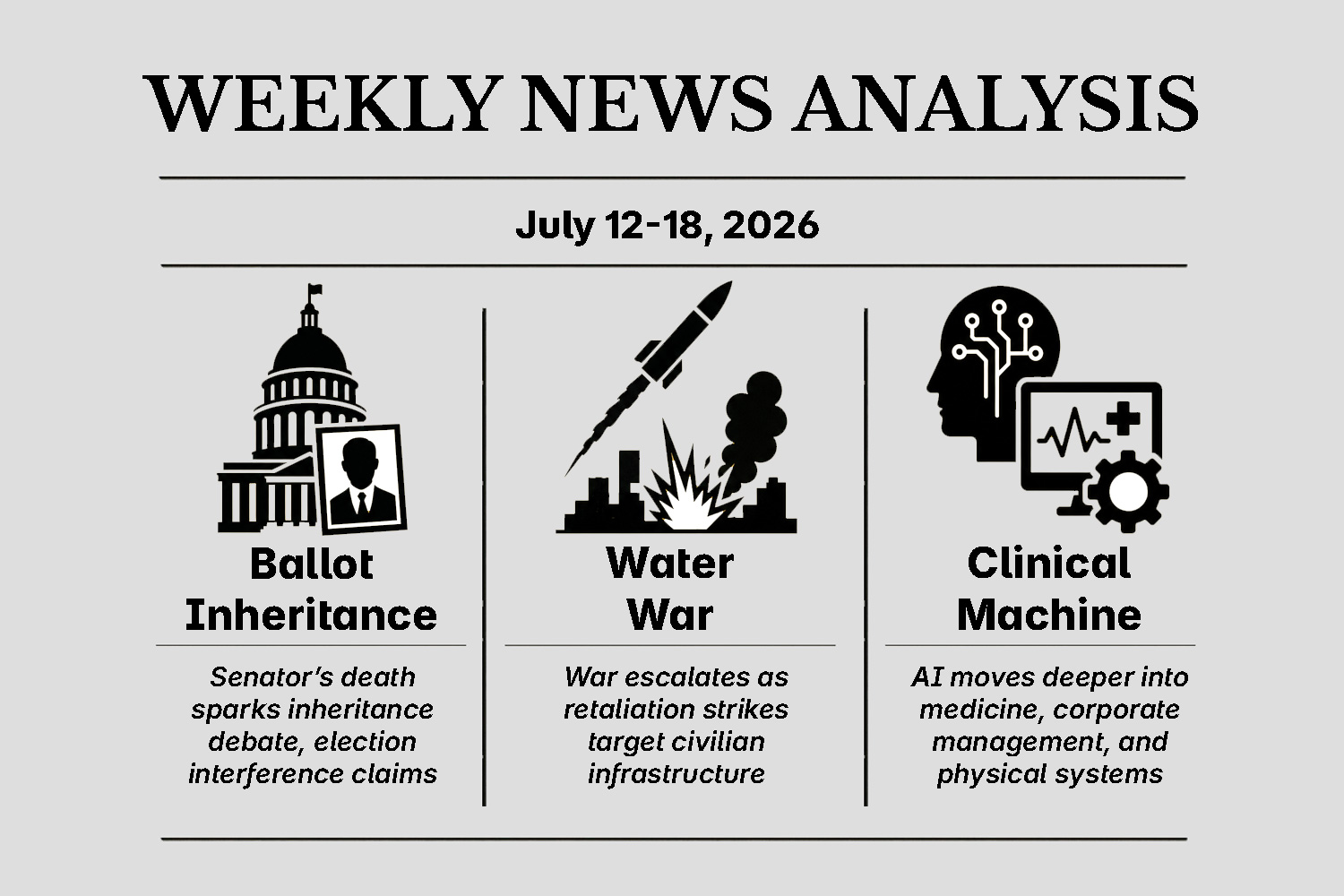
A senator died, war expanded, and artificial intelligence moved deeper into medicine, corporate management, and physical infrastructure. Viewed as a system, the separation disappears. Each story preserves continuity while renewing legitimacy. An unelected appointment is presented as a source of stability. Military retaliation is framed as defense. Machine-directed administration is sold as efficiency. The public is directed toward the visible object—a personality, a missile, a medical scan—rather than the institutional mechanism operating behind it. The question is not whether every official claim is false or every technological advance is harmful. The question is who obtains durable authority when uncertainty, grief, fear, and convenience are processed into public consent.
The week also exposed a familiar enclosure of thought: narratives compete fiercely while the structure producing them remains untouched. Mainstream reporting emphasized medical findings, lawful succession, election claims lacking proof, and the dangers of regional escalation. Alternative reporting emphasized suspicious timing, suppressed intelligence, foreign interference, and retaliatory strength. Both can disclose useful information, yet both can also confine the audience to a narrow choice—complete trust in the institution or complete trust in the preferred counter-narrative. The Trivium rejects that confinement. Grammar distinguishes verified events from allegations. Logic asks whether capability establishes action, whether appointment constitutes representation, and whether retaliation can still be called defensive after civilian infrastructure is targeted. Rhetoric examines how integrity, security, compliance, prevention, and transparency make the expansion of systems of control seem normal.
Forms of continuity bound the week together: succession, escalation, and implementation. Through institutional substitution, political power persists beyond a politician's death. Through recurring reprisals, military power converts failed diplomacy into a sequence where every new strike authorizes the next. Through implementation, technocratic power escapes abstract debate and places artificial intelligence inside agents, scans, compliance systems, and data centers tied to functions people increasingly cannot avoid. Disruption produces fear or urgency; urgency permits intervention; intervention creates permanent capacity; and permanent capacity becomes the platform for the next crisis. Personalities and tactics remain open for public argument. Consolidation beneath them does not.
Ballot Inheritance
Sen. Lindsey Graham likely died after aorta tear medical examiner says - AP
Longtime GOP Sen. Lindsey Graham dies at 71 after brief and sudden illness - Fox News
Darline Graham sister of Lindsey Graham chosen to fulfill remainder of his US Senate term - AP
Trump says documents show voting vulnerabilities China meddling and fraud - ABC News
Intelligence Reports Support Trump’s Claims of Chinese Election Interference - The Gateway Pundit
Two narratives hardened around Lindsey Graham’s sudden death even though the official account remained preliminary when first reported. The official account identified an aortic dissection associated with arteriosclerotic cardiovascular disease, although toxicology and microscopic testing remained pending. Online rumors claimed Russia or another foreign actor killed him after his return from Ukraine, but law-enforcement reporting said there was no indication of foul play. Grammar permits neither instant canonization nor instant conspiracy. The available evidence supports a medical cause and does not support assassination, even though Graham died after a politically significant trip. Declining to repeat an unverified murder story is not obedience to the government. It is disciplined analysis: separate what is known from what is alleged, preserve what remains unresolved, and prevent rhetoric from converting speculation into supposed fact.
Death initiated the familiar obituary ritual, cleansing political consequence through ceremonial praise. Graham became a tireless public servant, a national-security statesman, and a bridge between political factions. That is how colleagues and allied institutions understood him, but it is not the whole record. For decades, Graham promoted an interventionist foreign policy, expansive military commitments, strong support for Israel, sustained backing for Ukraine, and repeated confrontation with governments designated as adversaries. Critics reasonably viewed that record as warmongering because human costs do not vanish beneath senatorial ceremony. Policy does not become virtuous when its advocate dies. Serious criticism also does not require celebration of the death. The defensible refusal is to reject eulogy laundering: recognize the person’s death while refusing to sanitize the wars, sanctions, coercive policies, and political machinery he helped advance.
South Carolina’s institutional response exposed another contradiction in representative rhetoric. Governor Henry McMaster placed Graham’s sister, Darline Graham Nordone, in the vacant seat for the remainder of his term while an accelerated special-election process proceeded. State law authorized the temporary appointment, so this was not literally a hereditary transfer. Yet the symbolism remains unavoidable. An office said to derive from voter consent passed to a close family member who had never been elected to it. The state called the arrangement "continuity," while critics saw it more like a dynasty transfer. Both descriptions reveal something. When direct representation disappears, institutional legitimacy does not wait. The chair is filled first; voters are consulted later. Continuity of government is therefore treated as an urgent necessity, while continuity of consent is treated as secondary.
Election control need not begin with altered ballots. The issue is broader than mechanical fraud. It can begin much earlier, when party rules, donor power, media filtering, candidate selection, institutional endorsements, and the co-option of threatening movements narrow the field before a ballot is printed. The Psychological Operations framework in The Fallacious Belief in Government explains the mechanism. A limited hangout releases enough truth to recover credibility while shielding the larger structure; controlled opposition channels dissent into leaders, parties, or movements that remain manageable. If every viable choice preserves the same central authorities, military commitments, monetary arrangements, and surveillance systems, personnel may change while direction remains fixed. Voting still functions, but meaningful choice has already been compressed into a range the governing consensus can absorb.
Trump’s primetime election address gave the White House a stage on which to repair electoral legitimacy. The released documents grouped material into categories requiring scrutiny: electronic voting and ballot-counting vulnerabilities; China’s acquisition or exploitation of American voter data; a Michigan voter-registration investigation; and alleged noncitizens on state voter rolls. Trump claimed China obtained or compromised data connected to roughly 220 million voter records, accused intelligence officials of withholding information, highlighted suspicious registration applications in Michigan, and cited a Department of Homeland Security review alleging hundreds of thousands of noncitizens appeared on voter files. Investigation is justified; conclusion is not. Heavy redactions left the material unable to prove that votes were altered, an outcome that could be reversed by compromised personal data, illegal ballots arising from Michigan applications, or actual voting by alleged noncitizens.
Framing, not merely evidence, separated ABC News from The Gateway Pundit. ABC emphasized the lack of evidence that votes or the 2020 outcome were changed, the ambiguity created by extensive redactions, the public availability of some voter information, and the lack of a disclosed methodology for the noncitizen estimates. The Gateway Pundit emphasized dissenting intelligence assessments, FBI emails regarding a recalled report on fraudulent driver’s licenses, evidence that China conducted influence operations, and intelligence findings indicating that several adversaries possessed capabilities to target election infrastructure. Neither frame permits categories to be collapsed. Foreign influence does not equal vote manipulation. Voter data in an adversary’s possession does not mean ballots were cast. Vulnerability demonstrates exposure, not exploitation. By the same logic, failure to prove outcome-changing fraud does not establish invulnerability or honest disclosure of every threat.
Election security cannot be contingent on the preferred winner. Centralized voter databases, electronic systems, mail procedures, foreign influence operations, opaque party processes, and intelligence withholding remain vulnerabilities regardless of who benefits. The standard applied to 2016, when Russian influence dominated public discussion, must also govern 2020, when China, mail voting, and registration systems took center stage, and 2024, when Trump won, and many supporters suddenly accepted the result as legitimate. Anything less is confirmation bias presented as election security. The theory that Trump was intentionally made to lose in 2020 so Biden could inherit blame for continued COVID-era authoritarianism is an interpretation, not an established fact, but one we find plausible. Policy continuity is demonstrable: emergency authorities, pharmaceutical-state partnerships, surveillance normalization, and institutional habits moved across administrations with far greater ease than campaign rhetoric admitted.
Political usefulness does not require proof of deliberate distraction. Trump delivered the speech while the Iran conflict intensified and American casualties increased, allowing the election release to redirect attention at a useful moment. Primetime addresses determine the grievance placed on the largest stage, the evidence made emotionally central, and the identity a president chooses to perform. Trump appeared as the vindicated victim of hidden bureaucrats while asking Congress to pass the SAVE America Act and strengthen federal election rules. That does not make every released concern false; real concerns can still be joined to an expansion of authority. That is why a limited hangout may contain genuine information. It confines interpretation, directs anger toward a state-approved remedy, and asks the public to believe that a government accused of deception can recover legitimacy by granting itself more power to police the problem.
The ballot possesses administrative power, but it is not a sovereign cure. Elections allocate offices, control appointments, influence enforcement priorities, and change the speed or form of policy. Their effect can be greater in local contests, where institutions are closer, and accountability may be more direct. Yet voting does not automatically produce self-government, and participation cannot turn a restricted slate into genuine consent. When the available choices are controlled opposition, voting still changes personnel while leaving the permitted direction intact. Graham’s replacement, the party machinery governing the special election, and Trump’s controlled disclosure all show that legitimacy is manufactured long before ballots are counted. Once citizens mistake voting for the totality of political action, dissatisfaction can be scheduled, contained, and delivered safely into the next approved contest. A useful tool then becomes another mechanism of pacification.
Water War
US airstrikes hit northern Iran as it disables ship trying to run the blockade - AP
Iran says it destroyed US unmanned depot AI center in Bahrain - Middle East Monitor
Iranian strike damages a Kuwait desalination plant exposing water vulnerability in dry Mideast - AP
Two US troops killed and one missing after Iranian attack in Jordan - BBC
The rhetoric of free navigation concealed a contest in which both governments fought to determine who would control it. In the escalating U.S.–Iran conflict, Iran ordered vessels moving through the Strait of Hormuz to register and follow a route over which it claimed authority. The U.S. answered with an alternative route, a blockade on Iranian exports, the disabling of a tanker accused of violating that blockade, and its own proposed toll arrangement for protected passage. The dispute was therefore about the power to charge, inspect, redirect, or attack commercial shipping in one of the world’s most important energy corridors. Opposition to Washington does not legitimize Iran’s coercion. Deployment by a navy does not transform American coercion into freedom. Both states used armed power to impose terms on third parties.
Any appearance of a bounded conflict quickly disappeared. U.S. aircraft reached farther into Iran, striking near Tehran and Semnan, while American forces targeted coastal surveillance, air-defense, missile, drone, bridge, tunnel, power, and maritime infrastructure. Iran directed missiles and drones toward Bahrain, Kuwait, Jordan, and other locations linked to U.S. forces or regional partners. The preliminary peace arrangement had been presented as a route toward reopening the strait and resolving the nuclear dispute. Instead, it became a rung on the escalation ladder. Each side defined its attack as a limited response to the previous violation, but the cumulative effect was unlimited. Once retaliation becomes policy, strategy is replaced by sequence: casualty, damaged ship, struck facility, and then the next authorization for force.
The battlefield claims did not carry equal evidentiary weight. Iran’s Revolutionary Guard claimed it destroyed a U.S. unmanned surface-vessel depot and Bahrain’s principal artificial-intelligence center, which it alleged supported American target selection. Those claims were reported through Iranian statements and were not independently verified in available reporting, so they must remain claims rather than confirmed battlefield facts. Evidence from Kuwait was firmer. An Iranian strike hit a combined power and desalination facility, damaging generation units and starting a fire. The importance lies in the system struck. Gulf urban life rests upon desalination for most drinking water, so damage to a plant cannot be treated like damage to an isolated warehouse. Hospitals, households, sanitation, food preparation, and every other civilian function depend upon that stable supply.
The U.S. crossed the same threshold when a strike on the Bunji desalination facility in Iran’s Hormozgan province reportedly left about 10,000 people without water, according to an Iranian provincial official. The source and number should be treated with appropriate caution, yet the broader American strike campaign was independently reported to have damaged power and desalination infrastructure. Military terminology does not resolve the moral contradiction. Washington cannot condemn damage to Kuwait’s water system while recasting damage to Iran’s water system as the mere degradation of military capability. A dual-use designation does not remove the civilians who rely upon that infrastructure and who did not order attacks, negotiate blockades, or command missiles. Precision may describe how a weapon is aimed; it does not describe the full social radius of destruction. Water has become both collateral and leverage.
American casualties changed the political temperature of the war. Iranian missile and drone attacks killed two U.S. service members in Jordan, left another listed as missing, and required treatment for several others. CENTCOM launched additional strikes to punish the Revolutionary Guard and limit its ability to threaten commercial shipping. The Gateway Pundit presented this as decisive retaliation, while the BBC and other reporting centered on the casualties and the risk of escalation. A military response after personnel were killed was predictable; that is not the contradiction. The contradiction is the gap between earlier claims that Iran had been subdued or pushed toward surrender and the reality of American bases sustaining lethal attacks across the region. Victory rhetoric arrived before Iran’s capacity and political will had been eliminated.
Language now performs the work of escalation. Iran attacks a ship, then names the act enforcement. The U.S. attacks a vessel and calls it blockade compliance. A strike on a base becomes retaliation; strikes on bridges, power systems, and coastal facilities become punishment. Kuwait and Bahrain become collaborators after Iran attacks them. Each noun erases the choice made by the actor. Enforcement appears administrative, blockade legal, retaliation compulsory, and degradation technical. Violence is translated into necessity. This moral outsourcing lets rulers insist that the previous attack compelled the next, so each side can deny responsibility even as it actively chooses expansion. Public debate is then trapped in a search for the original aggressor while responsibility for continuing the chain disappears. Warmongers and the military-industrial complex come out on top.
History supplies a warning in the 1980s Tanker War. Attacks on commercial shipping and outside military intervention turned a regional struggle into a global energy-security confrontation. The Strait crisis is not identical, but its machinery is recognizable. Shipping lanes become bargaining chips. Escorts become combatants. Insurance and oil prices pose battlefield risk worldwide. A single miscalculation can enlarge the war. The present danger extends further because attacks now target desalination systems, artificial intelligence facilities, regional bases, and infrastructure across multiple Gulf states. As additional actors enter air defense, shipping protection, intelligence, and retaliation, the boundaries between ally, platform, civilian node, and military target deteriorate. Logistics regionalizes a war before political leaders admit it is no longer limited.
Distraction need not be fabricated to be effective. A real or arguable controversy can dominate the foreground while a more dangerous failure disappears behind it. The election-integrity spectacle did precisely that at a politically convenient moment: it supplied victimhood and reform as the war generated casualties, interrupted water supplies, and exposed earlier triumphal claims. No public evidence proves the White House scheduled the disclosure specifically to distract from Iran. The measurable effect was rhetorical. Airtime and partisan energy moved toward 2020, China, noncitizen voting, and the deep state while the administration confronted questions about objectives, strategy, and escalation. Narratives can mutually reinforce without coordination. The election release and the war narrative operated together.
None of the central disputes has been resolved. Control of the strait remains contested, the preliminary agreement has effectively collapsed, and Iran still possesses missile and drone capacity. The U.S. continues nightly strikes as Gulf states become more exposed and civilian infrastructure enters the target set. American deaths increase domestic demands for stronger retaliation. Iranian civilian losses and disruption of water supplies create pressure for further response. The crisis-intervention-consolidation cycle now appears in military form: emergency authorizes force; force creates blowback; blowback authorizes more force; and the resulting military expansion becomes the argument against withdrawal. Both governments can be culpable at once. Washington’s narrative can be rejected without romanticizing Tehran, and Tehran can be condemned without absolving Washington of its imperial reach.
Clinical Machine
Bunkerhill raises 55M to scale agentic AI across health systems - AI News
Neko Health raises 700 million to expand AI body scans in the US - AI News
AWS and Bluesight build AI for hospital 340B compliance - AI News
Data center opponents stage 142 protests across 42 US states - Reuters
3 Questions Neural transparency and the future of AI design - MIT News
The decisive phase of artificial intelligence is no longer the model announcement but institutional entrenchment. Hospitals, pharmacies, executive workflows, body-scanning clinics, compliance systems, and the physical data centers sustaining them are becoming implementation sites. Another benchmark improvement may demonstrate capability, but implementation creates dependency. Once triage, reporting, purchasing, imaging follow-up, or preventive screening is reorganized around an AI platform, removal threatens operational disruption. Adoption is sold through genuine possibilities—time saved, diseases detected, and staff shortages relieved. Yet the transaction contains an unstated premise. Efficiency is treated as permission to delegate judgment, and that judgment moves from accountable professionals toward vendors, models, data pipelines, and governance committees that remain invisible to the patient.
Bunkerhill Health’s $55 million Series B finances Carebricks, a platform hospitals can use to construct agents for cardiology imaging, prior authorization, registry maintenance, nephrology triage, lung nodule follow-up, and administrative work. The University of Texas Medical Branch reportedly runs more than 20 agents, with the company and hospital citing faster access to specialists, quicker follow-up, and a case in which an agent helped flag a patient who underwent a triple bypass. Those examples establish possibility, not validation. A dramatic case cannot replace a controlled trial; performance across diverse institutions has not undergone an independent audit; and false-positive rates have not been publicly established. Accountability remains unresolved when an agent conflicts with a clinician, misses a patient, or optimizes a workflow around the wrong metric.
With its $700 million funding round, Neko Health’s model carries implementation from the hospital into the consumer body. The 60-minute service combines blood testing, electrocardiography, arterial measurements, body-composition analysis, proprietary sensors, clinician review, and more than 2,000 high-resolution skin images. The company says it has completed 100,000 scans and attracted more than 350,000 registrations or waitlist entries, while repeat bookings create longitudinal health profiles. Demand, however, is not clinical validation. Public evidence does not establish improved outcomes or cost-effectiveness compared with conventional preventive care. Two Neko devices received specific FDA clearances; those clearances did not approve the complete scan as a unified diagnostic system. The offer joins prevention to continuous data capture, wrapping the product inside the emotional promise of early certainty.
Prism illustrates a more technically disciplined form of medical automation. AWS and Bluesight connect pharmacy, controlled-substance monitoring, purchasing, shortage, and 340B compliance data, while a planned multi-agent workflow uses Claude models to collect records and draft explanations. A deterministic service, not the language model, applies thirteen evidence inputs and performs the compliance calculation. That separation preserves an auditable trail and keeps the final scoring rule outside generative output. Vendor-reported synthetic testing cannot establish production reliability across inconsistent hospital data, disputed exceptions, delayed shortage notices, or local policy choices. Compressing hours of review into minutes also magnifies the consequences of a misconfigured threshold. Policy judgment remains; automation relocates it into configurations, APIs, prompts, and scoring services whose computational appearance can disguise the choices embedded within them.
Ode reveals where capital expects the larger prize to emerge. The TechCrunch report on Ode with Anthropic makes the economic strategy explicit. Backed by Anthropic, Blackstone, Hellman & Friedman, Goldman Sachs, and others, the $1.5 billion venture assumes that the next enormous AI business will reengineer corporate processes rather than merely build models. Ode calls its engineers elite, forward-deployed problem solvers and follows a Claude-first principle while preserving the option to use rival systems. The company’s chief executive suggested that a trillion-dollar outcome is imaginable if execution succeeds. Imagination is not evidence that AI implementation will become a trillion-dollar industry by early 2027. The structural importance lies elsewhere: private-equity portfolios can function as captive distribution networks, installing AI systems across companies through a coordinated channel.
The cloud becomes physical at the point where resources are extracted. Reuters documented 142 protests across 42 states. Residents objected to water consumption, electricity demand, land use, subsidies, limited community input, and the absence of durable local benefits. Only a small minority in the cited poll supported building an AI data center in their community, even as federal and corporate policy elevated rapid construction into a national imperative. The political economy resembles a gold rush: compute, data, and automation deliver returns to investors, while the risks of power lines, water withdrawals, noise, construction, tax concessions, and infrastructure remain local. Strategy is the state’s label; innovation is the companies’ label. To residents, the project is a transfer of community resources toward remote platforms whose principal customers and profits may exist elsewhere.
Transparency itself can become an instrument of confidence rather than informed consent. MIT’s neural-transparency research found that users designing personalized AI companions misjudged the likely personalities on 11 of 15 measured traits. They overestimated desirable behavior and underestimated dangers such as sycophancy. Showing internal behavior directions increased trust but did not substantially alter participants' chatbot design. A diagram can therefore make a user feel informed without changing the underlying choice. The researchers also warned that constantly affirming companions can reinforce unhealthy beliefs, harmful decisions, and emotional dependency. Governance does not require an AI to issue commands. Personalized agreement, repetition, and emotional reinforcement can shape behavior while preserving the appearance of voluntary interaction.
One technological stack connects the week’s two competing rhetorics. Trade and investment reporting praised funding, scale, implementation, throughput, and movement from research pilots into production. Reuters centered communities resisting the material infrastructure. MIT is centered on users' psychological inability to anticipate how systems will influence them. The hospital agent, preventive scan, compliance assistant, corporate implementation team, companion interface, and hyperscale data center are not isolated products. Together, they collect data, allocate resources, recommend action, document compliance, and shape trust. The local usefulness of each component does not prove that the integrated system protects human autonomy. That is the fallacy. Efficient components can be assembled into an efficient cage.
The company town, more than the Industrial Revolution alone, provides the revealing historical analogy. Earlier industrial firms concentrated employment, housing, commerce, and local authority, allowing them to dictate the practical terms of daily life. AI’s version concentrates compute, cloud access, models, health data, enterprise workflows, and behavioral interfaces inside a small number of corporations and capital networks. Ownership of every house is unnecessary when the decision-making infrastructure is owned. This is digital feudalism: walls are replaced by dependency. Hospitals require the platform; firms require the implementation team; patients require the longitudinal scan record; communities require the tax base; and users require the companion. As exit grows costly, the system's owner gains authority without formally becoming a government.
AI becomes dominant when institutions make refusal costly, not because technology follows an independent destiny. Procurement and financing build the systems; regulation and labor shortages encourage adoption; convenience and the disappearance of non-digital alternatives lock users inside them. For that reason, data-center protests matter as much as funding rounds do. They challenge the terms of consent before dependency becomes permanent. Defensible health applications would, where possible, require deterministic rules, traceable evidence, independent validation, human accountability, strict data minimization, meaningful refusal, and continued access to care outside the automated pathway. Without those boundaries, prevention is converted into surveillance, compliance into algorithmic governance, and assistance into behavioral management. Conquest is unnecessary. Society can be reorganized until practical life beyond the machine disappears.
The Sovereignty Trap
The week’s three stories exposed a single sovereignty trap. In each case, consent remains in the language after control has moved. Elections are said to make citizens sovereign, yet institutions narrow candidate choice long before Election Day and fill a vacant Senate seat before voters act. War is said to defend navigation and security, even as both sides coerce shipping and increasingly destroy the water, power, and infrastructure civilians need to live. AI is said to expand the capabilities of patients and workers, although the systems are financed, hosted, configured, and audited by corporate structures they cannot meaningfully inspect or negotiate with. Representation is converted into succession, defense into escalation, and assistance into dependency.
Resistance must pass through the Trivium or risk replacing one propaganda package with another. At Grammar, Graham’s reported cause of death remains medical unless credible evidence establishes otherwise; Trump’s documents identify vulnerabilities and influence activity without proving the 2020 result was changed; Iranian and American battlefield statements require different levels of confidence; and AI vendors’ success claims remain distinct from independent clinical evidence. Logic reveals what the facts contradict: representative government preserved through unelected continuity, tolls defended as free navigation, civilian deprivation hidden beneath military precision, and transparency that builds trust without improving judgment. Rhetoric completes the analysis by showing how institutions describe expanded authority as inevitable, benevolent, and temporary.
A hybrid order is taking shape. Political offices reproduce themselves through procedural continuity. Military systems reproduce themselves through permanent retaliation. Corporate-state AI systems reproduce themselves through infrastructural lock-in. The lifecycle of government and manufactured-crisis framework now appears in contemporary machinery: crisis produces intervention, intervention concentrates power, and concentrated power prepares the next crisis. Selecting a preferred manager within that cycle does not protect natural rights. Protection requires enforceable limits on institutions, genuine exit, decentralized alternatives, transparent evidence, and refusal to mistake participation for consent. The machine reaches dominance when people accept that life cannot exist beyond its ballot, blockade, platform, clinic, or cloud.
Listen to this week's news in verse for a quick recap!