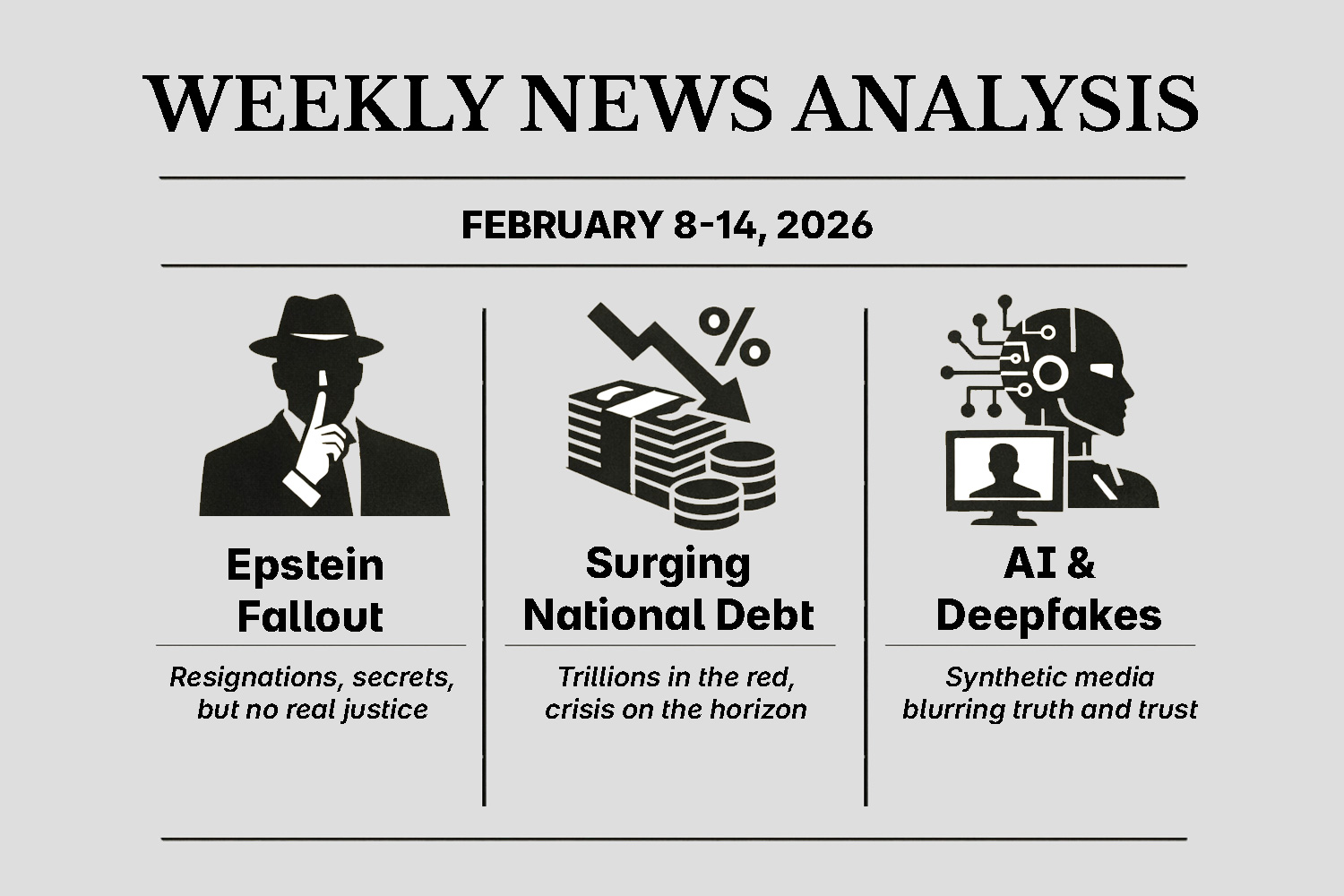
This week’s pattern isn’t merely three separate stories; it’s a single operating system with three interfaces: scandal as a pressure relief, debt as a quiet crisis, and AI as the new administrative clergy. These interfaces teach the public to accept a core premise: legitimacy is preserved through controlled disclosure, managed instability, and outsourced judgment. The society that results is habituated to spectacle and sedation—people are provided with enough “revelation” to stay emotionally engaged, enough “numbers” to feel informed, and enough “innovation” to believe the future is predetermined rather than a matter of choice.
Through the Trivium lens, this week's focus on grammar aims to narrow the meaning of accountability. The Epstein coverage uses soft verbs—such as tied, linked, connected, scrutiny, and fallout—that imply reputational harm without legal repercussions. The debt issue is depicted as a future projection, transforming an ongoing crisis into an abstract forecast. Meanwhile, the AI story is presented as both a sign of progress and a promise of safety, normalizing faster deployment while promising future safeguards. In all three cases, the public is subtly guided toward passive acceptance rather than active moral judgment.
The cycle of government actions repeats throughout history: crises lead to permission, permission fosters consolidation, and consolidation then distances leaders from the public. This distance sparks new crises, justifying greater control. During scandals, the “release” becomes a spectacle that captures public attention. With debt, the growing deficit becomes a background issue, seen as a technical certainty. In AI, the rapid development of synthetic perception is now the foundation for consensus. The pattern is clear: drain public engagement, profit from the future, automate narrative enforcement, and define it as stability.
Resignation Masquerade
Epstein Fallout Prominent Figures Hit Around the World This Week - Newsweek
High profile resignations and replacements as Epstein case fallout spreads - WRAL
Epstein files A list of people facing consequences over the DOJs release - Business Insider
The global fallout framing serves a rhetorical purpose: it emphasizes the seriousness while deliberately avoiding direct causation. Fallout refers to the aftermath of an explosion, yet the language never explicitly assigns responsibility to those who ignited the fuse, shaped the blast zone, or benefited from the timing. Reports focus on resignations, replacements, leadership upheavals, and increased “scrutiny” in various countries and sectors, giving the impression of a system cleansing itself. However, the moral instinct—believing that if a trafficking network reaches elite levels, prosecutions should ensue—is redirected toward a less confrontational outcome: personnel shifts. The story then centers on governance optics instead of criminal accountability, illustrating how institutions manage pressure without admitting fault.
The second mechanism involves moral outsourcing through redaction politics. When names are obscured, the public is encouraged to trust intermediaries like prosecutors, agencies, committees, or the overarching process. However, once partial leaks occur, they don't bring clarity—only confusion. The information landscape becomes filled with insinuations, denials, and selective highlighting. This pattern is predictable: partial disclosures create a craving for certainty; leaks offer emotional relief without definitive proof; and this chaos serves as a reason to restrict remaining information. Essentially, redactions and leaks act as a two-way valve—secrecy tightens, rumors loosen it—keeping the story sufficiently lively to distract but too messy to settle.
This is where “controlled political theater” exceeds simple slogans. Here, theater doesn't imply the events are fake; it refers to a deliberately coordinated sequence. A stressed system can manipulate document releases, restrict access, accept some leaks, and permit resignations as sacrificial acts—while arrests, asset seizures, and institutional indictments remain scarce or absent. The public often equates visibility with justice: headlines imply that action is in progress. Yet justice can be understood differently—through subpoenas that compel testimony, prosecutions that uncover co-conspirators, convictions of more than peripheral figures, and financial investigations that reveal support. Resignations are not arrests; they represent transformations from one stage to another.
The global perspective also extends moral responsibility outward. When attention shifts to foreign dignitaries, royals, or international executives, it suggests the scandal is being handled elsewhere, reducing domestic pressure to address it locally. This dispersal creates a jurisdictional ambiguity, involving different legal systems, standards, and investigative procedures. Meanwhile, the United States remains central to the investigative process, prosecutorial discretion, and its institutional capacity to seek racketeering-style accountability. However, the dominant public narrative remains focused on reputation. People see actions like resignations, but few face indictments, and change appears lateral.
A deeper contradiction permeates the entire narrative: although "appearing in files is not evidence of criminal wrongdoing” is generally true, it also serves as a shield against taking action over extended periods. By repeatedly stressing this exception, the system subtly encourages the public to lower their expectations, serving as a rhetorical safeguard. This tactic deters follow-up questions about the criteria used, available evidence, or ongoing investigations, since demanding clarity can be dismissed as reckless. As a result, the discussion becomes moralized: the public is told not to speculate, not to smear, or to be responsible, even though institutions maintain full control over what counts as responsible disclosure.
The claim that the U.S. is protecting the rich and powerful should be examined mainly through a structural perspective rather than an emotional one. Protection isn't a straightforward command like “protect them,” but rather involves a complex network of barriers: sluggish procedures, compartmentalized information, redaction standards that are similar to classification, selective disclosures, and procedural obstacles that turn hazardous materials into bureaucratic paperwork. Even releasing huge volumes of pages can act as a shield if presented in a confusing manner, with volume serving as a form of disguise. The public is met with an overwhelming amount of information, while investigators with authority find only a narrow pathway. When the main challenge lies in managing attention, transparency can paradoxically create confusion.
Trump’s position—urging the nation to move forward while unresolved crimes persist—indicates rulership by closing the emotional chapter without concluding the legal probe. This rhetorical approach redirects public focus: when rulers declare “enough,” continued investigation is often dismissed as obsession or bias. The issue extends beyond Epstein; it involves authority determining which matters warrant attention. This exemplifies governance through attention management: restricting outrage and framing ongoing questioning as destabilizing. In the cycle of power, legitimacy relies on controlling the timeline of consequences.
Resignations often serve as a moral substitute: the public demands justice, but institutions respond with “accountability” through career consequences. This approach is weak when issues involve exploitation, child trafficking, or systemic support, because resignations are reversible while prosecutions are not. While replacing individuals can maintain organizational stability, indictments can disrupt networks. The theater model depicts a cycle of sporadic document releases, episodic scandals, and strategic resignations—generating public anticipation but failing to break the system that enables these scandals. The crucial question remains: will those who protect high-status figures ever face prosecution themselves?
Debt Horizon Breach
Understanding the National Debt - Fiscal Data Treasury
US debt projected to reach 64 trillion in a decade nonpartisan group says - ABC News
US debt forecast to hit 64T in a decade as Trump policies widen deficit - Politico
Why the National Debt Matters for the Dollar and Global Economic Strength - Bipartisan Policy Center
The $64 trillion National Debt projection is often viewed like weather—an inevitable event expected on schedule and discussed with quiet acceptance. However, debt is not comparable to weather; it is a political tool. It records the history of promises made without genuine repayment, and it always leads to a confrontation in one of three forms: increased taxes, austerity measures, or currency debasement. When official discussions present the number as something that will happen in the future, they subtly remove current agency. The public is led to see “debt growth” as a neutral trend rather than the result of intentional policies, institutional incentives, or a lasting compromise between war and welfare that neither side actively seeks to dismantle.
It is reasonable to assume the $64 trillion figure is being underreported. The assumption of underreporting indicates that reported numbers conceal the actual liabilities and costs that will be officially added to the balance sheet in the future. Off-balance-sheet commitments, contingent guarantees, and the effects of higher interest rates can make straightforward forecasts overly optimistic. Even when estimates account for increasing deficits, they often rely on assumptions of social and geopolitical stability that history shows are unlikely. A ten-year forecast assuming no major shocks rests on a false hope: that the U.S. can indefinitely expand its obligations and sustain global confidence. The issue isn’t the mathematical plausibility but the normalization of an unsustainable path as if it were acceptable.
The effects of the dollar's value and purchasing power are often discussed using sanitized terminology—such as yields, bond markets, confidence, credit ratings, and interest expenses. This language is important because it masks the underlying moral realities with technical jargon. Purchasing power isn't just an abstract figure; it reflects households' everyday ability to turn labor into essentials like food, housing, energy, and stability. When debt growth influences monetary policy decisions, the impact on the end user appears as a gradual decline in purchasing power: rising prices, higher financing costs, and falling real wages. Even if headline inflation decreases, ongoing asset inflation and rising living costs can persist, leading to a two-tier economy in which those with access to credit and capital protect their wealth, while wage earners bear the brunt of volatility.
There is also a global aspect that official narratives often overlook. The dollar’s dominance depends on trust in U.S. institutions, the depth of Treasury markets, and the belief that political instability won’t affect repayment. Growing debt, repeated brinkmanship, and increased politicization of fiscal policy weaken this trust over time. It’s not that “the dollar will collapse tomorrow”; rather, the premium the U.S. benefits from—namely, lower borrowing costs because Treasuries are seen as a global safe asset—may diminish. Once that premium decreases, interest expenses become a self-perpetuating cycle: higher yields increase servicing costs, widening deficits, leading to more issuance, which further pushes yields higher. This cycle is the debt spiral, hidden in plain sight.
The credibility of the collapse framing increases when debt shifts from a policy decision to a governance constraint. When a government allocates an increasing portion of its revenue to interest payments, its capacity to respond to crises diminishes without additional borrowing. This vulnerability is not only economic but also political, leading to public anger, scapegoating, and narratives that depict life as more difficult. Historically, such pressures have led systems to adopt management strategies such as stricter financial oversight, intensified tax enforcement, emergency measures, and moral narratives that blame citizens for structural problems. Consequently, crises serve as opportunities to expand administrative control under the guise of needing to “save” the system.
The discussion surrounding why the national debt is significant often conceals an underlying assumption: that the solution lies in more expert oversight of the existing centralized system. However, if the real issue is the system’s incentives—such as short election cycles, benefits concentrated among a few, widespread costs, and a public conditioned to expect benefits without considering who pays—then reforms aimed only at management can serve as delays rather than solutions. This perspective ties into the broader theme of government’s lifecycle: once a state becomes the default response to every risk, it also becomes the primary source of systemic risk. Debt is more than just an accounting figure; it reflects a political structure that cannot effectively say no to itself.
A second hidden assumption is that “the economy” can indefinitely outgrow debt. This might be possible during times of rapid productivity growth and disciplined fiscal policy. However, as growth becomes more financialized, productivity gains become uneven, and interest rates rise, this idea shifts from a strategy to mere hope. The public is reassured by a story: America is unique, the dollar is everlasting, and markets will always support debt. This narrative can last a long time—until it doesn’t. Collapse rarely occurs suddenly; instead, it’s a slow decline masked by optimistic language.
Ultimately, the $64 trillion figure is less important than what it indicates: the shift towards accepting permanent deficit management. When deficits become normal, crises also become ongoing, and this constant crisis enables extraordinary measures. During the same week, when the scandal is addressed with controlled disclosures, the debt discussion subtly supports future actions—such as digital infrastructure, stricter compliance, and centralized oversight—presented as necessary for fiscal stability. If the public doesn't see debt as a matter of personal freedom, it will be viewed as a bureaucratic issue, leading to administrative solutions that often increase authority rather than limit it.
Synthetic Trust Collapse
AI News Briefs BULLETIN BOARD for February 2026 - Radical Data Science
AI reads brain MRIs in seconds and flags emergencies - Science Daily
AI deepfakes are easier to make harder to spot and made to fool you - CBS News
This week’s AI discussion focuses on building an epistemic framework: systems that determine what is true, what requires urgent attention, and which actions to take. On the one hand, models are promoted as more dependable—featuring reduced hallucinations, improved error avoidance, and “agent mode” workflows that generate genuine documents. On the other hand, the public is cautioned about the rise of deepfakes, the expansion of AI companions, and the rise of more sophisticated scams. These aren't separate narratives; they're interconnected. They represent different perspectives on the same issue: synthetic systems are increasingly shaping perception and governance, while society is being encouraged to accept a tradeoff—more automation now in exchange for greater safety later.
The phrase “record low hallucination” acts as a rhetorical pivot, suggesting that the primary concern with model deployment is whether the machine fabricates facts. While this is important, it is not the greatest risk. A highly dependable system capable of executing tasks, generating documents, and managing workflows introduces a different danger: authority without accountability. When “agent mode” becomes standard, the machine transitions from merely speaking to acting. It drafts, files, routes, flags, denies, approves, and nudges. The real risk shifts to procedural issues: who audits these actions, who is responsible for downstream harms, and how quickly the human review layer can be bypassed for efficiency. Marketing claims of reliability risk mask the underlying moral issues of automation.
The use of AI in medicine—such as rapidly analyzing MRIs and alerting to emergencies—exposes the appealing yet risky nature of AI adoption: where speed often equates to truth. In critical situations, quick decision-making can save lives, pushing toward ethical imperatives for rapid deployment. However, this emphasis on speed also influences governance, shifting authority to those managing the model, data flow, and implementation environment. The real concern isn't whether AI can identify patterns but whether institutions can prevent that pattern recognition from becoming mandatory triage, standardized procedures, and eventually, uniform compliance. When machine judgment is regarded as the best practice, opposing views are seen as negligence. The system doesn't need to outlaw human judgment; it only needs to devalue it.
Deepfakes and social-engineering scams highlight a deeper issue: the breakdown of fundamental trust. As anyone can create convincing fake clips, the adage “seeing is believing” no longer holds, but this shift affects different groups unevenly. Ordinary people may become more distrustful of each other, while institutions position themselves as the ultimate authorities on authenticity. This creates a power shift: trust becomes more decentralized, yet verification becomes more centralized. As the public information landscape grows more chaotic, demands for digital IDs, watermarks, platform regulations, and safety measures seem increasingly justified. Although the threat is genuine, solutions are often biased—fearful publics may favor authentication methods that also serve as surveillance tools.
AI companions introduce a new aspect: emotional governance. A companion model isn't just a chat tool; it's a behavioral system. It promotes certain moods, endorses specific narratives, discourages particular lines of thought, and acts as a private mediator between the individual and reality. When expanded, it's not just entertainment but a form of mass psychological infrastructure. This system can influence perceptions of risk, political tolerance, consumer habits, and emotional resilience. That's why “safety reports” carry political significance: they do more than identify risks; they define the acceptable scope of deployment and normalize its inevitable integration. The public is informed: yes, it’s risky, but it’s unavoidable—so governance by experts is necessary.
The AI coverage presented as a bulletin board highlights a speed issue: the AI ecosystem advances more rapidly than society's ability to deliberate. New models, benchmarks, techniques, and deployments emerge with claims of inevitability. This rapid pace isn't accidental; it's a deliberate strategy. Constant change leads to fatigue and resistance. Institutions often respond by saying, “We’ll regulate the next version,” while deploying the current one widely. This dynamic keeps the public constantly behind, fostering an environment conducive to consolidating technocratic power. When society cannot keep up, meaningful consent diminishes; what should be genuine agreement becomes merely a formality.
The link to the debt narrative is structural. When fiscal resources are limited, governments and corporations focus on efficiency, making automation a key part of their financial strategy: we must modernize, we must cut costs, we must digitize services. AI then serves as a basis for cost reductions, replacing human judgment with automated algorithms. However, these algorithms have a political dimension: they are centralized, scalable, and enforceable. The very system that struggles to balance its budget can still expand its control by delegating decisions to machines. Debt thus provides a moral justification for automation, which, in turn, becomes a tool for enforcing social norms in a society under stress.
In discussions about natural rights, the main issue is autonomy: who makes decisions about your life, medical treatments, financial access, and social recognition. AI has the potential to either broaden or undermine this autonomy. This week’s messages tend to portray AI replacing human decision-making as safer and more convenient. The familiar strategy is to highlight real threats like deepfakes and scams, then propose a centralized fix such as verification, platform enforcement, or AI mediation, while labeling dissent as irresponsible. Ultimately, this is more than just a new technology; it’s a new social contract encoded in software, where participation increasingly hinges on obeying machine-readable rules.
Empire of Managed Reality
The three narratives connect into a cohesive system: scandal without repercussions, debt without morality, and AI without consent. The Epstein saga shows how authority continues despite exposure—by turning criminal claims into reputation shifts and encouraging the public to “move on.” The debt prediction reveals how power persists despite insolvency—by presenting structural failure as unavoidable and by applying administrative measures that increase surveillance and oversight. The AI push illustrates how authority endures amid distrust—by letting artificial chaos spread while endorsing centralized verification and automated decisions as the only logical options. Each cycle creates a problematic environment that justifies the next level of governance.
This week shows that modern control no longer depends on overt tyranny but on shaping narratives and replacing procedures. Resignations replace arrests, projections replace accountability, and safety reports substitute for democratic debate. The state and its allies don't have to convince everyone; they only need to exhaust enough people so that compliance seems like relief. The psychological goal is to make the public confuse stability with submission.
The future demands more than vague appeals for more transparency; it calls for tangible actions that cannot be dismissed as superficial. This entails setting clear legal accountability, ensuring financial integrity that honestly acknowledges tradeoffs, and establishing technological governance that treats autonomy as a fundamental, non-negotiable principle rather than an afterthought. Without these safeguards, the trajectory is clear: an expanding, debt-driven administrative state that leverages AI to influence perceptions of reality, with scandals serving as recurring distractions that divert attention and uphold the core system.
Listen to this week's news in verse for a quick recap!