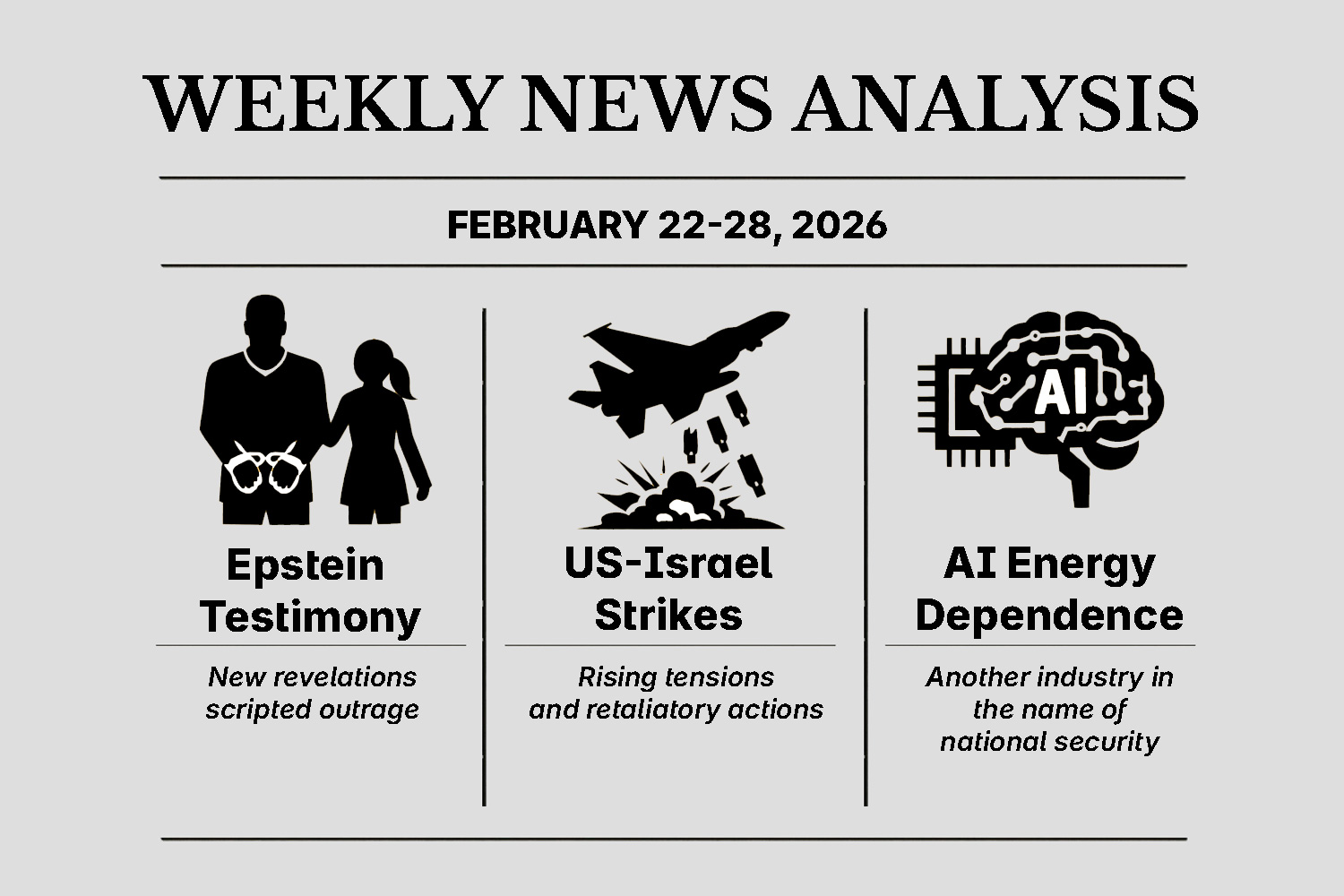
This week, scandal management acts as political anesthesia, the preemption doctrine functions as the foreign policy interface, and energy combined with AI serves as the foundational material for the next administrative regime. The front-facing stories seem unrelated—such as Epstein fallout and elite testimonies, the rapidly intensifying Israel–Iran crisis, and a Washington debate over which AI vendor is considered "safe" for government use. However, the common pattern is governance through narrative: public focus is directed by emotionally charged frames, while institutional authorities discreetly establish new permissions, dependencies, and infrastructures.
Once institutions are given exceptional authority for “containment," they tend to normalize and make it routine. In the context of the government’s tendency toward centralization, scandals serve as pressure outlets, wars act as catalysts for further centralization, and technological infrastructure forms a silent, enduring layer that outlasts any single administration. While the public discusses personalities and motives, the system’s true success lies in its continuity—a consistent ability to define risk, identify enemies, and use tools to shape reality.
Blackmail Fog Machine
Bill Clinton Testifies Under Oath That Trump Was Not Involved with Epstein - The Gateway Pundit
Epstein files impact fallout investigation - CNN
Bill Clinton breaks silence on infamous hot tub photo during Epstein testimony - Fox News
Bill Gates took responsibility over Epstein ties in staff meeting foundation says - BBC
This week’s Epstein narrative is presented as “accountability,” but it functions more like a controlled release of reputational pressure. Testimony is seen as a form of purification, as if speaking under oath instantly turns a systemic issue into a personal truth. This is a classic method of maintaining legitimacy—ritualistic disclosure that keeps the audience engaged while safeguarding the core framework. The public is given a binary choice (implicate or exonerate), which serves as a simple throttle: the story can be intensified to attract more attention or softened to maintain stability, all without requiring institutional transparency at a structural level. The scandal acts like a fog machine—dense enough to obscure, engaging enough to entertain, and ultimately designed to dissipate on schedule.
The “exoneration” motif shows how modern politics relies on relational testimony as a substitute for clear documentary evidence. A lack of knowledge is mistaken for innocence, and proximity to wrongdoing is treated as guilt only when it aligns with factional narratives. This isn't genuine reasoning; it’s a process of sorting information. The moral energy of scandals is diverted from systemic issues—such as prosecution decisions, intelligence conflicts, blackmail motives, and cover-ups—to personality conflicts that can be endlessly debated without leading to real accountability.
The “honey pot” framing heightens this diversion in a distinct way. It suggests something potentially systemic, such as intelligence gathering, leverage, or elite corruption. Even if true, it also risks transforming the entire issue into a self-contained myth in which everything is espionage, making it unprovable and, consequently, unpunishable, because the system protects itself. The brilliance of the honey pot narrative, when it dominates culturally, lies in its ability to make people feel they have identified the mechanism while simultaneously convincing them that it is too powerful to challenge or that voting will fix the issue. As a result, the audience becomes conspiratorially aware yet politically passive—certain there is a web, but conditioned to accept that webs cannot be cut. Government is not too big to fail; nothing is.
Observe how the story’s emotional focus shifts repeatedly from victims to reputations. Even when discussing exploitation, the narrative often centers on famous individuals, photo details, and partisan stakes. This shift represents a moral reversal: it nudges the audience to see scandal as a political tool rather than as a human rights violation with underlying institutional factors. Additionally, this serves as a long-term defense for entrenched power. When public outrage mainly targets which side is embarrassed, the system can persist without changes, as outrage becomes partisan rather than moral. In this context, this scripted outrage does not threaten the system; instead, it sustains it by maintaining high attention and minimal demands.
Some articles focus on a single infamous photo that highlights how the micro-mechanics of distraction work. Images serve as shortcuts to narratives, condensing complex situations into simple emotional signals. Viewers are encouraged to judge characters, speculate about what was known, and debate plausibility—asking, “Would he have known?”—while avoiding more difficult questions about documentation, deals, or institutional incentives to conceal evidence. In this context, a photo is treated as the “case,” thereby shifting the debate to what a powerful individual claims to have perceived. This storytelling structure, tailored for television and social media, is not suited to delivering justice. It keeps discussions just outside of truth, never fully within it.
Other articles have focused on organizational damage control related to connections and “taking responsibility”—introduces another element: corporate-philanthropic governance often prioritizes reputation management over genuine accountability. Here, “responsibility” is a flexible term; it can refer to moral remorse, compliance with regulations, or simply internal messages aimed at reassuring staff and donors. This framing depicts a scenario in which institutions maintain legitimacy through internal messaging and brand control rather than through transparent public accountability. It resembles a softer version of political testimony: a ritual of expressing regret without facing real consequences. The public is led to believe that acknowledgment alone is enough to resolve issues, as if simply identifying a problem eradicates its root causes.
This is where the government's lifecycle dynamic becomes important: governments often expand by turning crises into permissions. Scandal coverage exemplifies this, conditioning the public to accept opaque processes—such as sealed testimony, selective disclosures, and curated stories—as necessary for maintaining order and safety. Over time, this conditioning leads to a more accepting population toward black boxes. The Epstein case, regardless of political shifts, trains society to believe that truth is controlled by authorities and mediated through institutions, rather than something citizens can fully access. Once this belief is established, further increases in secrecy and control tend to encounter less opposition.
The core contradiction, then, is between the stated goals of transparency, accountability, and protecting the vulnerable, and the actual practices that focus on reputation management, controlling narratives, and maintaining power. The scandal of the week serves as both a show and a defense, creating the illusion of progress through testimony, investigations, and headlines, while actually preventing meaningful change, such as transparent releases, independent prosecution, and uniform standards. The “fog machine” doesn't just hide the truth; it trains the public to accept obscurity as a normal part of civic life.
Preemptive Spiral
Israel Iran attack live news - CNN
US - Israel attack Iran - Fox News
Israel launches preemptive strike against Iran, defense minister says - Fox News
The focus of Iran's attack reporting centers on a single term: preemptive. This word carries strong ethical connotations, implying inevitability, urgency, and a defensive stance. It simplifies uncertainty, making predictions appear as justified actions. In rhetoric, 'preemption' acts as a license—reframing acts of aggression as preventative measures and transforming intelligence claims into moral duties. Audiences are encouraged to accept emergency responses, such as airspace closures, the declaration of a state of emergency, and retaliatory actions taken in advance—presented as standard procedures, thereby framing escalation as a bureaucratic necessity rather than a deliberate political choice. This tactic makes escalation seem like a routine step in a hostile environment rather than a strategic, aggressive decision.
Preemption logic is inherently delicate because it depends on hypothetical situations. Since the public cannot observe the avoided future, such claims cannot be disproven at the moment, making them a potent tool for mass manipulation and potentially dangerous for responsible governance. Once a threshold is crossed—like framing “they were going to attack” as a justified reason—every subsequent action can be seen as necessary. This creates a feedback loop: fear of retaliation prompts emergency measures, which then reinforce the perceived threat, justifying even more actions. In the end, the public lives in a self-perpetuating narrative where the environment itself is regarded as evidence of danger.
Different media outlets often frame issues through ideological lenses, yet they frequently serve similar practical functions. One may focus on national defense, another on regional instability, and a third on human impact — but all tend to support the idea that centralized authority is essential to handle complex threats. This reflects a cycle where crises prompt intervention, leading to the accumulation of power. The public becomes accustomed to accepting extraordinary measures such as surveillance, censorship, emergency powers, and increased funding because they are portrayed as necessary responses. Meanwhile, alternatives are portrayed as helpless in the face of threats. Although outlets may blame different actors, they generally agree on expanding security measures.
Historically, preemption rhetoric often follows a common pattern: it starts as an exception and gradually evolves into a doctrine. When a state persuades others that “waiting is irresponsible,” it can then frame diplomacy as a sign of weakness and view caution as support for wrongdoing. This results in a limited political perspective: fewer policy options, reduced space for dissent, and increased social pressure against skepticism. In practice, preemption not only supports foreign policy objectives but also promotes domestic discipline. It stifles debate, diminishes hesitation, and instructs citizens that obedience is the morally right response in crises.
In attention economies, war and scandal reinforce each other. War generates urgency that can overshadow or diminish the importance of other controversies. Conversely, a scandal causes emotional division, which hampers collective discussions about war. Both issues are usually tackled with similar strategies—more intelligence, faster decisions, enhanced predictive systems—serving the same behind-the-scenes sectors: the security and tech industries, which expand as instability increases.
From the government’s lifecycle perspective, the crucial step is transforming temporary emergency measures into permanent infrastructure. Emergency declarations do more than authorize strikes; they also facilitate procurement, data sharing, and enhanced interoperability among government agencies and private contractors. While the public observes the strikes, the system has the opportunity to expand its tools for detecting, predicting, and “preventing” threats. Although battlefield results may be uncertain, bureaucratic outcomes are typically predictable: increased integration, heightened secrecy, and centralized control. Crises serve as catalysts, enabling upgrades to progress without requiring full public approval.
The core contradiction lies between stated objectives—such as security, deterrence, and stability—and the predictable outcomes—such as incentives for escalation, increased risk of conflict, and the normalization of extraordinary governance. Preemptive strategies rarely provide definitive solutions; instead, they establish precedents. When these precedents develop into doctrine, society becomes more controllable through fear-based language. This cycle is both geopolitical and domestic: a culture conditioned to accept continuous emergencies tends to accept ongoing control.
Power Grid Priesthood
American Energy Dominance Is Back Under President Trump - White House
Trump directs US agencies to toss Anthropic's AI as Pentagon calls startup a supply risk - Reuters
Anthropic says it will challenge Pentagon's supply chain risk designation in court - Reuters
OpenAI reaches deal to deploy AI models on U.S. Department of War classified network - Reuters
Energy dominance is often seen as a route to prosperity and sovereignty, but it’s also crucial for expanding AI capabilities. Market views suggest that energy growth drives the upcoming industrial revolution—an economy focused on electricity, data centers, and the physical processes behind machine intelligence. The grid is more than just infrastructure; it acts as a governance framework. Those who control ample energy and allocate it to computing gain leverage over finance, security, media, and administrative decision-making.
The White House’s rhetoric acts as a political ritual: framing deregulation as liberation, extraction as independence, and increased capacity as moral virtue. “Dominance” is a key term, highlighting that the aim is not just sufficiency but gaining an advantage—supporting an international competitive stance that justifies faster growth and reduced resistance. Connecting energy policy to national security language, the narrative prepares the public to accept extraordinary measures, such as faster permitting, centralized agencies, industry-government collaboration, and emergency responses centered on supply issues. Citizens are encouraged to see this approach as sensible, even as it boosts the state’s power to prioritize economic winners and determine which technologies are acceptable.
The Reuters article highlights how quickly “risk” language can be politically weaponized in the AI industry. Labeling a top AI provider as a supply-chain risk, instructing agencies to phase it out, and warning of further consequences are more than just procurement decisions—they are about asserting control over the government's cognitive infrastructure. The core issue isn't just security but gatekeeping: deciding who gets to be the approved interpreter of reality within federal processes. When the government chooses which models to use internally, it essentially designates the authorities responsible for managing documents, intelligence, advice, and automated decisions.
The legal challenge by Anthropic underscores a new battleground: courts and contracts as tools of technological sovereignty. These encompass more than just legislation; modern technocracy emphasizes vendor eligibility, compliance criteria, and supply-chain classifications that impact market success. While this form of control is more subtle, it is highly effective because it functions through administrative processes most citizens are unaware of. The narrative of safety and security offers moral justification, but the real effect is consolidation: fewer approved vendors, greater integration with defense agencies, and a more centralized pipeline for AI capabilities into government.
The OpenAI agreement to deploy models on a classified defense network marks a key milestone: energy policy supplies the raw materials, risk policy determines the winners, and deploying within a classified setting integrates the technology into a highly opaque domain. This area presents major accountability issues because, by nature, classified systems are hidden from public oversight, yet they increasingly impact real-world outcomes—such as targeting, intelligence analysis, procurement, and strategic assessments. The public must trust that safety measures and guardrails are in place, even when they cannot verify them. This environment provides an ideal opportunity for power to grow quietly.
The narrative of AI’s “race to power” mirrors geopolitical tensions, both driven by rising energy demands and the need for quicker centralization. When the public is told that a country must “lead the world in AI,” it implies that hesitation is tantamount to failure. This mindset can hinder critical discussions of ethics, surveillance, labor, and the centralization of decision-making within machine systems. While innovation is seen, reliance on specific models grows, making the vendor a quasi-institution. This dependency makes it difficult and costly to escape the system.
We are witnessing emergency justifications consolidate into permanent administrative measures. Instead of openly declaring tyranny, the state may use tools that enhance centralized control, making it more efficient, quicker, and less visible in its reach toward absolute dominance. Rhetoric promoting energy dominance garners public backing, while narratives about supply-chain risks restrict alternatives. Deploying classified systems can circumvent public oversight. This creates a form of digital feudalism with a hierarchy of compute lords, approved platforms, and citizens who increasingly experience governance through algorithms rather than human decisions. Consequently, the public’s role shifts from active citizens to users engaging with interfaces governed by external rules.
The core contradiction exists between the rhetoric of freedom and the structure of dependency. While abundant energy can enable decentralization, it is often exploited to strengthen centralized control through national security measures, vendor selection, and classified system integrations. This week’s narrative isn't solely about “AI in government,” but about a governance framework that centralizes power among those who control energy, computing resources, and the authority to determine what is “safe.” This issue extends beyond technology; it concerns sovereignty.
Empire Runs on Crisis
The three topics of the week—scandal, war, and infrastructure—operate as an interconnected system that maintains authority amid declining public trust. Scandal cycles emotionally engage the public while keeping them structurally powerless; they teach the masses to associate disclosure with accountability and accept partial truths as normal. War cycles escalate the sense of emergency, normalizing preemptive logic and making exceptional measures seem like responsible governance. Infrastructure cycles subtly standardize essential tools for future crises: expanding energy to support computing needs, enforcing procurement controls over vendors, and deploying classified operations to keep the deepest integrations beyond public oversight.
A recurring pattern emerges: crisis triggers intervention; intervention leads to consolidation; and this consolidation creates new vulnerabilities, justifying the next crisis. In this cycle, language is not just decoration but the core mechanism. Words like “preemptive,” “dominance,” “risk,” and “classified” facilitate permission, shaping public perception. Consequently, society becomes conditioned to view opaque management as safety and to interpret institutional actions as justice. The structural trend suggests a future where autonomy diminishes not through explicit bans but because the systems governing life become too integrated, emergency-driven, and machine-mediated, making contestation difficult without first breaking the illusion of inevitability.
Listen to this week's news in verse for a quick recap!