This week’s pattern resembles more of an interface design than specific "events": a legal limit on executive authority appears in one window, spectacle and cosmic drama unfold in another, while a subtle transfer of power and funds moves smoothly in the background, functioning like routine administration. The public is encouraged to click on the most eye-catching tab—aliens, intrigue, personality clashes—while the real mechanisms work behind the scenes: courts defining the boundaries of emergency power, institutions normalizing funds managed by the executive, and the national security apparatus maintaining the potential for escalation. This isn't accidental confusion; it's a deliberate form of confusion that stabilizes the system, helping maintain legitimacy while the operational system undergoes updates.
Using the Trivium, the week's focus on Grammar plays a central role. Words such as emergency, national security, peace, disclosure, deal, and ultimatum are not neutral; they serve as control terms that reduce moral complexity into a sense of administrative urgency. Logic is kept in check through compartmentalization: one narrative is presented as a constitutional process, another as entertainment, a third as a foreign-policy necessity, and yet another as innovation. Rhetoric weaves these together by shaping the audience's belief that the system is self-correcting (like court limits), benevolent (peace initiatives), vigilant (Iran posture), and modernizing (AI governance)—even when these so-called corrections and protections act as permissions for greater power concentration.
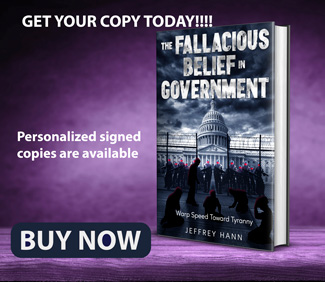
The underlying theme reflects a recurring cycle: crisis leads to intervention, followed by consolidation, which then triggers a new crisis. Society, conditioned to accept emergency governance, increasingly perceives exceptions as normal, and then they become the norm. In The Fallacious Belief in Government: Warp Speed Toward Tyranny, the evolution of state power is depicted as a self-perpetuating process in which each “solution” creates a dependency on subsequent interventions. This pattern doesn’t require a dictator but relies on a shared narrative. Currently, that narrative is distraction-as-therapy, where spectacle calms the public while the state machinery reestablishes control.
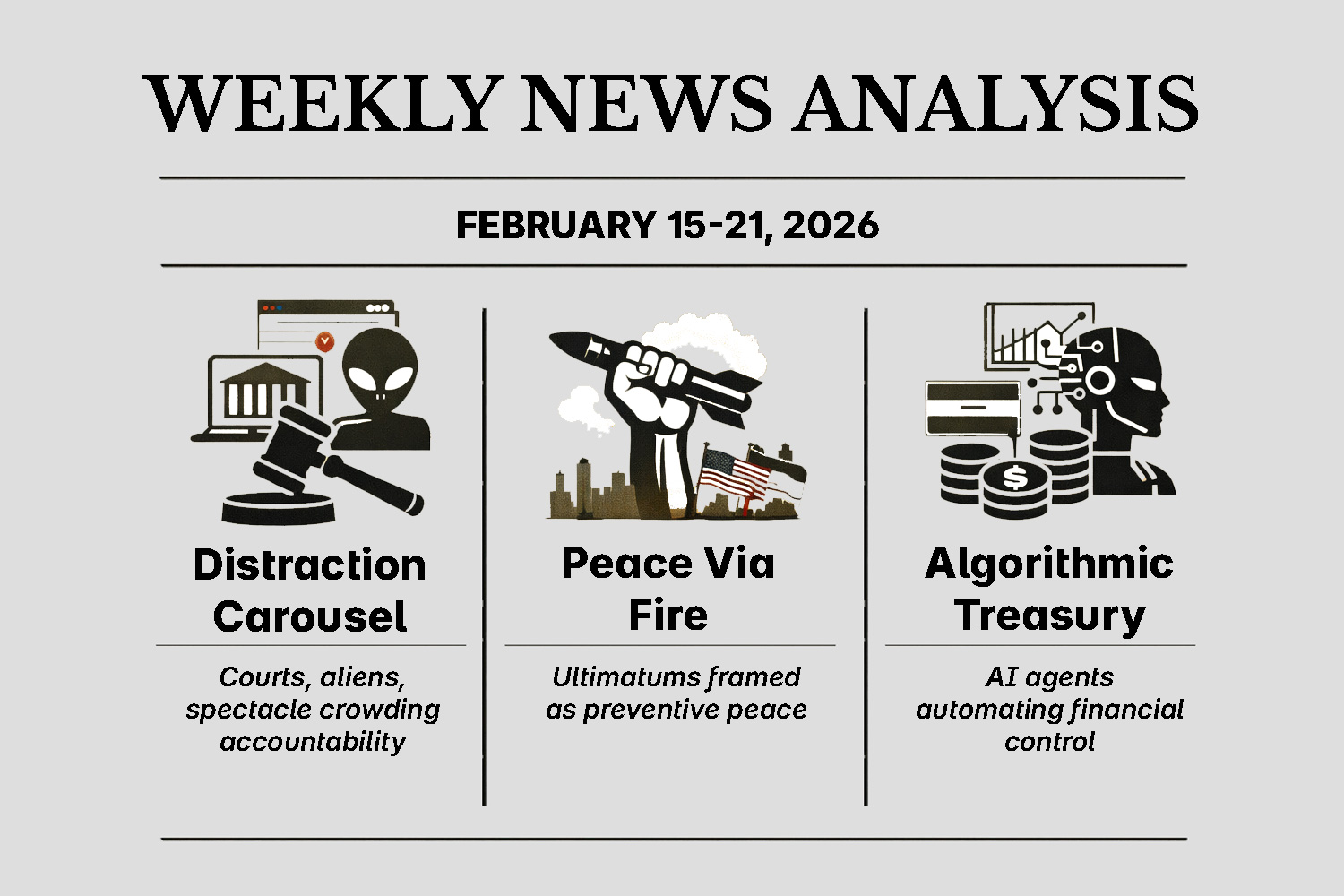
Distraction Carousel
Takeaways Supreme Court stands up to Trump on emergency tariffs - CNN
Trump reacts to Supreme Court ruling on power to impose sweeping tariffs - Fox News
Trump directs US government to prepare release of files on aliens and UFOs - BBC
Alien files incoming Trump orders government release of UFO records - Reuters
Israeli space chief says aliens may well exist but they havent met humans - Times of Israel
Trump pledges 10 billion Board of Peace meeting - Rolling Stones
The Supreme Court’s tariff decision acts as a rare definitive boundary in a time dominated by executive improvisation. Whether seen as a triumph of judicial independence, a betrayal by judges, or market reassurance, the core message remains unchanged: language indicating an emergency does not automatically grant emergency powers. While many outlets highlight the confrontation between branches, the more significant lesson is what the ruling signals to the public about what is acceptable. It does not necessarily reaffirm congressional dominance; rather, it re-legitimizes the system by demonstrating a clear constraint while keeping the larger emergency governance framework unchanged. Essentially, one well-publicized limit can serve as credibility for future, subtler expansions elsewhere.
The discussion about “emergency tariffs” exemplifies a common tactic: framing political decisions as technical necessities. When tariffs are presented as mere preferences, they are openly debatable; but if portrayed as an emergency, opposition is dismissed as naive or disloyal. This approach also creates a false choice: either accept unilateral measures or face national harm. The Court’s rejection challenges this narrow dilemma, but only in the context of this specific legal route. The larger danger is that the public might mistake this legal critique for a broader systemic fix—believing the system self-corrects simply because it occasionally rejects certain methods, even as new approaches emerge. This reflects the lifecycle of policies: the system often cares less about a particular policy than about establishing the precedent that policies can be tested at scale until prevented.
Amid ongoing legal tensions, the announcement of the “alien files” serves as an almost ideal example of redirecting public attention. Whether UFO disclosures are taken seriously, dismissed as trivial, or considered partially credible, the key point is how they shift the public’s mental focus. The media treats this topic as a highly engaging novelty, effectively providing a soft pardon for other concurrent issues, such as institutional conflicts, corruption claims, and power struggles that demand ongoing focus. Even when coverage criticizes it as a "distraction," such commentary can unintentionally amplify it by endlessly echoing the headline and turning the spectacle into saturated content. In this way, rhetoric acts like judo: criticism inadvertently fuels the very distraction it aims to critique.
The angle of claiming that “Obama revealed classified information” adds another layer: using scapegoating to drive the narrative. It shifts focus from the facts about what the state knows or whether disclosures are genuine, to a personality clash—highlighting who embarrassed whom, who “broke rules,” and who is “in trouble.” This is a common escape route: when institutions are asked to explain secrecy, they often reframe the issue as a matter of partisan etiquette. Reuters and other outlets point out Trump’s uncertainty about aliens while emphasizing his claim about Obama; this keeps the discussion in the realm of insinuation and spectacle rather than a verifiable institutional review. The audience is lulled into passivity, caught in a dopamine loop where revelation is promised but real accountability is delayed.
The Times of Israel article about an Israeli space official’s comments on alien life falls into the same epistemic fog: it’s speculative but presented as credible because it comes from a “space chief” figure. Authority by title replaces evidence, teaching the public that elites can hint or imply without making falsifiable claims. This rhetorical strategy reflects a broader trend in modern governance: secrecy becomes culturally accepted, and “trust us” becomes the default. When the state later justifies secrecy for war, surveillance, or economic reasons, people are already conditioned to see information withholding as normal rather than scandalous.
According to Rolling Stone and other sources, Trump's $10 billion funding pledge to the Board of Peace, which he controls, exposes a major contradiction: peace is framed as a corporate-style initiative led by executives and supported by large public funds with unclear governance. The language used hints at a philanthropic and institutional setting rather than a coercive or self-interested one. Yet when decision-making authority is concentrated, it leans toward a privatized foreign policy rather than genuine peace—a shadow organization whose legitimacy depends on narratives rather than on formal legal or constitutional authority. The real concern isn't merely about efficient fund use but about how executive-controlled funds are perceived as moral projects rather than tools for power transfer, which should be under strict public oversight.
Traditionally, this resembles the ancient imperial “bread and circuses” tactic, but adapted for today's algorithms. Rome didn’t require all citizens to adore the Senate; it simply needed them distracted to facilitate centralized control. Today’s version isn't a stadium event but a multi-channel spectacle—encompassing court dramas, alien encounters, “peace plan" disputes, and personality conflicts—each serving as a narrative chamber that prevents the public from forming a single, clear understanding. In the context of the Fallacious Belief in Government, this fragmentation itself acts as a form of governance: if people can't see the full picture, they can't develop a unified consent or organized resistance. The weekly carousel isn’t mere chaos; it's social pacification through an overload of stories.
Peace Via Fire
Iran US military strike prep - CNN
Trump gives Iran 10 day ultimatum experts signal talks may be buying time for strike - Fox News
US Israel warn Iran amid military buildup - The Express Tribune
Trump moves closer to a major war with Iran - Axios
Cheney pushes Bush to act on Iran - The Guardian
United States strikes on Iranian nuclear sites - Wikipedia
The label of a “peace president” falters under the pressure of escalation. Issuing an ultimatum to Iran, along with military buildup and talk of strikes, does not equate to a peace strategy; it constitutes coercive diplomacy supported by the credible threat of violence. While this might be justified as deterrence, rhetorically it amounts to moral laundering: framing war preparations as “preventing war.” The public is asked to accept a paradox—that violence is necessary for peace—without recognizing the underlying incentives. When leaders see that labeling actions as “peace” shields them from accountability, that label becomes a reusable tool. The administration can then depict each escalation as a reluctant but necessary step, even when such escalation is strategically planned.
The significance of the long-term historical trend is evident. In 2007, The Guardian highlighted how internal U.S. pressure to “act on Iran” reflects a deep-rooted strategic focus that predates any particular president. This demonstrates that ideas about regime change endure through changes in political parties, rhetoric, and public opinion because they are linked to lasting institutional interests—such as regional dominance, maintaining alliances, securing energy routes, intelligence strategies, and deterrence signals. The public hears different justifications over time, like WMDs, terrorism, nuclear timelines, or democracy promotion, but the core aim remains consistent: controlling the key strategic region. When the same policy goal persists across multiple administrations, the key question isn't “why now,” but “who gains each time.”
The perceived benefits of overthrowing Iran’s regime are often described as promoting security and stability. However, reality on the ground frequently yields different outcomes. Removing an adversary can destabilize regional equilibrium, leading to increased proxy conflicts, refugee crises, and retaliatory acts such as terrorism and cyberattacks, while also causing global economic disruptions—particularly in energy markets. Domestically, war can serve as a tool to strengthen authority: expanding surveillance, stigmatizing dissent, approving budgets swiftly, and increasing executive powers—all justified by national unity. COVID-19 serves as a structural analogy: artificially created or exaggerated emergencies can manipulate fear to ensure compliance. Similarly, war, like pandemic management, can reshape what populations consider acceptable or rational. The familiar strategies—constant threat alerts, reliance on experts, and moral distancing—easily transition from the public health to the foreign policy realm.
Counting strike patterns is important because it reveals the gap between rhetoric and actual behavior. In just the second term, multiple sources report an increase in U.S. operations across various countries, including strikes on Iran’s nuclear sites in June 2025 and discussions of further escalation into 2026. Other reports have outlined broader, multi-theater military actions aligned with the administration’s renewed strategy. The goal isn't to score political points; it’s to normalize continuous force projection. When “peace” is claimed even as the strike frequency rises, it conditions the public to accept war as ordinary; two and a half decades and counting of official war theater, we have been conditioned.
Why aim to overthrow Iran? Official reasons often cite nuclear nonproliferation and regional stability. However, underlying assumptions include strengthening alliances (notably with Israel and Gulf states), maintaining deterrence credibility, and gaining domestic political benefits by appearing decisive. Additionally, security agencies tend to exaggerate threats because their budgets and power depend on justifying their existence. This fosters a feedback cycle: as the public accepts emergency narratives, demand for more options grows, creating a self-reinforcing justification for action. Although the logic is cyclical, it can appear convincing, highlighting the fallacies the Trivium aims to reveal. The argument “If we don’t act, disaster will happen; therefore, action is necessary” isn’t proof but a fear-based fallacy with concealed assumptions.
Society gains nothing from war. War shifts wealth upward via procurement, contracts, and rebuilding efforts; it diminishes civil liberties under the guise of unity; it causes blowback that fuels future interventions; and it distracts from domestic decline. Even when tactical aims are met, strategic results often worsen because the force cannot create legitimacy. The public bears two costs: first, through taxes and debt, and second, through the domestic repercussions of militarized rule. This reflects the economic logic of empire—war becomes a routine source of subsidy. The rhetoric of “public good” masks extraction: the state claims to protect while expanding its control over people's labor and lives.
A historical analogy explains the trap: in late-stage empires, “mission creep” is often not an error but a structural necessity. When legitimacy relies on global dominance, rulers find it hard to choose restraint without seeming weak; thus, escalation is the default. The label of “peace president” is particularly dangerous because it shields a ruler from moral scrutiny that might otherwise restrain him. When the public believes peace can be bought with threats, the state has a free hand to label any aggression as “preventive.” This rhetorical immunity acts as a form of tyranny-by-consent—initially gentle, but potentially disastrous.
Algorithmic Treasury
How AI upgrades enterprise treasury management - Artificial Intelligence News
DBS pilots system that lets AI agents make payments for customers - Artificial Intelligence News/a>
Britain is the closest the world has to an AI safety inspector - The Economist
Study AI chatbots provide less accurate information to vulnerable users - MIT News
Exposing biases moods personalities hidden large language models - MIT News
If Topic 1 is the main spectacle of the week, then Topic 3 is the unveiling of the week’s infrastructure. Enterprise treasury automation and AI agents that make payments are not just about boosting productivity; they serve as fundamental governance tools in finance. Treasury management is where liquidity, risk, and timing translate into real influence—deciding who gets paid, when, under what conditions, and with what level of visibility. When that layer is handed over to systems promoted as “smart,” it subtly shifts public perception toward a new standard: decisions that were once the responsibility of humans are now based on metrics and model outputs. The language of efficiency gains moral legitimacy by emphasizing competence. However, competence does not necessarily imply consent, and automation does not inherently mean neutrality.
The idea of an “AI agent making payments for customers” blurs the line between recommendation and action, and it is at this boundary that democratic accountability primarily resides. A tool that merely suggests can be ignored, but one that takes action demands trust, permissions, and dispute-resolution mechanisms. When actions are automated, the key question becomes: who bears responsibility if something goes wrong—bank, vendor, model, or customer? This ambiguity isn’t a flaw; it often functions to spread liability. Additionally, it serves as a cultural training mechanism: people get used to delegating decision-making, only to be surprised when the system treats them as passive bystanders. This reflects a “you’ll own nothing” approach to decision-making, where ownership extends beyond property to encompass control over choices.
The Economist’s depiction of Britain as an “AI safety inspector” highlights the growing regulatory landscape, with institutions resembling weapons inspectors emerging as the industry advances rapidly. Even a well-meaning safety institute can serve a pacifying role, implying that “someone competent is watching” to reassure the public. Here, rhetoric shifts into governance: the mere label of oversight can stand in for actual control. This pattern reflects past crisis responses: commissions are set up after scandals, frameworks announced after harms, and the process continues—now with increased legitimacy. Oversight becomes a strategic narrative rather than a practical enforcement tool.
MIT’s report on chatbots providing less accurate information to vulnerable users challenges the myth that model outputs are always reliable. The important point is not that “AI sometimes gets things wrong”—that’s widely recognized—but that errors are unevenly spread. When vulnerable users get poorer-quality information, “AI everywhere” risks increasing inequality under the guise of democratizing access. This presents a moral hazard: institutions may justify reducing human support by relying on AI coverage, leaving the most at-risk individuals with the lowest-quality assistance. This pattern mirrors other sectors, where systems claim to offer universal benefits but, in reality, provide direct real help primarily to those with existing wealth and power.
The second MIT piece—discussing hidden biases, moods, and personality-like traits in large language models (LLM)—reveals a deeper issue: these systems are not just simple calculators. They can contain underlying tendencies that influence tone, framing, and persuasion, often without visibility, that were embedded by the developers of the LLM, even if by accident. This is significant because governance involves more than policy; it also includes how policies are explained, justified, and made normal. If models influence public information, customer service, finance, or government operations, their unseen “rhetoric” acts as a silent co-author of social reality. In Trivium terms, the rhetoric layer is outsourced to machines whose internal grammar is not publicly transparent. This represents a major shift: persuasion without a clear, accountable persuader.
Connecting this to the other themes of the week uncovers a clear systemic pattern. War rhetoric hinges on managed fear; legal conflicts rely on controlled legitimacy; and AI implementation depends on preserving trust. Although each area employs a different language, they share the same core principle: reducing human deliberation, prioritizing administrative concerns, and transferring decisions to systems that are hard to contest. The Fallacious Belief in Government framework posits that legitimacy should be grounded in individual autonomy and voluntary association, rather than in technocratic justifications such as “because we can.” Conversely, AI financial tools are moving in the opposite direction — toward centralized control points that can be updated, monitored, and constrained in real time.
The industrial era centralized production; the digital era centralized information; the AI era threatens to centralize judgment. When judgment becomes centralized, dissent is labeled misinformation, refusal is seen as risk, and autonomy is regarded as noncompliance. Achieving digital feudalism doesn’t need overt tyranny; it relies on convenience and institutional lock-in. Infrastructure such as Treasury AI, payment agents, and safety inspector procedures support this system. While the public is told to celebrate innovation, the true change is the transfer of agency from individuals to platforms.
Crisis As Governance
The three topics merge into a single framework: surface-level narrative overload with deeper consolidation. Legal reviews of emergency tariffs appear to balance actions, but spectacle and novelty divert attention from the oversight that would normally hold power in check. The stance toward Iran replicates the oldest state-growth mechanisms—fear and force—while branding it as peace masks escalation and elevates it as a virtue. Simultaneously, AI systems are penetrating finance and governance, shifting decision-making from humans to models, committees, and algorithms. This pattern is deliberate and adaptive; as one legitimacy channel weakens, another—such as spectacle, war, or innovation—gains prominence.
The warning is about the structure. A society that lives in constant emergency—whether related to health, war, the economy, or information—becomes psychologically conditioned to accept a permission-based lifestyle. This creates a “warp speed” effect: crises accelerate time, limit debates, and favor executive decisions. In such an environment, even genuine reforms can be used as tools of control if they increase authority without enhancing accountability. The solution is not to be cynical but to be consistent: avoid allowing the system to divide reality into separate, disconnected narratives. When people reconstruct cause-and-effect models—who benefits, who makes decisions, who is responsible—the illusion is shattered.
If a future “alien season” ever becomes a political talking point, it won't be primarily about cosmology; it will serve as a tool for governance—another form of emergency language on a broader scale. Whether the focus is extraterrestrials, tariffs, or AI safety, the core goal remains the same: the state’s aim to turn fear and fascination into compliance. The best lasting defense is moral clarity regarding natural rights and a firm stance against outsourcing judgment—because once judgment is handed over, autonomy shifts from a living reality to merely a nostalgic aesthetic.
Listen to this week's news in verse for a quick recap!