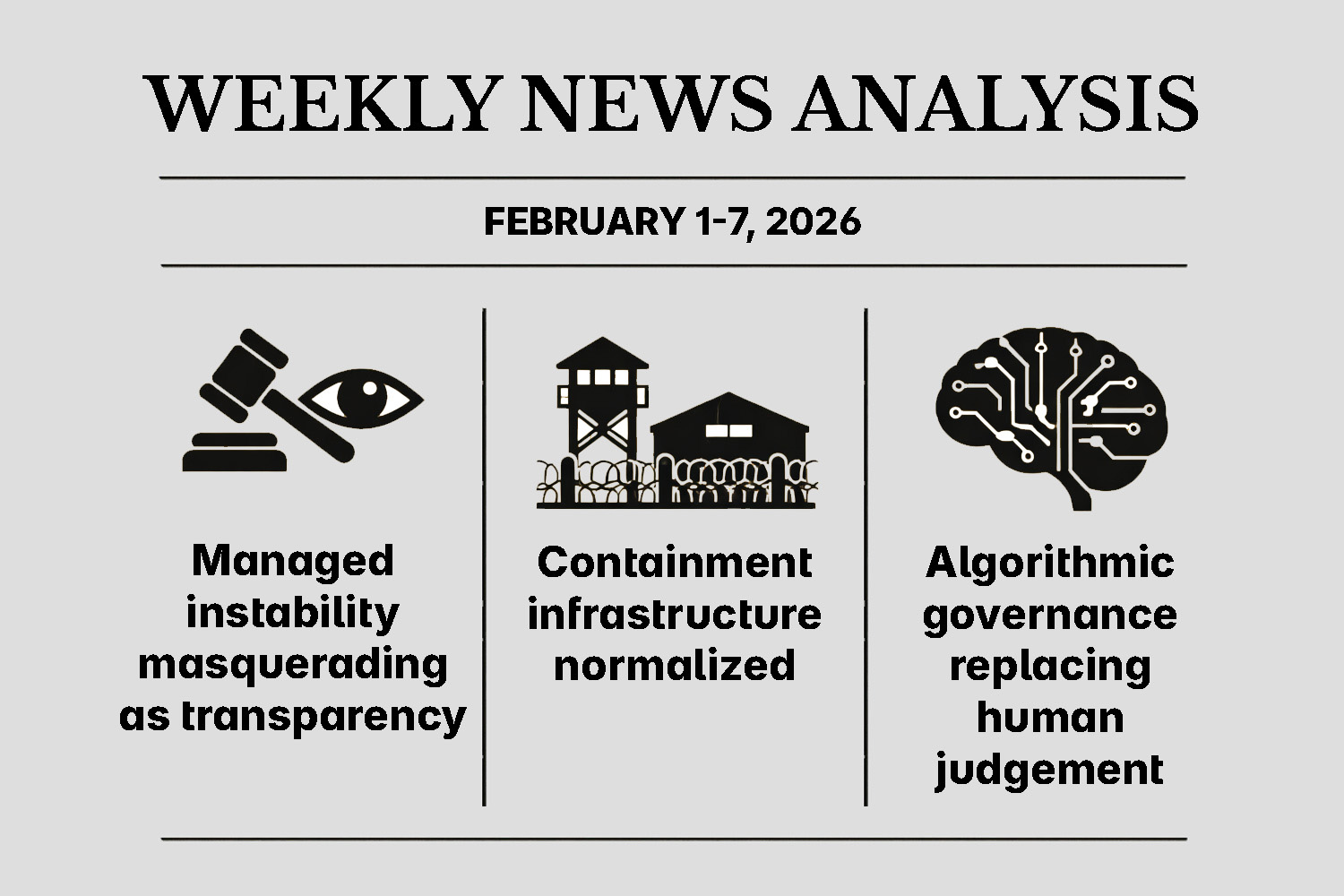
This week resembles a staged systems test: fiscal disruption acts like a controlled burn by printing more money, scandal-related information is still being reviewed, and innovation is used as a cover for deeper command consolidation. Congress ends a partial shutdown, lawmakers privately review Epstein-related materials, new detention facilities expand, bird flu vaccine projects progress, and AI tools are advancing faster in finance, government, and media. However, the true pattern is one of integration. Each narrative masks a different aspect of the same underlying architecture: unstable discretionary funding, persistent lack of transparency, adaptable infrastructure, and automated decision-making capable of influencing public opinion and replacing human judgment.
This week feels overly choreographed. Words such as stopgap, back pay, unredacted, oversight, warehouse, emergency, and AI agent serve as comfort terms—language that conveys protection, competence, and containment. The public faces limited choices: accept short-term funding or chaos; see congressional gatekeeping as accountability; accept detention expansion as immigration control; and view AI acceleration as inevitable progress. The system trains the audience to see structural moves as separate events, hindering pattern recognition—the key skill that causes propaganda to falter.
Across all three topics, the core mechanism reflects the lifecycle of authority outlined in The Fallacious Belief in Government: crises are seen as evidence of necessity, interventions as acts of kindness, and consolidations as improvements in efficiency. Meanwhile, the pandemic-era strategy described in COVID19 – Short Path to ‘You’ll Own Nothing. And You’ll Be Happy.’ remains the standard: pre-constructed logistics, pre-positioned narratives, and pre-justified exceptional control, all presented as temporary measures for harm reduction. The true continuity is not along partisan lines but in procedural consistency.
Scripted Transparency
House passes funds ending government shutdown - The Guardian
Partial shutdown ends less than four days after it began - Gov Exec
Epstein files DOJ Trump Clinton oversight – NPR
Trump is named in the latest batch of the Epstein Files - Miami Herald
Epstein-related coverage – BBC
Members of Congress view unredacted Epstein files - NBC News
The resolution of the shutdown isn’t about creating stability; it acts as a timed release valve. A $1.2 trillion funding package may seem like a definitive solution, but in practice, it operates as a short-term leash: the government is funded only through September, with DHS funding ending even earlier on February 13. This isn’t responsible budgeting; it's using budgets as leverage. A “partial shutdown” that begins, gains attention, and then quickly concludes helps condition the public to accept frequent disruptions as normal. It also entraps federal workers in a dependency cycle—back pay serves as a reward that makes future shutdown threats seem manageable, even routine. Ultimately, this creates a system of managed instability: governance based on deadlines, where each deadline restores control, secures concessions, and leaves the public mentally drained.
The paired spectacle—Epstein disclosures—follows the same logic of manipulation. Although “new files” are shown as a form of accountability, the real structure of their release is what counts: redactions remain, public access is limited, and the most important information is kept behind congressional viewing restrictions. This setup turns outrage into a dead end, making people feel like change is happening while preventing them from checking the facts. It’s not just about hiding information; it’s about training the public to see withholding as a form of responsible governance. Transparency is framed as a privilege of the elite, managed through committees, security clearances, and curated oversight, transforming citizens into spectators of what they believe is their justice system.
The missed deadline for the Epstein Transparency Act reveals a troubling message. When a transparency requirement is bypassed for over a month without enforcement, and the response is merely staged rather than compliant, it signals that the law is optional if it conflicts with institutional interests. This implies that legality is seen not as a moral obligation but as a managerial tool, especially when the law is often only a tyrant’s will. The public is expected to view delays as simple bureaucratic issues, not as displays of power. However, true power is shown by what it can ignore without repercussions. A system that can breach its own transparency deadlines yet still claim legitimacy indicates that legitimacy stems not from following rules but from maintaining a narrative through a monopoly on violence.
Narrative control is maintained by casting familiar villains and heroes. Names like Clintons, Gates, Trump, DOJ, and committees serve as symbolic figures in an ongoing moral drama. The public tends to interpret these stories through personalities instead of systems. Hearings and oversight debates give the illusion of progress, but in reality, these efforts lead nowhere: committees issue sound bites rather than genuine accountability. Even the phrase “nothing will come from it” becomes part of the show, cynically accepted as realism that keeps people emotionally engaged. The system thrives on both belief and skepticism, as long as attention stays on the spectacle rather than on dismantling the actual gatekeeping infrastructure.
The most revealing aspect is the shape of the redactions. When communications supposedly contain gritty, criminal details—such as references to children, torture, and operational coordination—while suspected names remain concealed, the redactions act as a confession: they are there to protect reputations rather than victims. The public is asked to trust that the very institutions that failed to stop a trafficking network are now responsibly managing its disclosed footprint. This creates a circular logic: the system relies on its custodianship as proof of trustworthiness. In reality, this approach prevents independent analysis, cross-referencing, and pattern recognition—methods that could expose the scandal as a prosecutable structure.
Trump’s remark that he “likes” the Clintons and doesn’t understand why people are “obsessed’ is rhetorically powerful because it breaks down partisan lines exactly where the public expects division. It subtly reveals a hidden logic of elite continuity, suggesting that common electoral conflicts are superficial. The statement also casts suspicion as an irrational obsession, subtly implying that those who notice repeated influence networks are somehow mentally ill. Instead of addressing why certain names keep reappearing, the rhetoric questions why citizens are so fixated. This is a form of narrative judo: it shifts the focus from possible corruption to the observer's supposed mental instability. It cleverly maintains the social taboo against holding elites accountable while appearing neutral.
One of the most troubling aspects is the extraordinary range of alleged communications, such as Maxwell being invited to a 9/11 Shadow Commission. Whether all these claims can be verified or not, the surrounding rhetorical environment is influential: it combines taboo topics into a unified field where the public struggles to distinguish evidence, inference, and insinuation. This confusion isn't accidental; it is a deliberate control tactic. When information is shared in incomplete, redacted, or fragmented forms, it encourages speculation—only to be criticized for it. This system effectively creates the "conspiracy culture” it criticizes, using it to justify more secrecy. Similar to how the CIA turned conspiracy theory into a negative connotation after the JFK assassination to help discredit any theories outside of the official government narrative.
This week exemplifies a repeating pattern: crisis leads to temporary fixes, followed by renewed deadlines, curated disclosures, procedural delays, and public fatigue. This cycle indicates a governance shift from strict law to performance-based management. In the framework of The Fallacious Belief in Government, it's the Tyranny phase disguised as administrative processes, where the public isn't asked for direct consent to coercion but accepts continuous management. Promises of stability, accountability, and transparency are deferred and later become an indefinite policy.
Warehoused Futures
How the Pentagon is quietly building camps - Migrant Insider
Locked down, rounded up, warehoused - The Free Thought Project
ICE warehouse detention DHS immigration - Washington Post
US spends hundreds of millions on warehouses for ICE detention centers - Bloomberg
Disease Outbreak News 2025 DON590 - WHO
HHS gives Moderna $590m to accelerate bird flu vaccine trials - Fierce Biotech
HHS phases out mRNA vaccine trials for COVID 19 bird flu - Roll Call
Detention facilities are often presented as a “logical” solution, e.g., for immigration detention, but the more significant issue is developing a scalable containment infrastructure—comprising facilities, contracts, transport systems, staffing models, data pipelines, and legal frameworks—that can be repurposed. The public is encouraged to debate “who deserves to be detained,” while ignoring the critical question in a mature security state: what else can this infrastructure be used for once established? Warehousing people is not limited to a single purpose; it is a versatile capability. Once normalized, it can expand to include classifications such as public health risk, domestic extremist, noncompliant, quarantined, or threat to order. The moral justification may shift, but the physical infrastructure remains.
This is why the pandemic overlay is significant. A future outbreak—particularly one labeled as bird flu—would serve as a clear rhetorical link from immigration detention to domestic containment. Instead of explicitly mentioning camps, it would use terms such as isolation, surge capacity, temporary housing, field triage, and community protection. The memory of COVID-era restrictions makes this shift more straightforward: if society has already accepted movement restrictions for health reasons, the next step is to expand from home confinement to managed facilities, justified by risk and compliance. The infrastructure itself doesn’t impose tyranny; it facilitates tyranny when the narrative is set.
The active development of bird flu mRNA vaccines, including human trials and significant funding, follows this logic like a fuse. Despite the cancellation of 22 federal projects, the continuation of select initiatives indicates prioritization rather than retreat. The framing will be familiar: accelerate, prepare, get ahead of the next one. However, preparation is never neutral when coupled with coercive power. It creates a dual system: biomedical acceleration on one side and containment on the other. This combination can foster a policy climate in which the state claims authority over bodies through both injections and confinement—especially when adverse events, viral mutations, or policy failures necessitate blame-shifting. In such an environment, the public becomes the variable to be controlled, not the beneficiary to be served.
The COVID-era field hospitals serve as a clear example: they had few or no patients, yet cost a lot and were highly visible. This reflects a model similar to a live-fire exercise: the focus was not on patient care but on deployment readiness—how quickly resources can be activated, how contracts are issued, how agencies collaborate, how media campaigns support compliance, how emergency powers are normalized, and how dissent is portrayed as a threat. Even if one views this cynically, the key operational insight is still valid: crisis infrastructure is justified by worst-case scenarios and then kept in place or adapted, regardless of actual use. In this view, unused becomes ready, and ready becomes necessary once the next narrative wave arrives.
The discussion of concentration camps is often dismissed as an exaggeration, but such dismissal can serve as a protective mechanism for the system. A clearer, more accurate perspective is institutional: the U.S. is developing capacity for mass detention that is modular, expandable, and protected from political backlash by initially targeting unpopular groups. This reflects a common pattern in coercive systems: starting with marginalized groups, normalizing the detention mechanism, and then expanding to include more categories. While the official goal remains limited, the system adapts in practice over time. Once society accepts “warehousing” as a policy option, the only question left is who will be detained, not if.
Now consider the AI-driven surveillance state. Warehousing data requires identification, tracking, and organization, tasks at which AI is highly effective. The dystopian scenario doesn't depend on blatant dictatorship but on data integration: facial recognition, device metadata, financial oversight, predictive analytics, and automated systems that assess risk at scale. When risk assessments become policy, confinement becomes an administrative output—an AI-generated recommendation that is then reviewed by a human with no way to audit the model. The public is assured this approach is safer, more efficient, less biased, and more evidence-based. However, the underlying assumption is that due process can be replaced by probabilistic governance.
The moral hazard intensifies when the government acts as both storyteller and judge. If an outbreak is broadly defined, ignoring compliance becomes a health risk; protests are labeled "super-spreader events”; and dissent online is called "misinformation," making it a public menace. These category boundaries are flexible. In this situation, warehouses are more than just storage spaces—they represent the physical manifestation of narrative classification. The progression from policy disagreement to threat to containment can be accelerated significantly when crises are portrayed as existential, with AI systems speeding up decision-making.
This week, the key lesson is that infrastructure shapes outcomes when combined with emergency rhetoric. Camps don’t need a single dictator; they require contracts, locations, transportation, bureaucratic protections, and a public conditioned to accept the language of necessity. While the official focus may be on immigrants, the underlying capacity is more extensive. A system that constructs cages usually doesn’t confine itself to just one narrative.
Algorithmic Sovereignty
SpaceX acquires xAI orbital AI merger - eWeek
Why has Elon Musk merged his rocket company with his AI startup - The Guardian
Deepfake taking place on an industrial scale study finds - The Guardian
Goldman Sachs teams up with Anthropic to automate banking tasks with AI agents - Reuters
Trump administration official says quiet part out loud on AI in government plans - Tech Policy Press
Maybe AI agents can be lawyers after all - Tech Crunch
The merging of rockets and AI represents more than just corporate strategy; it signifies the centralization of control over perception, communication, and decision-making processes. When AI combines with orbital and communication infrastructure, the true asset is sovereignty over the information landscape, not merely technological innovation. Although the public often views mergers as a source of efficiency gains or visionary entrepreneurship, the critical concern is what happens when a small group of private entities manages both the physical infrastructure and the cognitive flow. In this scenario, the term “platform” shifts from being just an app category to a layer of governance. Controlling the entire stack—compute, connectivity, models, and distribution—enables actors to influence reality on a large scale through mechanisms beyond censorship, such as prioritization, framing, and automated mediation.
Deepfakes produced at scale are not just a cultural issue; they also give institutions a strategic advantage. As synthetic media becomes widespread, verifying the truth becomes costly, requiring time, expertise, and access to original evidence—resources most people lack. This imbalance favors well-funded institutions with press offices, intelligence alliances, and legal protections. Ironically, as fake content proliferates, the public increasingly relies on “trusted authorities” to judge authenticity. However, if these authorities are connected to the platforms that create and distribute the content, the public becomes caught in a cycle in which the solution to misinformation is to clearly define a single, centralized narrative. The system can thus suppress dissent not just through censorship but by overwhelming, muddying, and then offering verification as a service.
AI agents in finance follow a familiar pattern: automating banking tasks to increase productivity also shifts responsibility. When agents handle decisions such as credit evaluation, fraud detection, compliance escalations, and transaction monitoring, humans often approve based on machine logic. Mistakes are viewed as model issues, and harm as unintended outcomes. This serves as a form of moral laundering: responsibility is spread across vendors, models, and oversight bodies. Although the public claims AI reduces bias, the underlying assumption is that bias is just variance and can be justified as part of risk management. When risk becomes the main criterion, excluding certain cases becomes logical, and appeals turn into formal procedures.
The idea that AI agents could act as lawyers emphasizes the core logic of legitimacy: law itself. As legal reasoning—such as drafting arguments, predicting case outcomes, and preparing filings—becomes partly automated, the legal system becomes an optimization problem for those with access to the best AI models. Justice already favors those with more resources, and AI can reinforce this by creating infrastructure that deepens existing inequalities. Additionally, if governments use AI for decision-making support, compliance checks, or the issuance of administrative rulings, the relationship between citizens and the state shifts from human judgment to algorithmic processes. Risks to due process emerge when legal protections are reduced to chatbot conversations powered by risk assessments and policy templates, with “human review” serving as a symbolic formality.
This aligns with government initiatives for AI in administration, raising concerns for anyone observing the surveillance state’s development. While AI is often described as a means to modernize—offering quicker services, reducing backlogs, enhancing targeting, and improving fraud detection—these same capabilities also facilitate coercion. Faster classification and enforcement, along with more precise targeting of problematic individuals and scalable compliance methods, blur the line between service delivery and population control. As society increasingly digitizes identity, banking, health, speech, and movement, the so-called “AI modernization” risks becoming the foundation of soft authoritarian rule.
The week’s focus on AI also ties into the Epstein and shutdown stories: controlled dissemination and curated attention are easier when machines direct the feed. If platforms can identify trending outrage and channel it into controlled outlets—such as committee hearings, partisan conflict loops, or symbolic villains—they can manage dissent without losing control. This represents rhetorical governance through recommender systems—what people see shapes what they believe is important, and what they believe is important becomes manageable by institutions. In such an environment, truth is not only debated but often deprioritized. Newspeak for our reality, not only a fictional sophist language in the book 1984.
Historically, empires depended on controlling roads, ports, and currency. Today, this has evolved into controlling networks, digital infrastructure, and narratives. Orbital infrastructure, AI, deepfake technology, and automated financial systems form a complex dominance: the capacity to communicate, persuade, verify, and transact is often managed by systems that the average person cannot audit. The public will be assured that this is for their convenience, but often, convenience masks dependency. Such dependency becomes the foundation for coercion without direct force.
The resulting structure resembles a new form of feudalism, but instead of land, it is based on digital stacks ruled by corporations via the Great Reset. Corporations, platform owners, and government allies act as the lords, while users are like peasants whose ability to speak, access funds, and engage socially depends on adhering to specific policies, terms, and algorithmic assessments. The messaging often highlights safety, trust, and innovation, but in practice, it results in a permissioned existence in which participation rights are granted only after passing legitimacy checks conducted by machines.
The Managed Reality
This week’s topics—stopgap funding, gated scandal disclosure, and expanding containment plus AI governance—show a unified trend: institutions are moving from rule by law to rule by management. The public faces ongoing temporality: temporary funding, secrecy, emergency infrastructure, exceptional measures, and AI pilots. However, this temporality never truly ends; it builds up over time. As it does, it becomes the new standard. The underlying pattern isn't incompetence; it's a steady operation mode for a system that thrives on crisis pacing and limited attention.
The most perilous aspect is the convergence of physical infrastructure, such as detention capacity, and informational systems, including AI-mediated narratives, with procedural frameworks, including committees, redactions, deadlines, and oversight. Each layer masks the others, enabling scandal to be hidden through gated disclosure. Containment becomes normal because initial targets are already unpopular. AI adoption is accelerating amid deepfake chaos, underscoring the need for authentication. Collectively, these factors lead the public to outsource judgment, accept managed transparency, and tolerate systems designed for others, which can later be extended to anyone deemed a risk.
The warning is structural: when authorities can delay transparency requirements, fund the state through continuous cliffs, store populations in modular facilities, and automate perceptions with agents and synthetic media, society is no longer simply governed—it's operated. An operated society can be directed toward almost any policy goal if the narrative is skillfully staged. The solution is not to trust the next committee or the next “release.” Instead, it is to reject the conditioning: demand verifiable truth, insist on real limits, and recognize that once the infrastructure of control is established, it rarely stays true to its original stated intent.
Listen to this week's news in verse for a quick recap!