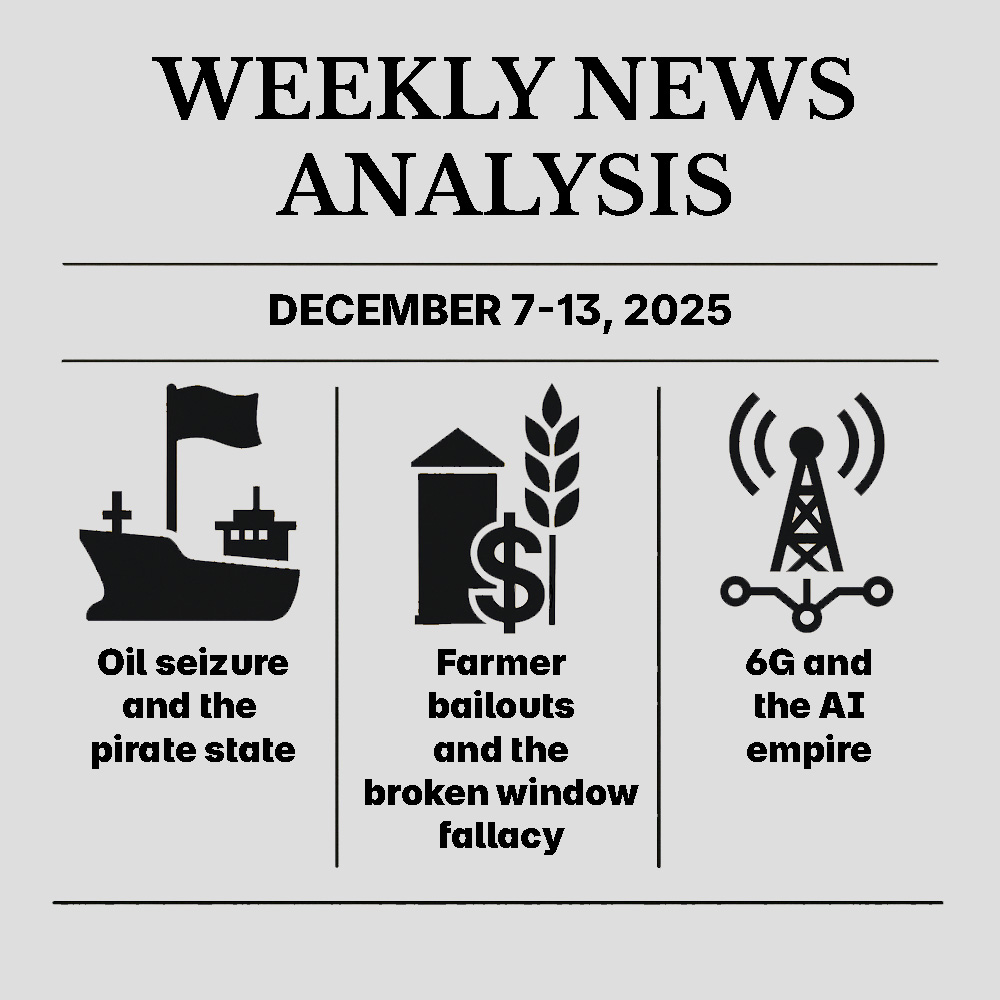
This week, the focus isn't on “policy” but on narrative management: portraying force as order, subsidies as relief, and surveillance infrastructure as innovation. In all three cases, the public is told a straightforward morality story—heroes stopping villains, aiding “the heartland,” and “winning the future”—while underlying systems become more powerful: coercive state authority, engineered dependency, and tech governance that substitutes consent for code.
A second pattern is the continual framing of escalation as righteousness. Whether involving seizing foreign energy assets, compensating for domestic backlash from trade disruptions, or centralizing AI policy against “state obstruction,” the same cycle repeats: political authority creates volatility and then asserts special legitimacy to "resolve" it—often through expanding authority, spending, and enforcement. This cycle—from crisis to control to normalization—is how an Age of Tyranny becomes commonplace and enduring.
Oil Seizure and the Pirate State
US seizes oil tanker near Venezuela - CNBC
Trump administration releases video of seized oil tanker - The Gateway Pundit
US seizes tanker near Venezuela – Council on Foreign Relations
Seizing an oil tanker is not merely a “drug interdiction story” in a geopolitical context; it is fundamentally a matter of sovereignty. When a significant power captures an energy asset linked to a rival nation—particularly in a contested regional area—it communicates a message that exceeds the official explanation: the sea lane is ours, enforcement is our authority, and the resource flow is under our control. This reflects imperial logic rather than law enforcement reasoning.
The “drug running” framework is practical because it presents a clear moral narrative: it simplifies geopolitics into a straightforward cops-and-robbers story, dismissing anyone who questions this as supporting trafficking. However, energy geopolitics is far more complex. Venezuela sits at the intersection of oil, sanctions, regional influence, and a multipolar power struggle—meaning any significant maritime action sends a message not only to Caracas but also to Beijing, Moscow, and other nations observing Washington's willingness to enforce its extraterritorial authority.
Labeling this as a “pirate king” moment isn't an exaggeration; it’s accurate language because piracy mainly involves coercive seizures disguised as lawful actions. The government claims it enforces the rules, but those impacted see it as armed theft. This discrepancy in narratives is significant because once seizure is regarded as “policy,” the distinction between a rule-based system and one ruled by force becomes just a matter of propaganda—relying on naval strength rather than moral authority. Isn’t that the core issue with a tyrannical government and its monopoly on violence, rule through force?
This also raises the irony of the term “peace prize” being pushed upon Trump. Trump is portrayed domestically as a peacemaker, even as he expands the use of coercive measures internationally. Modern “peace” branding often aims to appeal to the home audience by implying no visible sacrifices, no draft, and no acknowledgment of war, rather than representing a genuine reduction in coercion and violence. When violence is hidden, outsourced, or redefined as enforcement, the public can believe in “peace” while the empire remains engaged in expansion and acquisition.
Venezuela's deeper role is that it serves as a flexible platform for broader global strategies: sanctions that resemble sieges, maritime enforcement that resembles blockades, and energy chokepoints used as pressure points. Whether the issue relates to oil, shipping, or supposed contraband, the main approach is consistent: managing flows—fuel, currency transactions, trade routes, and reputation on the international stage.
There is also a domestic advantage: foreign seizures reinforce the “strongman competence” narrative—featuring action shots, released videos, and decisive postures—while diverting attention from the fact that seizures do not resolve underlying structural problems. They do not automatically reduce prices, eliminate corruption, or establish stability. Instead, they generate headlines that are subsequently used as political leverage and ideological reinforcement.
The warning—linked to the concept of a “new Age of Tyranny”—is that once the public views this form of authority as usual, the same reasoning applies internally. If the state can “seize” power abroad in the name of security, it can also freeze accounts, blacklist groups, and criminalize dissent domestically using similar moral justifications. International acts become training grounds for domestic control; the methods remain the same, only the targets differ, as the 1974 Kissinger Report detailed.
Farmer Bailouts and the Broken Window Fallacy
Trump farmers aid package - The Guardian
Trump to unleash $12B farm rescue as China trade reset hits US growers - Fox News
Farmers bailout Trump - The Nation
Meager farmer bailout after reckless trade war - Democrats
Trump trade affordability - New York Times
(2019 article) Trump to give $16 billion to farmers hurt by trade war - CNBC
The bailout narrative exemplifies political “broken window fallacy” economics: policy actions that disrupt the market, followed by claims of credit for “relief” spending that offset the harm caused. People tend to view financial aid as kindness rather than compensation, and overlook the sequence of events that politically justify the check.
Understanding taxation and trade is crucial because they reveal how the state seeks to build support. When policy harms a sector, that sector depends on continuous interventions, making the intervening authority a key mediator. The “fix” isn't a real solution; it’s a dependency arrangement that is repeatedly renewed whenever instability arises.
In 2019, a $16 billion aid program linked to trade-war consequences set a precedent while demonstrating a pattern: escalation causes blowback, blowback leads to subsidies, and subsidies reinforce political loyalty. Within this cycle, the state can simultaneously act as the arsonist and the firefighter, with many praising the firefighter since the fire has become the prevailing situation.
Politically, this alters the American Right's ideological stance. Previously, anti-socialist rhetoric served as a cultural dividing line; today, “our subsidies” are portrayed as acts of patriotism, strategy, or resistance against China, whereas “their subsidies” continue to represent socialism. This is less about economics and more about rhetoric—socialism is used as a label for out-groups rather than being tied to specific policies.
Sophism and education are essential because when critical thinking diminishes, people tend to overlook secondary effects. They often focus on quick fixes rather than exploring the underlying structural causes. This results in a binary mindset: either supporting bailouts or opposing farmers, without questioning why policies repeatedly lead farmers into bailout situations.
Trump embodies a form of national socialism. He advocates nationalist rhetoric paired with state-led economic measures, a typical political pattern. When a movement merges nationalism, a strong executive, and managed markets—such as subsidies, tariffs, and favoritism—it can appear “anti-socialist” emotionally while, in practice, adopting socialist-leaning state planning, provided it is justified as national defense. Remember, the Nazis were national socialists, and we know how that ended.
This framing explains why debates over “affordability” often justify increased control rather than decentralization. When trade policies increase costs, responses tend to move away from encouraging free trade and local resilience, focusing instead on managed redistribution, regulatory incentives, sanctions, and a constant state of emergency. Consequently, the public adapts to a regulated economy in which stability depends on adherence to policy expectations. Increasing government control to fix problems caused by the government is not the right approach.
A key consequence is cultural: when the Right embraces “socialism when we do it,” the last significant ideological safeguard disintegrates. The sole remaining debate then revolves around which faction manages the redistribution system. This shift marks an important move toward the Age of Tyranny—since the system no longer needs to persuade individuals to oppose control; it only needs to motivate them to select a controller.
6G and the AI Empire
We want 6G Trump takes aim at US tech firms - Fox News
Trump bizarrely links 6G to camera tech - Android Headlines
Trump 6G networks skin - Raw Story
Eliminating state law obstruction of national AI policy - White House
https://www.bbc.com/news/articles/crmddnge9yro - BBC
Pressley pushes AI Civil Rights Act - Fox News
The term ‘6G’ functions as a public symbol for a more profound issue: the race to dominate the next level of connectivity. This future network will unify devices, identity, payments, and governance into an integrated, surveillable system controlled by AI. Despite media coverage often emphasizing confused remarks, culture-war debates, or rivalry, the core reality is that next-generation networks are more than just faster internet—they form the backbone for extensive data gathering and control.
This shows how technical complexity functions as a form of narrative camouflage. Most citizens lack the expertise to assess 6G standards, spectrum policy, edge compute architectures, or AI governance frameworks. This knowledge gap favors politicians and institutions, enabling them to promote significant power shifts under the guise of "innovation," while the public remains distracted by personality shows and media ridicule.
The White House initiative “Ensuring A National Policy Framework For Artificial Intelligence,” which seeks to eliminate “state law obstruction,” is the most structurally significant element here because it formalizes centralization. Framing a national AI policy as needing protection from local interference suggests that local democratic disagreements are viewed as problems rather than natural diversity. In reality, this results in governance moving upward—away from community-level differences and toward uniform national oversight, implemented through administrative and legal means.
The civil rights framing of AI employs a typical rhetorical pattern: it’s morally compelling, emotionally resonant, and challenging to oppose without appearing cruel. Yet, it can also be exploited to justify more data collection, enforce compliance systems, and reinforce large institutions as the “trusted” authorities. Essentially, the idea of "protecting the marginalized” can be used to justify widespread monitoring, scoring, and management of everyone.
This is where the concept of the "algorithmic empire" becomes clear: it exerts influence not only through ships and sanctions but also via standards, platforms, identity systems, and automated decisions. When the state manages AI policy nationwide, and networks enable pervasive sensing, enforcement becomes omnipresent. Instead of frequent raids or intense crackdowns, the focus shifts to default-enabled systems that subtly restrict choices.
The discussion around 6G-to-camera and surveillance connections and capabilities—often called “bizarre” or “conspiratorial”—persists because the fundamental concept remains plausible: increased bandwidth, more sensors, and AI enhance institutions' perceptual capabilities. While the public may evoke fears with simple language, the underlying trend is undeniable: monitoring becomes cheaper and higher quality, and the inclination to govern via automated systems increases.
This also relates to the dependency cycle discussed above. When the state assumes responsibility for managing economic hardships and regulating AI risks, it can justify more extensive integration: using digital identities for benefits, biometric verification to combat “fraud,” behavioral analytics to “protect democracy,” and automated controls to prevent “harm.” The core aim remains safety, fairness, or efficiency; however, the outcome will be reduced autonomy and greater tyranny.
From Seizure to Subsidy to System Control
Across all three areas, the public is being conditioned to view coercion as standard governance: external coercion via seizures and enforcement, internal coercion through manipulated economic dependence, and systemic coercion via centralized AI policies that see local resistance as an obstacle to be removed. The terminology varies—security, relief, innovation—but the goal remains the same: concentrate power upward and render dissent administratively insignificant.
The underlying warning of “Age of Tyranny” is not merely that conditions will significantly worsen; it’s that the decline will happen gradually and systematically. Tyranny becomes normalized—being justified by continuous crises and upheld through bureaucracy and regulations. When people are conditioned to concentrate solely on the storylines (pirates vs. patriots, socialism vs. strategy, innovation vs. fear), the machinery keeps moving forward, regardless of which side wins the weekly narrative.
Listen to this week's news in verse for a quick recap!