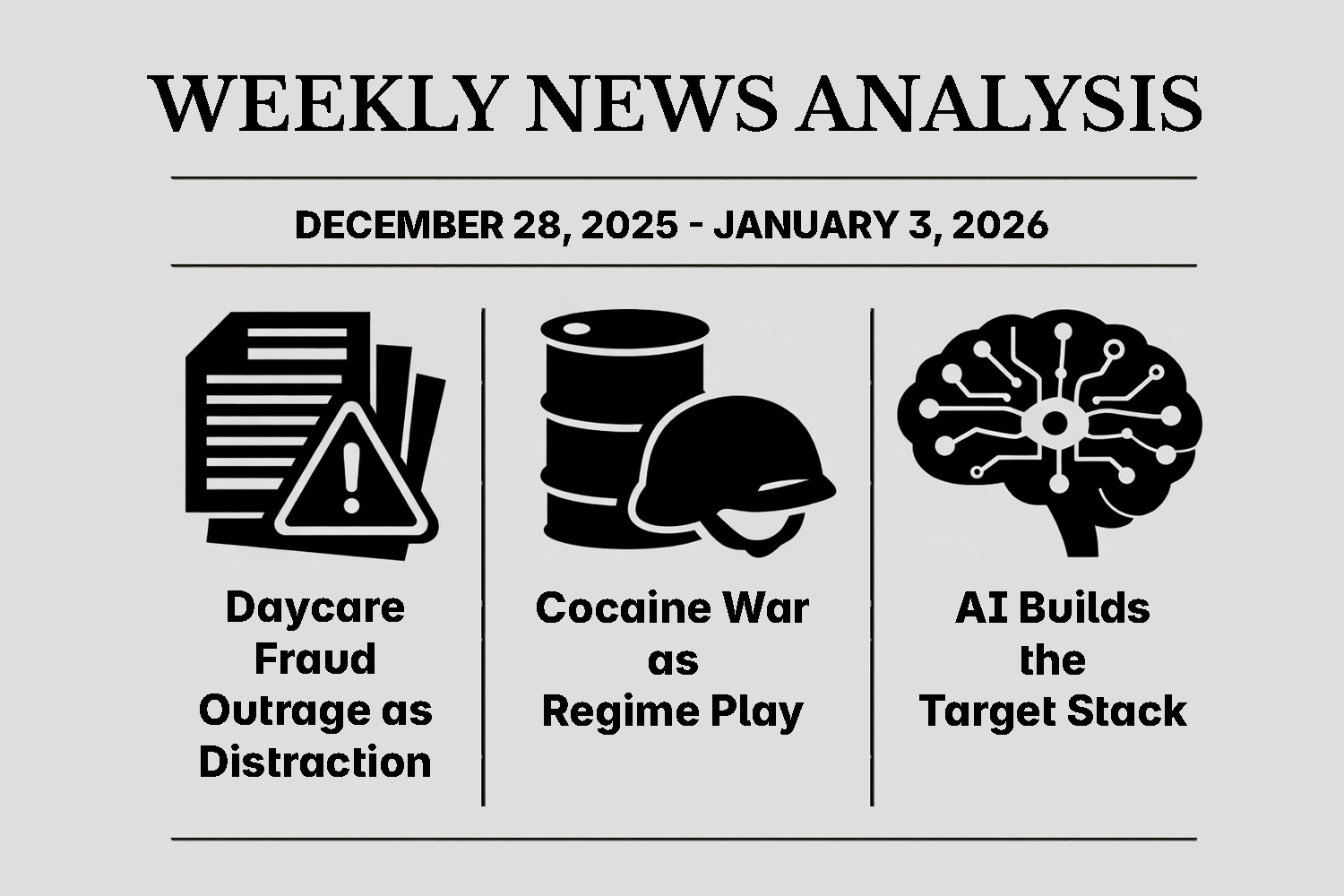
The common thread this week isn't just "fraud,” “drugs,” or “AI” alone. Instead, it’s the repeated governance pattern where the state and media decide which abuses trigger moral panic, which are dismissed as background issues, and which new systems are introduced while the public focuses on the headline villain. The familiar rhetorical flow starts with highlighting a vivid scandal to fuel partisan outrage, declaring a crackdown, and secretly expanding discretionary powers, budgets, and surveillance. This cycle creates an illusion of accountability but keeps the underlying extraction mechanisms in place.
Across all three subjects, language plays a key role. Allegations in daycare serve as a stand-in for debates on immigration and identity; Venezuela issues are portrayed as a morality tale about drug trafficking and security; and AI discussions focus on future implications for jobs, safety, and rights. The underlying pattern is that institutional incentives remain the same: agencies unable to account for trillions of dollars seek more authority; protection-focused interventions strengthen control over resources; and safety rhetoric fuels the automation of targeting, monitoring, and administrative powers. The surface story shifts, but the platform remains unchanged.
The core idea behind the phrase "platforms stay while leaders change" is that while personalities and leadership change—leaders (rulers) rotate, parties exchange accusations—the underlying system remains. This system includes contract networks, emergency authorities, compliance regimes, and data systems, which continue to wield power regardless of who is in office. This cycle is key to understanding the pattern described in The Fallacious Belief in Government: crises are used as justification for action, justification becomes permanent, and permanent control gets normalized—often presented as reform.
Fraud Outrage as Distraction
Nick Shirley’s Minnesota daycare fraud claims - NPR
FBI surged resources to Minnesota over daycare fraud claims - NPC News
Nick Shirley Minnesota daycare fraud - Snopes
Somali daycare national fraud investigation – KOMO News
DOGE hearing wrap-up on fraud and improper payments - House Oversight
Secret Service says pandemic fraud totals nearly $100B - Washington Times
Pentagon fails eighth audit, eyes 2028 - Military.com
The daycare story is rhetorically powerful because it lies at the crossroads of “children,” “public money,” and “outsider suspicion.” This combination makes it highly shareable and easy to fit into partisan narratives: the Right focuses on waste, fraud, and weak governance; the Left on stigmatization, scapegoating, and procedural caution—especially when accusations target immigrant communities. Snopes’ framing underscores uncertainty and the limits of verification—particularly concerning claims that fraud is specifically “Somali-owned”—while recognizing the political impact of viral content. The debate quickly shifts from invoice auditing to narrative policing: who can accuse, who is presumed guilty, and which institutions are seen as legitimate.
That partisan divide is a key part of the system. When the Right’s anger targets a specific fraud scenario—especially one with cultural or ethnic implications—oversight becomes more about morality than about thorough financial checks. Conversely, when the Left’s criticism centers on the motives and tone of the accusers, the debate often shifts to defending the system’s outputs (like "these programs matter”) instead of demanding precise, transparent accounting. This creates a public discussion driven by emotion rather than solution, where one side relishes outrage, and the other condemns it, all while the underlying processes of procurement and payments remain unchanged.
The key comparison lies in scale and follow-up. Minnesota’s history of significant pandemic fraud cases shows how emergency funds can lead to substantial leakages, weak controls, and prosecutions that seldom recover losses. Current reports on daycare allegations often refer back to the COVID era, when officials and the media debated the actual numbers. Meanwhile, the public learns that oversight is frequently delayed and incomplete. The Washington Times highlights Secret Service estimates of pandemic fraud nearing $100 billion, noting that even cautious estimates of COVID relief fraud far exceed those of many local program scandals.
The DOGE-style “war on waste” rhetoric adds a layer by promising new enforcement methods to recover funds and prevent misuse. Its messaging often emphasizes “billions lost” and “improper payments,” typically alongside a performative reset with hearings, outrage videos, and lists of villains. The key question is whether this signals a genuine institutional reform—such as stricter controls, real-time audits, and procurement changes—or just another spectacle with episodic prosecutions that leaves the same complex, discretionary processes intact. Historically, governments excel at promoting crackdowns but struggle to redesign incentives that prioritize speed of spending over proper verification. In the past year, Congress and the Trump Administration did not cut spending or address most waste and fraud. Still, they canceled contracts and redirected funds to support AI implementation across the federal government.
The daycare dispute also reveals how quickly “fraud” can become a proxy for broader political identity conflicts. Once allegations target an immigrant community, it provides a convenient distraction: the public is directed toward cultural blame instead of administrative scrutiny. This diversion helps protect key leverage points—such as federal emergency funds, contractor networks, and transparency in agency finances—from direct challenge. The pattern of manufactured crisis → managed dependency → normalized control is repeatedly fueled by fear and urgency. The daycare case mirrors this process on a smaller scale: moral urgency replaces structural reform, and “bad actors' stand in for “bad architecture.” It will be forgotten within the month as the next crisis emerges.
The most glaring difference is that the most significant and ongoing financial problem isn't daycare reimbursements but the federal and state governments’ failure to manage their finances, especially within the war apparatus. Since audits began, the Department of War (DoW) [previously Department of Defense (DoD)] has failed everyone and still aims to achieve a clean audit by 2028. This includes the September 10th, 2001 announcement that the DoD couldn’t account for $2.4 trillion. Reuters reports that the Pentagon’s 2025 audit reveals trillions in assets and liabilities, along with numerous serious weaknesses—basic internal control failures of a scale that no private company could withstand. If public outrage over fraud matched the severity of the fiscal issues, the audit failures would be a constant headline, not just occasional news, and neither side would find Trump and Congress’s push to increase funding for the DoW acceptable.
This is why the rhetoric around daycare feels theatrical: it’s a stage filled with high emotion but with little systemic impact, while the main financial issues remain offstage. The national debt, now close to $39 trillion, combined with agencies that struggle to account for their finances properly, creates a scenario in which minor fraud cases serve as pressure-release valves. The public sees a semblance of corrective measures—such as investigations, raids, and prosecutions—yet the core spending structures stay unchanged, and key institutions remain resistant to audits. The so-called “war on waste” is just a branding effort unless it targets the sacred budgets and convoluted procurement processes that normalize misstatements and fraud.
Ultimately, the orchestrated partisan dance serves to maintain the status quo. When one party states, "We are cracking down,” and the other counters, “You are scapegoating,” both sides sidestep the more serious bipartisan issue: why does the payment system keep expanding without real-time transparency, and why do the largest agencies remain structurally unaccountable? In The Fallacious Belief in Government, the lifecycle theory suggests that government failures fuel its growth. Each failure justifies the creation of new offices, the expansion of authority, and increased spending. The daycare scandal cycles exemplify this pattern: the scandal isn't an outlier; it's a recurring resource that drives the next round of expansion.
Cocaine War as Regime Play
Venezuela US military strikes live updates - CBS News
Explosions in Caracas reports - Fox News
Caracas explosions live - The Guardian
Former Honduras president Hernández freed after Trump pardon - PBS NewsHour
The typical argument for U.S. military intervention in Venezuela involves familiar themes: drug trafficking, instability, and the need for force after diplomacy fails. The language is moralistic (“criminal regime”), securitizes (“threat to Americans”), and simplifies the situation into a single villain, making it resemble policing rather than war. Currently, reports describe significant U.S. strikes in the capital, Caracas, and claim Nicolás Maduro was captured and brought to New York to face drug charges. In contrast, international condemnation describes the act as a breach of international law. This approach shifts the perspective of geopolitical action into a law-enforcement framework.
Alternative interpretations emphasize that "drugs" serve more as a pretext than a direct cause, providing a recurring narrative that persists regardless of actual outcomes. If the primary goal were to stop narcotrafficking, strategies would target financial networks, ports, shipping routes, and domestic demand—none of which necessitate capturing a head of state or controlling a country's transition. However, the Guardian’s live coverage reports that Trump said the U.S. planned to oversee Venezuela during its transition and rebuild oil infrastructure with American companies. This indicates that governance control and resource influence are explicit objectives, not mere side effects. Therefore, this is not solely about drug enforcement; it is about regime management with economic aims.
The hypocrisy is especially evident because it targets the moral basis of the intervention rather than its implementation. If the intervention is morally justified to combat drugs, then forgiving a leader convicted of large-scale trafficking weakens that moral stance. PBS reports that former Honduran president Juan Orlando Hernández was released after a Trump pardon, despite being convicted for extensive cocaine trafficking (400 tons) into the U.S. and serving a 45-year sentence. The contradiction is apparent: the government claims it must invade to fight drug trafficking, yet it also frees a prominent figure convicted of facilitating it. This inconsistency indicates that the “drug war” language is more of a tool than a genuine principle.
This is where the Trivium lens helps clarify the persuasion technique. Grammar: “narcotrafficking” is regarded as a sacred term—an accusation that halts debate and justifies exceptional measures. Logic: the argument employs a bait-and-switch, shifting from “drug harm is real” to “therefore regime change is justified” without proving necessity, proportionality, or likely success. Rhetoric: it depicts opponents as defenders of criminals, trapping dissenters in a reputational bind. Once “drugs” is the rallying point, the public is encouraged to accept aggressive actions as policing and see blowback as the cost of righteousness rather than a predictable outcome of intervention.
The CRS clarifies how Congress and the policy establishment frame options, authorities, and constraints, often in ways that maintain executive flexibility. Even when Congress is formally notified, the practical outcome can be retroactive legitimation: actions are taken, a simplified public justification is provided, and institutional documentation is produced afterward to rationalize them. This pattern is typical in modern state expansion, where emergency measures are followed by later authorization and, if any, oversight. The public perceives “decisive leadership," while the bureaucracy views it as setting a precedent.
Alternative perspectives also highlight oil and geostrategy, and recent reports make this connection clearer by explicitly stating it: U.S. efforts in “rebuilding oil infrastructure with U.S. firms” suggest that economic restructuring is a goal. The narcotrafficking narrative serves as a way to justify public acceptance of actions that ultimately aim for control over governance, contracts, and resource flows. This is a consistent pattern: moral language sets the stage, and material changes follow.
The core systemic problem lies in how “crime” stories domesticate imperial actions for local audiences. Traditional war justifications risk damaging reputation; terms like “anti-drug operations” and “criminal indictments” appear more acceptable. However, when a president states the U.S. will “run” another country during a transition, the facade weakens: stewardship language replaces sovereignty, and the public is encouraged to view managerial empire as benevolent. Similar rhetorical disguises are seen elsewhere: surveillance as “safety,” censorship as “trust,” and coercion as “stability.”
Finally, the contrast of “pardon while invading” exposes the underlying logic of power: rules serve as tools for leverage rather than for consistency. In The Fallacious Belief in Government, the lifecycle argument claims that legitimacy is continuously created through selective enforcement—punishing enemies and pardoning allies. The Hernández pardon appears less as an anomaly and more as a sign that alliances and utility outweigh the stated moral crusade. When the “drug war” is used as a means of regime change abroad and political control at home, it shifts from being a policy to a narrative weapon.
AI Builds the Target Stack
Israeli military ties to big tech - The Guardian
AI pioneer says be ready to pull plug, warns against AI rights - The Guardian
Five tech trends we’ll be watching in 2026 - The Guardian
Investors predict AI is coming for labor in 2026 - TechCrunch
Illinois education measures focus on immigrant rights, AI in the classroom - Capital City Now
Security flaw could allow hackers control robots - Interesting Engineering
This topic centers on convergence: areas such as military AI, labor automation, education policy, and robotics security suggest that AI is evolving into a foundational layer of society rather than just an external application. The Guardian’s extensive investigation into Israeli military ties with major tech companies reveals how cloud and AI technologies can facilitate surveillance, data storage, and quicker targeting processes—transforming warfare by amplifying decisions that were once limited to humans. When a nation can industrialize targeting via data infrastructure, AI stops being merely innovative and instead becomes a form of administrative authority conveyed through code.
The typical defense of this shift often rests on two claims that can both be true but still mislead: first, that “AI increases efficiency,” and second, that “AI reduces harm by improving precision.” The underlying assumption is that moral risks are mainly about accuracy, ignoring the political choice to automate lethal or coercive actions. The Guardian’s framing—“Data is control”—captures the honest reality: whoever controls the data and compute infrastructure can influence outcomes at scale. While precision doesn’t eliminate violence, it reorganizes it into a workflow that can be replicated and scaled.
At the same time, TechCrunch’s investor insights on 2026 suggest that as budgets shift from labor to "agents," human displacement is viewed as a value opportunity—reducing workers, increasing automation, and boosting profits. The tone is mainstream and managerial, and it sees the change as inevitable, framing labor mainly as a cost rather than a social asset. The core driver is that AI adoption follows capital-allocation logic, not public debates about stability, dignity, or community resilience. When investors expect job losses, they also foresee political backlash—implying that automated systems for work can be combined with those that control dissent. Journalistic Revolution has maintained that this will be the driver that finally establishes a universal basic income.
Education policy acts as an early conditioning tool. Illinois's approach to AI in classrooms emphasizes practical modernization—rules, safeguards, and responsible use. However, the underlying long-term impact is normalization: students come to see AI mediation as standard, evaluation as algorithm-driven, and institutional “guidance” as the interface for granting permission. Even when presented as safety measures, this fosters a culture of compliance where thinking is increasingly delegated and overseen. A society conditioned from childhood to accept AI systems as legitimate decision-makers will be less inclined to oppose their broader use in areas like hiring, lending, policing, and benefits.
The discussion around AI rights acts as a secondary distraction, much like other culture-war issues: it is emotionally compelling and philosophically stimulating, but can divert focus from pressing governance matters such as procurement, oversight, accountability, and kill-switch authority. Some have been sounding the alarm that humans should be ready to “pull the plug” and oppose granting legal rights to AI, cautioning against assigning moral personhood to systems that may act strategically. However, even this warning can be co-opted: institutions might use the concept of "AI safety” to justify increased monitoring, centralized control, and restrictions on independent development—while still advancing the same AI infrastructure for government and corporate interests. Let's be clear, AI is a tool and product. It is not alive and should not have rights.
The Guardian’s “tech trends” article emphasizes that infrastructure shapes the future: data centers continue to grow, autonomous systems expand, billionaire wealth continues to grow, and AI becomes more integrated into everyday life. While it reads as a neutral forecast, it also hints at consolidation within the political economy. Since building compute clusters demands substantial capital, energy access, and regulatory approval, these benefits are primarily held by the largest corporations and governments. When computing power is concentrated, so is decision-making authority. This reflects the “platforms stay” issue in a technological context: although leadership and brands may change, the core compute and data infrastructure remains and even intensifies.
Robotics security highlights the physical vulnerabilities at the system's edge. As Interesting Engineering reports on flaws that allow attackers to control robots via voice commands or wireless connections, it shows how quickly automation can turn into a safety hazard when security lags. If robots are hijacked for botnets or for physical interference, the trend toward connected devices suggests a future in which security justifies ongoing surveillance, authentication, and movement restrictions. The risk is that genuine safety concerns may be exploited to legitimize broad control measures that also support political agendas.
AI follows a similar path: safety issues, labor disruptions, cyber threats, and geopolitical tensions all drive faster deployment. Once institutions adopt these systems, reversing this dependence becomes politically and economically challenging. As a result, the system and tyranny expand while freedoms and rights decline.
Techniques such as data fusion, scoring, automated targeting, and cloud-based surveillance, initially developed during conflicts, are not confined to local use. Instead, they serve as templates sold as “solutions,” adopted by other countries, and integrated into commercial platforms. Therefore, AI is not just about replacing labor or raising ethical concerns; it functions as the foundational control system that makes large-scale administrative coercion cheaper, faster, and more covert. The key point is not AI replacing humans but reorganizing society around machine-readable permissions.
Accounts Unchecked Empires Expand
The three stories, taken together, depict a coherent control framework. The daycare fraud story functions as a way to channel public anger, guiding people on where to focus their outrage and framing accounting failures as part of a partisan morality debate. Venezuela serves as a mechanism for coercive legitimacy, transforming geopolitical actions into seemingly justified police operations, even though contradictory actions—like pardoning a convicted trafficker—reveal that such "principles" often mask strategic leverage. The AI component represents the systems layer, integrating data, computing power, and automated decision-making processes that enable scaling of both domestic governance and international targeting.
The common rhetorical approach is consistent across fields: focus on a vivid, morally charged object while the structural power remains in the background. For example, the Pentagon's audit failure isn't merely “another scandal” but a foundational condition that makes other issues believable: a state that cannot verify its largest agency is inherently motivated to create smaller dramas as stand-ins for accountability. According to the lifecycle concept in The Fallacious Belief in Government, these dramas don't fix the system; they sustain it—each episode justifies increased authority, expenditure, and mechanisms to control public reaction.
The trajectory points toward a hybrid order characterized by fiscal opacity at the top, a moral theater on the surface, and algorithmic management underneath. If this pattern continues, the crucial issue in the near future will not be whether specific scandals are “real,” but whether societies can maintain the ability to demand transparent accountability, resist false pretexts, and keep AI from becoming the default authority in areas like work, education, and security. As platforms persist and leadership changes, the only lasting safeguard is not electoral victories but structural constraints—such as clear auditability, decentralized power, and a refusal to sacrifice natural rights for superficial reassurance.
Listen to this week's news in verse for a quick recap!