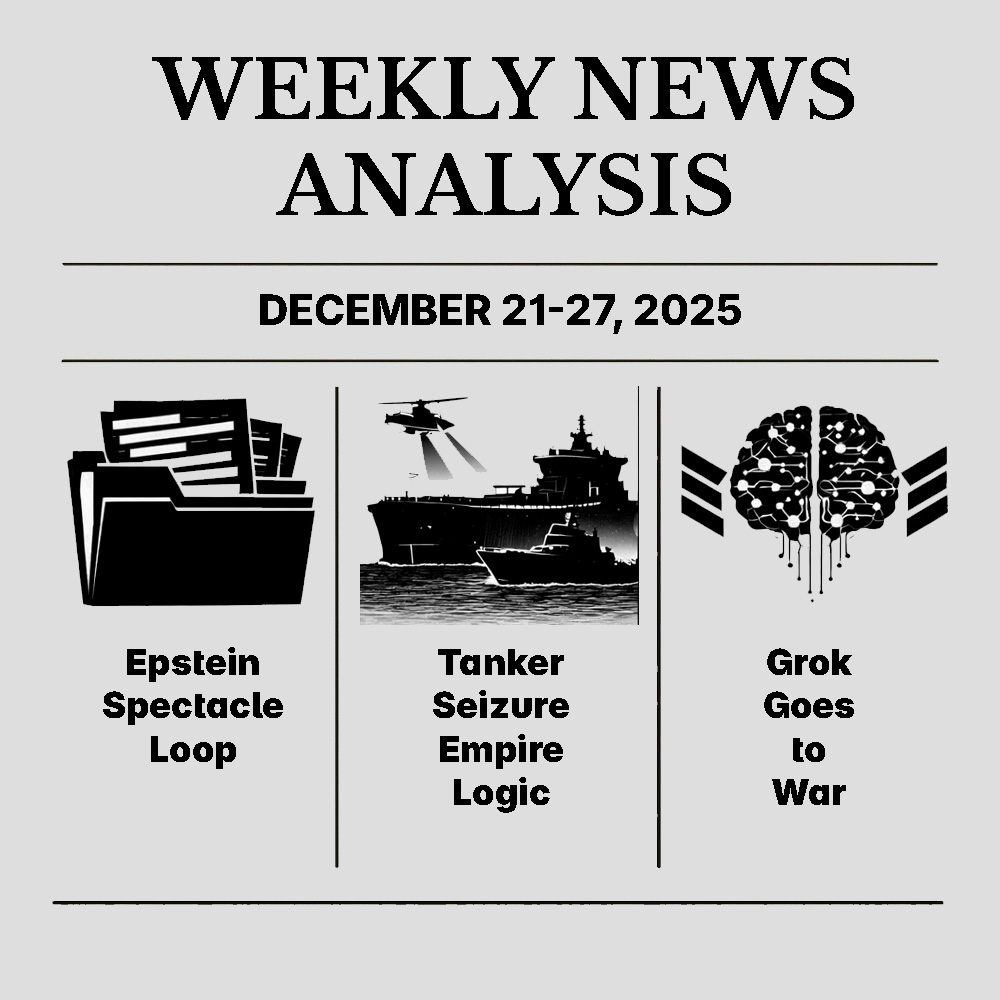
This week’s three stories may seem unrelated: the ongoing partisan debate over the "Epstein files" release; the U.S. effort to control Venezuelan-linked oil tankers in international waters; and the Pentagon’s quickening integration of commercial generative AI—now including Musk’s xAI/Grok—into government operations. However, the real connection is not in the headlines but in the underlying mechanism. Each story represents a different aspect of the same process: perception management (Epstein), resource leverage (tankers), and administrative–military automation (AI). In essence, it’s a combination of distraction through media and visuals and material consolidation, running in parallel.
The rhetoric across all three topics follows a familiar control cycle: crisis cues, moral theater, institutional expansion, public fatigue, normalization. The Epstein drop provides intense emotional impact with minimal policy impact; tanker pursuits showcase coercive state power with economic and war-risk side effects; AI militarization acts as infrastructure that continues regardless of which scandal dominates the news. This pattern, known as the “managed crisis” approach, discussed in The Fallacious Belief in Government: Warp Speed Toward Tyranny, involves directing public focus to spectacle while enduring systems—legal, economic, and technological—gradually harden in the background.
What clarifies the week is how the narratives support each other. The Epstein story introduces disruption and division; the tanker story emphasizes emergency language and geopolitical motives; the AI story offers the tools to implement both—quickly, at scale, and with less human oversight. When the public perceives politics as mere entertainment episodes, the state and corporations can approach governance as long-term engineering.
Epstein Spectacle Loop
Epstein file drop includes ‘untrue and sensationalist claims’ about Trump, DOJ says - Fox News
So This Is Why Trump Didn’t Want to Release the Epstein Files - The Atlantic
Trump Named in New Epstein Files Published by Justice Department - Time
Republican behind Epstein files act responds to Trump ‘lowlife’ taunt – The Guardian
Can Epstein files be unredacted with a simple copy and paste - Snopes
The new “Epstein files” release is portrayed — both implicitly and explicitly — as a significant reveal. However, it functions more like a mixed collection of partially redacted documents, prosecutor emails, varying credibility tips, and political fallout designed to generate maximum disruption. Fox points out the DOJ’s caution that some claims are “untrue and sensationalist,” but also highlights a prosecutor's email mentioning Trump’s documented presence on Epstein’s jet multiple times in the 1990s. The goal isn’t to determine which outlet is accurate; it’s to craft a narrative that keeps the audience shifting between certainty and doubt — an emotional rollercoaster that fuels engagement without offering clear answers. This ongoing oscillation is the intended outcome.
TIME’s framing reveals the same pattern in a different tone: it enumerates the explosive items—such as the 2020 FBI file mentioning allegations, an internal email about flights, and other references to names—while reiterating that inclusion does not equate to proof of wrongdoing. It also references the DOJ’s statement that a letter in the dump was deemed fake. A narrative emerges around the idea that “something is there.” Still, the design also maintains plausible deniability and procedural delays: more documents are kept, more redactions are applied, and more “review” processes are ongoing. This explains why “transparency releases” often serve as narrative control—they provide the public with carefully managed fragments that keep engagement alive without demanding institutional accountability.
The Atlantic’s analysis is especially insightful because it highlights the political role of the files: they serve as “ammunition” for Congress to maintain pressure, while also citing numerous references from news reports and unverified tips. Despite this, they demonstrate that law enforcement found the relationship noteworthy. This creates a cycle of ongoing coverage: enough verified information to keep the story alive, and enough ambiguity to prevent a clear resolution. The outcome isn't justice but a continuous conflict narrative. Once politics shifts into episodic content, the public subconsciously accepts that each "next episode” is the expected response to credible allegations, rather than insisting on definitive legal conclusions.
Meanwhile, The Guardian reports on the internal party drama fueling the spectacle: Trump’s constant attack by calling Rep. Thomas Massie a “lowlife,” Massie fundraising in response, and the ongoing deadline issues that keep the story alive—such as the DOJ missing the statutory deadline and then citing the discovery of more documents that will take “a few more weeks” to review. This pattern resembles a “we’ll comply, but later” approach, which bureaucratic power uses to defuse public demands while seeming to respond. The story shifts to a conflict over process and personalities, rather than pressing for broad, enforceable accountability for Epstein’s networks.
Snopes introduces a technical nuance with rhetorical significance: claims suggesting that at least one document’s redactions could be bypassed through copy-and-paste. Regardless of how broad or limited this scope is, the mere presence of this angle fuels debate—one side argues “they’re hiding names,” while the other dismisses it as “internet hysteria.” Consequently, the audience is led into amateur forensic analysis and partisan interpretation. This is intentional. “Information overload” acts as a form of soft paralysis: when everything appears potentially meaningful, nothing can be acted upon. This serves a key technocratic purpose—public attention is diverted to interpretation, while institutions control the outcomes.
Journalistic Revolution sees the Trump–Epstein link as a recurring pattern rather than a one-time story. One that we have been reporting on for the past decade. The media keeps 'discovering' the exact details, each time framing it as a breakthrough. Viewers are conditioned to see moral outrage as entertainment: sharing, debating, rewatching, and repeating. But when outrage doesn't lead to action, it's just consumption, not resistance. The emotional response fuels ad dollars, partisan backing, and algorithmic exposure, even though the underlying class protections that safeguard Epstein’s network stay essentially unchanged.
Late-stage 'authority theater' manifests in institutions' staged releases, committees, and deadlines that claim to ensure accountability. Meanwhile, the public experiences a false sense of participation through interpretation and outrage. The assumption is that these institutions, which have previously failed, will now deliver justice—if only the public remains attentive. Yet, observation alone isn't a strategy. As the week’s framing suggests, the likely result is mere entertainment, distraction, and disruption—serving a legitimacy-management system behind the scenes, which includes economic coercion abroad and the growth of domestic AI infrastructure.
Tanker Seizure Empire Logic
Third Oil Tanker in U.S. Crosshairs as Venezuela Pressure Builds - Military.com
US intercepts another vessel near Venezuela, officials say - Reuters
US pursues another oil tanker near Venezuela reports - Al Jazeera
Trump’s ongoing efforts to target oil tankers near Venezuela are officially seen as enforcing sanctions and putting pressure on Maduro. However, the methods resemble coercive maritime tactics that increase geopolitical tensions. The U.S. pursued an oil tanker, called “Bella 1,” in international waters—marking the third such attempted interception in less than two weeks—amid claims of false-flag operations and sanctions evasion. The crucial issue is not the label but the setting of a precedent: interdiction actions blur the line between sanctions enforcement and a quasi-blockade, and it is in this gray area that miscalculations are most likely to occur.
Al Jazeera’s coverage clarifies the escalation logic further by quoting a U.S. official who stated that the Coast Guard “remains in active pursuit,” referring to claims of a “dark fleet,” and highlighting the political framing of a Trump-ordered “blockade.” The report also shows how this story is already causing internal dissent—Sen. Rand Paul described the moves as a “provocation and a prelude to war,” which is significant because it indicates that the policy is not just administrative but also politically volatile. When “blockade” language appears in the debate, narrative pressure naturally grows: opponents may label it as piracy, supporters see it as strength, and the system increasingly leans toward confrontation, as backing down becomes rhetorically costly.
This is where historical analogy becomes useful—not as a casual insult but as a tool for logistical analysis. National socialism is a form of state-led nationalism combined with industrial strategy and resource coercion. To be clear: Trump is not Hitler, and it’s imprecise to reduce current politics to WWII morality tales. However, it is valid to explore the pattern where governments, confronted with scarcity or strategic risks, externalize domestic issues as conflicts over resources. Nazi Germany’s war efforts weren’t driven solely by ideology; they also resulted from industrial logistics, energy reliance, and strategic resource pursuits—factors that transformed geopolitical ambitions into mechanized warfare. The key parallel to observe isn’t about uniforms but about the “resource imperative” used to justify expanding coercion.
The tanker story highlights a crucial issue: energy is more than mere fuel. It represents leverage, currency stability, and the continuation of the industry. When political leaders justify seizure or interdiction as 'justified enforcement,' they subtly teach the public to accept the normalization of state force in economic matters. This process follows the “lifecycle" described in The Fallacious Belief in Government: the state asserts necessity, expands its powers, reinterprets resistance as disloyalty, and then accepts this new power as the norm. If the public becomes accustomed to ships being pursued, boarded, seized, and redirected under broad justifications, it becomes easier to apply this same logic to other assets, banking infrastructure, supply chains, and even domestic “emergency” situations.
The Great Reset and Agenda 2030 are tangible plans shaping our future, not just ideas. They outline a world created through disruption, steering populations toward dependence, digital compliance, and centralized control. The pattern is clear: resource conflicts often lead to consolidation efforts, such as tighter financial controls “to prevent sanctions evasion,” increased surveillance “to prevent sabotage,” expanded executive powers “to act swiftly,” and new international tech standards “to secure supply chains." Essentially, escalation isn’t merely a threat; it offers opportunities for institutions that benefit from crisis-driven growth.
The importance of pairing the tanker narrative with a broader stance of enforcement in international waters lies in how it obscures the line between policing and warfare. Al Jazeera explicitly mentions critics questioning the legality and highlighting deaths caused by strikes on suspected trafficking ships, which introduces a moral risk: when operations result in fatalities yet stay politically popular, there is an incentive to expand this approach. The public is led to see escalation as a form of protection, even when the strategic need is disputed, and the costs are spread out.
The more profound critique focuses on how fear and emergency framing are used: the government doesn't need the public to understand maritime law. Instead, it depends on the public accepting that perceived threats justify extraordinary measures. The tanker example illustrates this well: it is remote, technical, and easy to moralize. Since most citizens cannot verify issues such as "false flags,” “dark fleets,” or sanctions, they rely on authorities rather than evidence. This trust is precisely what technocratic governance aims for. The likely outcome isn't a clear victory but an expanded space for coercion, increased tension levels, and a population more accustomed to accepting “managed conflict” as usual.
Remember, this conflict started with Trump targeting suspected drug-running boats and destroying them without hesitation. The next step was the seizure of oil tankers. If this pattern of escalation persists, what could be the next move in force? Deploying troops on the ground? Or tactical strikes deep within Venezuela's borders?
Grok Goes to War
Pentagon inks deal with Elon Musk xAI - Stocktwits
Pentagon partners with Musk’s xAI - Blockchain News
New Pentagon report on China’s military notes Beijing’s progress on LLMs - Defense Scoop
DOD initiates large-scale rollout of commercial AI models and emerging agentic tools - Defense Scoop
How will AI affect jobs - Nexford
The Pentagon’s approach to AI has shifted from experimentation to platform establishment. According to Fox News, the Department of War, previously called the “Department of Defense,” is collaborating with Musk’s xAI to integrate Grok into government systems via the newly launched GenAI.mil platform. The deployment is targeted for early 2026 and aims to provide access to about 3 million military and civilian personnel. This isn’t just a pilot program; it reflects an institutional decision to incorporate advanced model interfaces into the routine operations of a large bureaucracy that also conducts kinetic military actions. The key focus isn’t merely on “productivity" but on supporting “critical mission use cases.”
The phrase—“I’ve seen this movie before,” in reference to the Terminator cinematic universe—resonates because it captures an intuition many already share: when a system surpasses human decision-making speed, humans end up supervising outcomes they don’t fully grasp. Advanced militarized AI won’t resemble a humanoid robot but will manifest as targeting pipelines, faster procurement, automated intelligence triage, synthetic media operations, and decision loops running at machine speed, shrinking the window for moral judgment. The real risk isn’t consciousness but the combination of high velocity and institutional incentives. As systems reward quickness and penalize hesitation, the role of “human in the loop” risks becoming just a procedural step.
DefenseScoop introduces a strategic justification layer, framing the U.S. monitoring of China’s advancements in large language models (LLMs) and AI as part of an accelerating competitive race. This “race” narrative acts as a rhetorical device that turns caution into a liability: objections are seen as falling behind, oversight requests are perceived as hampering progress, and warnings about errors or bias are dismissed with the argument that the other side won't wait. In technocratic language, this race framing functions as a social override, bypassing democratic restraints by framing governance as engineering under tight deadlines.
In terms of implementation, DefenseScoop’s earlier coverage of GenAI.mil and the rollout of the commercial model indicate a clear pathway toward normalization: a dedicated platform, enterprise-scale distribution, and the deployment of “agentic tools” that not only respond to queries but also perform multi-step actions. When such “agentic” systems become integrated into administrative workflows, policies tend to mirror what these tools facilitate—shifting from traditional governance based on law and consent to governance driven by system design, access controls, and platform management. This scenario echoes the warnings in The Fallacious Belief in Government about technocracy: power moves away from legal authority toward system architecture and platform governance. Even if electoral leadership changes, the platform's presence persists.
Now, considering the labor dimension, militarization and automation are interconnected aspects of the same adoption process. Nexford’s overview of AI and employment highlights a common understanding that AI will transform the labor market by displacing workers and automating tasks, with a focus on reskilling and job changes. Even in optimistic views, these frameworks often contain an implicit assumption: that social stability will persist as millions undergo transition. However, social stability is not guaranteed. When large portions of the population lose bargaining power—since machines can perform cognitive tasks at nearly zero additional cost—people become more controllable through dependency. This is the political economy behind the discussion on jobs.
As the state and its corporate allies implement systems that reduce the need for human labor while increasing surveillance and enforcement, the traditional social contract begins to disintegrate. The public is led to view “efficiency” as progress, even though their daily lives are characterized by insecurity, precariousness, and pressure to conform. In such a setting, the very institutions responsible for displacement also offer solutions—such as digital credentials, monitored benefits, behavior-based access, and “safety” narratives that justify tighter control. The real threat isn't just unemployment; it's the shifting of citizenship into a conditional privilege within a controlled system.
Once AI is integrated into command structures, workflows, and intelligence processes, removing it becomes operationally unfeasible. This phenomenon, known as “lock-in” and “structural power,” means that even if the public debates personalities or scandals, the fundamental truth remains: governance systems—including the military—are now dependent on machine intermediaries. In practical terms, this represents the “coming machine,” not marked by a single catastrophic event but by a gradual accumulation of technological integration that could lead to the birth of “Skynet.”
Finally, the tell in rhetoric is how “security” acts as a universal excuse. The more sensitive the area, the more the public is asked to trust that protections are in place—without ever seeing them. This imbalance is the core of technocratic power: “we can’t show you, but it’s for your safety." As AI increasingly influences what officials see, prioritize, and how quickly they respond, the most considerable risk is that accountability becomes superficial—reviews after the event, committees after harm, and press statements after deployment. Humans have a historical pattern of developing systems first and setting moral guidelines later.
From Spectacle to System: How Distraction Masks the Machinery
Across all three topics, governance relies on narrative partitioning. The public is presented with a high-drama scandal (Epstein) that captures attention and erodes trust; meanwhile, coercive resource policies are pushed through maritime pressure (tankers), heightening geopolitical tensions. Beneath both, an administrative–military AI infrastructure is being established to outlast the current outrage cycle. This system’s strength lies in not requiring the public to agree on truth, only that they remain engaged—arguing, reacting, and consuming—while the infrastructure solidifies.
The warning from Journalistic Revolution isn't that any individual story is “fake,” but that the overall sequence is deliberate. The Epstein release, with its redactions, disputed claims, and ongoing “more to come,” exemplifies a typical reality-TV narrative; the tanker pursuit serves as an ideal external crisis trigger; and the AI rollout acts as an internal consolidation mechanism. This cycle of managed crises justifies expansion, which leads to dependency, reduces resistance, and invites the next crisis. Ultimately, society gradually transforms into a platform-based system, where access is controlled, behavior is influenced, and governance is carried out through systems the public neither fully approves of nor can easily escape.
Listen to this week's news in verse for a quick recap!