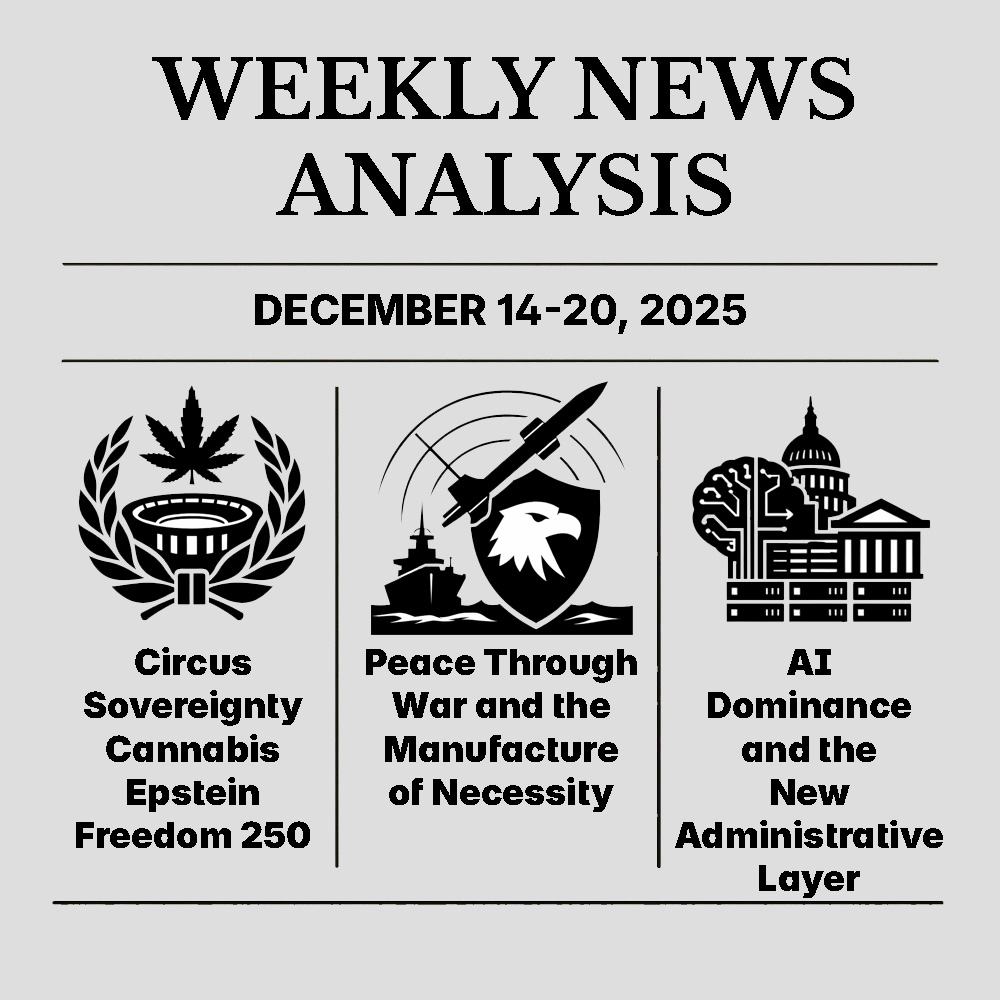
This week’s headlines seem like separate stories—cannabis rescheduling, a patriotic sports event, a “peace through strength” war stance, biometric border architecture, AI industrial deals, and a big urban power outage. However, they are all connected by a common theme: governance driven by mood management. One track offers symbolic relief through drug-policy “modernization,” a 250th-birthday festival, and curated elite scandals. Another track heightens insecurity with naval intercepts, aggressive language, and potential domestic strikes. The third track creates a lasting foundation—data systems, biometric chokepoints, and AI capacity—all consolidated within state–corporate partnerships that outlast current public debates.
The pattern's historical clarity comes from how bread-and-circuses thinking can coexist with and even facilitate tightening control. Rome didn’t keep its provinces peaceful by explaining imperial finance; instead, it managed emotional conditions through rituals, games, public distributions, and a constant display of legitimacy. Today, the “bread” isn’t just material; it’s narrative permission—allowing people to feel that there’s progress (“historic change”), to belong (“Freedom 250”), to fear (“security strategy,” war stance), and to delegate moral judgments to official labels (“terrorist,” “sanctioned,” “unsafe,” “minor safety”). Meanwhile, backend systems—such as international commerce channels, biometric exit/entry procedures, and AI procurement pipelines—advance more smoothly because attention is diverted elsewhere.
Across all three topics, the consistent rhetorical pattern involves presenting an emotionally appealing surface story while silently expanding institutional capacity. Changes in user-facing policies are presented as acts of benevolence or strength, whereas the underlying expansions are framed as prudence or innovation. This lifecycle pattern is highlighted in The Fallacious Belief in Government: crises (or crisis-language) justify the introduction of new authority; that authority then becomes normalized, setting the stage for the next “emergency.”
Circus Sovereignty and Managed Vice – Cannabis, Epstein, and the Freedom 250
Trump signs order reclassifying marijuana as less dangerous - The Guardian
Trump launches massive ‘Freedom 250’ push to ignite America’s 250th birthday celebration - Fox News
Trump ‘Patriot Games’ 2026 - The Hill
Patriot Games: What we know about Trump’s proposed high school athletic competition – Fox 5 DC
Epstein files release live updates - New York Times
Newly released DOJ documents reveal IDF sweatshirt in Jeffrey Epstein’s closet – The Gateway Pundit
Rome’s lesson isn’t simply that “people like entertainment,” but that empires learn to turn public attention into political leverage. Bread-and-circuses is a governance method: offering enough symbolic satisfaction, periodic relief, and civic rituals to sustain legitimacy while decision-making becomes more centralized and accountability diminishes. This week’s happenings—rescheduling cannabis, launching a national anniversary campaign, and hosting a youth sports event—serve as a modern civic ritual. The public is presented with a narrative of national renewal, “250,” a moralized story of competition, and a “historic” policy update. The rhetorical goal is to keep the masses focused on a story of controlled progress rather than on the deeper question: who maintains lasting influence over commerce, culture, and information as these “wins” unfold.
The story of cannabis rescheduling is presented as a blend of pragmatic compassion and scientific advancement. The Guardian notes that Trump signed an executive order reclassifying cannabis from Schedule I to Schedule III, framing this as a step to facilitate research and ease specific regulations, while stopping short of full nationwide legalization. The crucial question is what rescheduling achieves beyond cultural symbolism: it influences how capital engages with the industry, impacts taxes and banking hurdles, and makes interstate commercial standardization more politically feasible. If the federal stance shifts from “no legitimate medical use” to “legitimate medical uses," it simplifies arguments for unified distribution, payment systems, and compliance regimes on a national level—more of an administrative shift than a revolutionary change. Essentially, the “bread” is social approval and market optimism; the real prize is a more straightforward route to interstate commerce regulation and institutional influence.
This highlights the critique of technocracy from the work here at Journalistic Revolution: the system’s favored approach to social issues isn't personal freedom but standardization. Once the government endorses something, it usually imposes credentialed controls—such as approved products, vendors, research models, and payment systems. The Guardian points out that HHS is directed to develop research methods based on “real-world evidence” to examine long-term effects. Although this language seems neutral, it often leads to governance-by-metric: measurable things can be regulated, regulated items can be licensed, and licensed items can be centralized. The public perceives this as “less dangerous” and “medical research." Ultimately, there's a sustained shift toward a federal framework that defines acceptable cannabis through agencies and data standards, while keeping enforcement discretion in other areas.
Placed above the “bread" layer is the “circus”: Freedom 250 and the Patriot Games. FOX 5 DC describes the Patriot Games as a four-day athletic event in Washington, D.C., featuring 100 top high school athletes—one boy and one girl from each state and territory—eerily similar to the Hunger Games—showcasing the 250th-anniversary celebrations. The surface message is inspiring: youth, excellence, unity, and pageantry. The underlying message is more Roman: legitimacy is demonstrated rather than debated. You don't persuade a divided public with solid constitutional arguments; instead, you re-establish their loyalty through ritualized national emotion. Since it is presented as a "celebration,” criticism is often labeled unpatriotic or joyless—a classic rhetorical barrier protecting power.
When politics turns into spectacle, people become mere props. The issue isn’t the existence of a sports event, but that the state (or state-branded entities) trains the public to see governance as entertainment. The Fox 5 segment emphasizes that the events are still undefined, focusing only on the symbolic goal—“highlight American skill, sportsmanship, and competitive spirit”—which is characteristic of a circus: the storyline matters less than the sensation. With the Epstein scandal still topping headlines, it should be a red flag that the government is bringing minors to D.C. to compete for the elite.
The newest round of Epstein documents release, which in a healthy accountability culture should have highlighted institutional failures and elite shielding, instead mostly encouraged controlled outrage. The coverage provided enough revelations to capture public attention, but heavy redactions and partisan framing prevented the uncovering of key truths and blocked coalition accountability. Many outlets criticized the release for its extensive redactions and perceived incompleteness. This pattern and the reason it happens are outlined in The Fallacious Belief in Government, where fear-driven outrage is used to stir permanent moral agitation. However, unlike structural reform, the outrage here is manipulated through carefully controlled information, keeping the public reactive rather than encouraging thoughtful deliberation.
The Gateway Pundit’s emphasis on an IDF sweatshirt image serves as a symbolic catalyst. This artifact supports the intelligence-asset hypothesis highlighted in the COVID19 book (such as Epstein being a Mossad intelligence asset). However, the main point is not that "this proves X," but that the information environment is designed so that symbols can overshadow evidence: a sweatshirt picture, a celebrity name, or a redaction block—each becomes a rhetorical tool for supporting existing narratives. Meanwhile, the underlying institutional question—why “transparency" comes in controlled doses, why essential documents are missing or sanitized, and why accountability keeps stalling—gets overshadowed by spectacle.
Ultimately, when you combine cannabis rescheduling, Freedom 250 pageantry, and Epstein-file theatrics, the underlying Roman architecture becomes apparent: vice is controlled rather than freed, loyalty is performed through rituals, and scandals are carefully curated. The public is kept shifting between relief (noting "historic policy shift”), pride (celebrating "national achievement"), and outrage (highlighting "elite corruption")—a triad that distracts from focusing on the detailed backend processes. This backend is where Agenda-style governance flourishes: gradual administrative reforms, coordination across agencies, public-private partnerships, and enduring data systems that outlive any single narrative. The “circus” isn’t just a distraction; it sustains the space for power to expand.
Peace Through War and the Manufacture of Necessity
DHS sets Christmas week launch of nationwide biometric entry-exit for all foreign travelers - VisaHQ
A New National Security Strategy for a New Era - White House Archives
Trump announces National Security Strategy to advance America’s interests - White House Archives
US intercepts second merchant vessel off coast of Venezuela in international waters - The Guardian
NORTHCOM general says he is willing to authorize attacks on US soil - Free Thought Project
“Peace through strength” is not contradictory in imperial ideology; rather, it serves as a branding tool that portrays escalation as a virtue. The 2017 National Security Strategy, documented in the Trump White House archives, explicitly lists “Preserve peace through strength” as one of its four core pillars. This phrase is effective rhetorically because it conceals an underlying assumption: that peace results from the state's ability to dominate rather than from restraint, diplomacy, or decentralization. Once this assumption is accepted, expanding military power can be easily framed as a step toward peace, while any opposition appears naive. This underlying logic means that war is not defined as war; instead, it is justified as necessary for security, essential for stability, and a sign of being serious.
The Guardian's account of the U.S. intercepting a second oil-carrying merchant ship off the coast of Venezuela further illustrates that rationale. It reports that U.S. forces stopped a vessel in international waters during an American blockade, noting that the ship was not on the sanctions list, which could represent an escalation in enforcement. The stated reason—tracking the “illicit movement” of sanctioned oil and linking it to “narco-terrorism”—is rhetorically compelling because it combines crime, terrorism, and foreignness into a single moral fault. However, following a traditional imperial pattern, resource control and trade restrictions are often justified by a broader strategic aim. Even without implying hidden motives, the reality remains that blockades and seizures in “international waters” establish a norm where the dominant power enforces economic morality through force.
This is where the book, 1984, seen as a “roadmap,” offers a valuable interpretive perspective: the phrase “War is Peace” influences people to accept contradictions as policy. When officials claim “peace through strength,” they encourage citizens to view coercion as kindness. Likewise, when they depict blockade enforcement as an anti-terrorism virtue, they ask the public to see economic warfare as policing.
The Free Thought Project highlights a domestic aspect of that posture: a NORTHCOM commander allegedly indicating willingness to approve strikes on U.S. soil for specific reasons. The main point isn't sensationalism, but the increasing merging of foreign-war logic into domestic policy. As the state adopts the view that threats are omnipresent and that 'preemption' is justified, the scope of force becomes more adaptable. This concern echoes historical examples like Operation Northwoods: even without claiming it's a direct repetition, such proposals in U.S. history show that government planners can consider deception and domestic manipulation as policy tools.
The Fallacious Belief in Government framework highlights a common misconception: people often think false flags are rare because they conflict with the moral intuition that the government’s primary responsibility is to protect the public. However, the original NSS language emphasizes protecting citizens, which can be exploited to justify extraordinary actions. The mistake is assuming that stated duty indicates actual restraint. In reality, claims of duty to protect can justify increased surveillance, preemptive measures, and shield decision-makers from accountability. As the public is conditioned to link security with legitimacy, it becomes easier to channel any disruptive event—whether genuine or fabricated—into justification for expanded authority.
A war stance is costly politically when the public is united, attentive, and skeptical. It is less expensive when spectacles divert attention and legitimacy is renewed through pageantry. Events like national celebrations and youth sports tournaments do more than distract; they help restore the emotional connection between citizens and the state, easing the justification for "homeland defense" escalations. This echoes Rome: games and grain were integral to conquest, serving as domestic stabilization tools that made expansion sustainable. In modern terms, spectacle functions as a load-balancer for the empire.
The inclusion of biometric entry-exit expansion in this list is deliberate: it acts as the administrative link between external and internal controls. According to VisaHQ, DHS will mandate biometric data (initially facial images, with fingerprints and iris scans to follow) for non-U.S. citizens entering or leaving the U.S., starting Dec. 26, 2025. While this appears to be "border management," it also sets a precedent. Once a system for reliably logging individuals at scale is established, mission creep becomes a political issue rather than a technical one. War strategies justify, while data infrastructure provides the capacity. The state is not just narrating threats but also investing in the machinery that ensures continuous threat governance.
AI Dominance and the New Administrative Layer
Power outage hits 130k in San Francisco: What we know - Newsweek
OpenAI adds new teen safety rules to models as lawmakers weigh AI standards for minors - Tech Crunch
Amazon reportedly in talks to invest $10B in OpenAI as circular deals stay popular - Tech Crunch
Trump AI Tech Force Amazon Apple - CNBC
If Topic 1 is the circus and Topic 2 is the sword, then Topic 3 is the operating system. This week’s headlines on AI and infrastructure highlight both innovation and consolidation: significant investments in OpenAI, new safety regulations targeting minors, and a federal effort to attract private-sector technologists for government modernization. TechCrunch reports that OpenAI has implemented teen safety rules as lawmakers consider AI standards for minors. The same outlet notes Amazon’s discussions to invest $10 billion in OpenAI, within the context of “circular deals.” Nextgov reports that the Trump administration has launched a “US Tech Force” to recruit temporary workers, following thousands of layoffs earlier this year. Overall, the trend is clear: AI capacity is becoming centralized through a cycle driven by government needs, corporate investment, and regulatory focus.
The rhetorical appeal here revolves around “dominance” and “safety.” Dominance is framed as essential for national survival—highlighted by phrases like “winning the future” and outcompeting rivals—while safety is depicted as a moral obligation—focused on protecting children and preventing misuse. The issue is that both perspectives push the public to accept rapid decision-making and centralization as unavoidable. The core mechanism is emergency governance: identify a critical threat, claim only centralized expertise can handle it, and embed that expertise into lasting systems. Examples like teen safety regulations and debates over standards follow this pattern: they may be genuinely motivated, but they also serve as a socially acceptable justification for adding layers of control, monitoring, and enforcement to AI systems. The public hears “protect kids,” while system developers see a “permission structure for enforcement.”
“Circular deals” are more than just financial gossip; they demonstrate how power consolidates through mutual dependence. For instance, if Amazon is considering investing $10 billion in OpenAI, with cloud and computing relationships and partnership structures becoming interconnected, the market shifts from a mere competitive arena to a cartel-like system with shared interests and risk management. This is politically significant because governments tend to favor the largest, most integrated providers of AI—especially those that can ensure scale, compliance, and rapid deployment. In this way, “public-private partnership” often acts as a diplomat's term for outsourcing governance: the government issues the mandate, the corporation delivers the system, and accountability is spread across contracts and classification boundaries.
The US Tech Force narrative emphasizes this issue. Nextgov reports on a recruitment effort for temporary staff following substantial staffing cuts—highlighting a pattern in which institutional capacity is depleted and then supplemented with private-sector talent during times of urgent modernization. Another source echoes this, noting the hiring of about 1,000 technologists from major companies to upgrade government systems with AI and better data infrastructure. The misconception is the idea that bringing in private expertise automatically benefits the public. While it can, it also introduces private motives and increases reliance. When government operations depend on a constant flow of corporate technologists and vendor ecosystems, sovereignty tends to shift from voters to system administrators—favoring rule by platforms over rule by law.
The Newsweek article on the San Francisco outage initially appears as a local incident. However, infrastructure fragility plays a crucial, often overlooked role in AI governance. Newsweek highlights impacts such as disruptions to traffic signals, transit, and public safety instructions, emphasizing the dependence on utility restoration. This connection isn't conspiratorial; it reflects systemic vulnerability: as societies digitize, outages serve as real-time tests of governance resilience. Centralizing services—like payments, transportation, identity, and communication—justifies resilience strategies that can resemble surveillance and control, including mandatory verification, trusted user tiers, real-time monitoring, and emergency powers that tend to become permanent. Infrastructure failures caused by storms, aging grids, or sabotage become ongoing crises that condition the public to accept increasingly fortified systems.
This topic connects again to the biometric expansion discussed in Topic 2. Both border biometrics and AI safety standards rely on the need for identity certainty at a large scale. As biometrics become standard at ports of entry and exit, it becomes easier to promote identity security in domestic digital spaces—especially “for minors,” “to prevent fraud,” “to stop extremism,” or “to protect critical infrastructure.” This approach exemplifies the “Agenda 2030" implementation pattern: not through a single declaration of total control, but through a series of plausible, justified modules—each defensible alone—that together form an administrative framework. People agree to these modules, but rarely to the entire system.
The recurring bread-and-circuses pattern appears again in this deployment strategy. AI development tends to be most successful when the public is either captivated by innovation or fatigued by conflict. Topic 1 sparks fascination and scandal, Topic 2 triggers fear and patriotic rallying, while Topic 3 handles implementation. This combination explains why the week feels coherent: spectacle calms emotions, crises justify authority, and AI/data infrastructure enacts the new normal. Practically, AI “dominance” is less about outpacing rivals and more about creating a system capable of managing populations—economically, informationally, and administratively—without needing ongoing democratic persuasion.
From Circus to Code: How Spectacle Hardens Control
This week’s pattern is primarily structural, not partisan. Cannabis rescheduling, the Freedom 250 pageantry, and youth spectacles demonstrate how systems gain legitimacy through rituals and controlled relief. Naval interceptions, the “peace through strength” doctrine, and domestic-strike insinuations show how systems enforce compliance through fear and preemptive strategies. AI collaborations, recruitment campaigns, and debates over safety regulations reveal how systems establish permanence by embedding governance into software and data infrastructures. When these layers function together, the public perceives politics as a series of emotionally intense events—hope, pride, outrage, fear—while the underlying system expands its capacity and reduces the need for public consent. This pattern reflects a framework outlined in The Fallacious Belief in Government: crisis, response, and control as a continuous cycle rather than occasional occurrences.
Rome’s warning, adapted for today’s digital world, suggests that the “circus” is more than entertainment—it’s a tool for governance that hampers the development of lasting, rational opposition. Similarly, the “bread” isn’t just sustenance; it’s any form of relief granted by authorities that encourages people to negotiate with power instead of withdrawing their legitimacy. By 2025, the "circus" includes national brands and curated scandals, while the "bread" involves policy updates that still allow enforcement discretion. Algorithms increasingly drive the masses. When AI becomes the administrative backbone, the empire doesn’t need to persuade each new generation; it only needs to uphold the system, safeguard data, and keep the population engaged with emotionally appealing stories.
Listen to this week's news in verse for a quick recap!