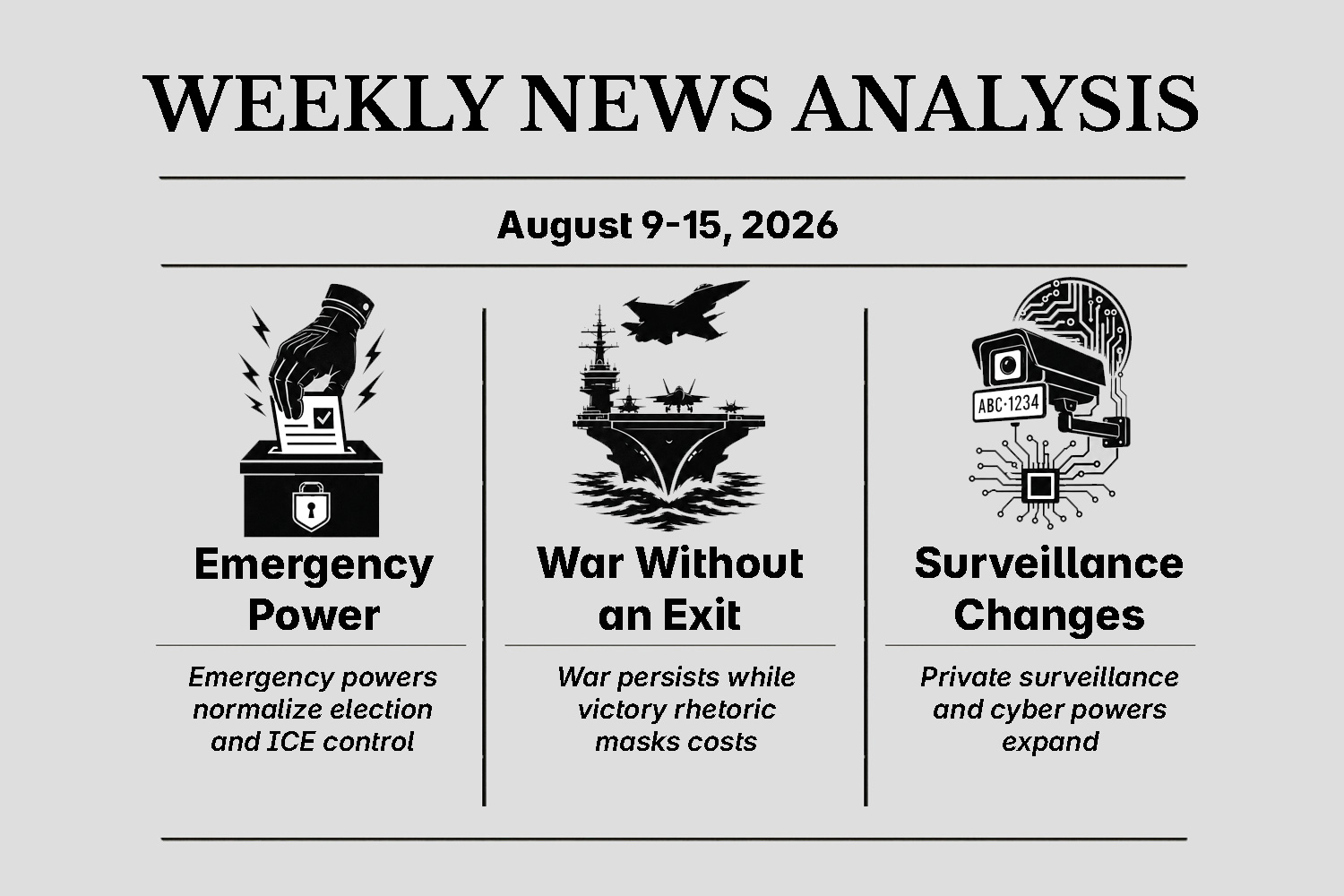
At first glance, three developments this week appear unrelated, yet each reflects the same underlying transfer of power. At home, President Donald Trump left open the possibility of using a national-security emergency to impose election rules Congress has not enacted, and courts have repeatedly questioned, while Immigration and Customs Enforcement prepared to spend millions of dollars on electric-shock gloves marketed to obtain physical compliance. Abroad, a war repeatedly framed through the rhetoric of victory and control continues to consume military resources, restrict global shipping, and exhaust sailors aboard ships like the USS Abraham Lincoln. Meanwhile, surveillance companies are reshaping products and contracts under public pressure as the federal government begins formally deputizing private corporations for offensive cyber operations. On the surface, the subjects are elections, immigration, Iran, cameras, and hackers. Beneath them sits the same systemic subject: authority.
The governmental lifecycle examined in The Fallacious Belief in Government: Warp Speed Toward Tyranny follows a familiar pattern: crisis supplies the justification, intervention enlarges authority, consolidation converts the exceptional mechanism into infrastructure, and normalization turns yesterday's extraordinary power into tomorrow's administrative routine. The question is not whether each policy, standing alone, constitutes dictatorship. That is an easy straw man because tyranny seldom arrives through one legislative announcement abolishing liberty. Institutions change by increments. A voter database becomes election security. A pain-compliance weapon becomes de-escalation. A blockade becomes territorial control. A license-plate reader becomes public-safety infrastructure. A private hacker becomes a government-supervised cybersecurity partner. First the vocabulary is normalized; then the architecture built beneath it becomes ordinary.
This is why the Trivium matters more than partisan loyalty. Grammar asks what authority is actually claimed, what equipment is actually being purchased, which military operations remain active, and what data is actually being collected. Logic tests whether the stated justification corresponds to the mechanism being built. Rhetoric asks why expansions of coercive capacity so consistently arrive wrapped in words such as security, integrity, safety, de-escalation, and innovation. The danger cannot be reduced exclusively to Trump, Democrats, Republicans, Flock, Axon, ICE, or any single institution. It lies deeper, in a political culture trained to judge power by who temporarily holds it rather than by what that power enables whoever holds it next to do.
Emergency Power
ICE plans to give officers gloves that can deliver painful electric shocks - AP
ICE plans to give officers electric shock gloves - The New York Times
Donald Trump did not announce a federal takeover of the 2026 midterm elections this week. That distinction must remain clear. Instead, after conservative television host Wayne Allyn Root proposed declaring a national-security emergency to bypass Congress and impose proof-of-citizenship requirements, photo identification, and restrictions on mail voting, Trump declined to reject the idea and responded that “stranger things have happened.” The constitutional problem remains fundamental: presidential emergency authority does not automatically transfer state-administered elections to the executive branch, and courts have already blocked portions of Trump's attempts to impose election rules by executive action. The significance is therefore not an accomplished takeover but the normalization of a premise—that congressional resistance might itself justify emergency executive substitution. Once ordinary constitutional disagreement is recast as proof that extraordinary authority is necessary, separation of powers ceases to be a boundary government must respect and becomes merely an obstacle awaiting a sufficiently alarming adjective.
Election-legitimacy rhetoric reveals an obvious logical contradiction. Trump and many of his most committed supporters still treat the 2020 result as inherently suspicious while accepting the 2024 result that returned Trump to power as authentic. Legitimate election questions are not the problem; election systems should remain auditable, transparent, challengeable, and subject to rigorous examination, even though they aren’t. The fallacy appears when the evidentiary standard changes with the preferred outcome. Confirmation bias then merges with special pleading: defeat becomes proof of corruption, while victory becomes proof that the system functioned. The Independent notes that evidence has not established mass voter fraud capable of changing the outcome Trump contests, yet systemic illegitimacy continues serving as the premise for stronger presidential involvement. Once citizens declare elections legitimate when their faction wins and corrupt when it loses, they stop defending election integrity. They are defending the result they want. The chapter on Psychological Operations in The Fallacious Belief in Government examines voting fraud and its different types. Trump and the Republicans emphasize just one aspect, giving the impression that it is the sole form of election cheating.
More consequential is what happens when this reasoning outlives Trump. Suppose a future Democratic president declares right-wing voter suppression a national-security emergency and federally suspends state identification requirements. Suppose another president declares foreign disinformation an emergency and temporarily restricts political communication during election season. Suppose federal agents surround polling locations because intelligence analysts or AI identify an unspecified extremist threat. Anyone accepting emergency election authority because they trust Trump has already handed the precedent to political opponents. Natural-rights analysis therefore evaluates powers, not personalities. Government authority deemed legitimate only because the preferred ruler possesses it is not a principle; it is temporary partisan permission. The constitutional architecture distributes election administration precisely because concentrated power creates concentrated failure. Emergency rhetoric inverts that logic, insisting uncertainty requires centralization when uncertainty is exactly when institutional checks matter most.
Gradualism is the larger danger. Republics rarely awaken one morning and knowingly vote themselves into recognizable tyranny. Extraordinary powers generally enter as narrow answers to a defined danger, then remain, replicate, broaden, or become technologically modernized. The post-9/11 surveillance structure offers a recent American example: authorities defended as exceptional tools against foreign terrorism eventually became embedded throughout domestic intelligence and law-enforcement architecture. Authority concentrates under promises of restored stability until coercive mechanisms settle into ordinary governance. Election administration is uniquely sensitive because the government wielding power also depends on the process that determines who continues to hold it. Even without an actual federal seizure of the midterms, presidential discussion of emergency election control lowers the rhetorical barrier for the next attempted expansion. As everything shifts toward AI review and digital systems, it's crucial to ask: who is responsible for counting votes and verifying their validity? Who can reliably confirm the accuracy of the vote-counting mechanism? Can we trust and rely on a system when the only options available are controlled opposition?
ICE's planned acquisition of electric-shock gloves makes that expansion of coercive capacity tangible. DHS disclosed plans allowing ICE to spend as much as $20 million on thousands of G.L.O.V.E. devices—Generated Low Output Voltage Emitters—worn as ordinary patrol gloves until electrically activated against exposed skin. The manufacturer markets the device as pain-compliance and de-escalation technology, while defenders argue another less-lethal option could prevent officers from moving directly to more dangerous force. That possibility deserves consideration; not every nonlethal weapon is inherently more dangerous than the weapon it may replace. The logical error is assuming replacement rather than addition. A new force option may displace a harsher one, but nothing guarantees it will not simply add another rung to an expanding coercive ladder. That concern grows when the device is concealable, instantly available during physical encounters, and designed specifically to make resistance painful.
The documented concerns show why the euphemism de-escalation device deserves scrutiny rather than automatic acceptance. AP reported that the manufacturer itself warns against using the gloves for punishment, verbal defiance, or on vulnerable populations including children, pregnant women, elderly people, and severely disabled individuals. AP also detailed a pending lawsuit involving a 43-year-old Kentucky jail detainee who died after allegedly being shocked 27 times with the gloves and 13 additional times with a Taser; an internal investigation found that two glove applications substantially exceeded the manufacturer's recommended duration. None of this proves ICE intends to torture detainees, protesters, or American citizens. Even if it happens, it makes a more useful analytical point: technology sold as controlled pain compliance can be misused once personnel inside an institution make rapid discretionary judgments about resistance. The political question is not whether legitimate applications exist, but whether accountability expands at least as quickly as the government's capacity to inflict coercive force through its monopoly on violence.
Placed alongside the election-emergency discussion, the gloves expose a shared governmental grammar: compliance. Election policy seeks compliance with federally preferred voting procedures; immigration enforcement seeks physical compliance with federal officers. The first operates institutionally and the second bodily, yet both enlarge the executive government's capacity to overcome resistance. Here the “protect and serve” contradiction analyzed in The Fallacious Belief in Government becomes relevant. The state labels enforcement mechanisms as protective technologies even though they ultimately compel behavior when persuasion fails, not protect individual citizens. ICE may legitimately confront violent individuals, just as election systems legitimately require security. The fallacy begins when those realities become unlimited appeals to authority: because some threats are real, whatever mechanism government identifies as protective is presumed justified. Critical thinking reverses that burden. As a mechanism becomes more powerful, secretive, painful, or politically consequential, demands for evidence, external oversight, due process, and constitutional restraint should increase before normalization occurs.
War Without an Exit
Trump says U.S. has total control over Strait of Hormuz and might keep it - CBS News
Trump says Strait of Hormuz could become U.S. territory - The Hill
USS Abraham Lincoln sailors try to jump overboard as safety concerns mount - Newsweek
USS Abraham Lincoln sailors tried to jump overboard amid extended deployment - The Guardian
Political declarations and operational reality continue moving in opposite directions in the Iran conflict. Trump has repeatedly framed events as a decisive victory under overwhelming American control. Yet the conflict that began in late February was still, by this week, sustaining a U.S. naval blockade, severely disrupting shipping through the Strait of Hormuz, redirecting major naval assets, fueling regional fighting, and requiring continuing diplomatic efforts to restore an agreement. CBS reported that vessel traffic through Hormuz fell to only eight ships on August 12, compared with roughly 130 daily transits before the war. The same reporting described U.S. forces firing Hellfire missiles at a Panama-flagged vessel that CENTCOM said attempted to violate the blockade of Iranian ports. A completed war does not ordinarily require these continuing acts of coercive military power. Commercial shipping, energy markets, regional sovereignty, and escalation remain directly exposed. The rhetoric says the conflict is settled; the logistics say otherwise.
Trump's claim that the United States has “total control” over the Strait of Hormuz—and his suggestion that America might keep it—moves the rhetoric beyond battlefield victory and toward imperial possession. Iran immediately rejected the claim and continued asserting control over the waterway. Whichever military force can temporarily dominate movement through the strait, the change in language matters. Control describes operational capability; territory describes sovereignty. Confusing the two is an equivocation historically associated with imperial expansion: military access becomes strategic necessity, strategic necessity becomes permanent presence, and permanent presence becomes asserted entitlement. The Strait of Hormuz does not become an American domestic waterway merely because American naval forces can project force through it. Turning domination into ownership revives the logic of gunboat diplomacy, where superior military capability is rhetorically converted into political legitimacy. CBS's reporting makes the contradiction starker because Iran continues contesting both the blockade and Trump's claim of control.
Any clean narrative of victory becomes harder to defend when you examine the wider battlefield. In and around the Red Sea, Houthi attacks have again killed people aboard commercial shipping; fighting has intensified in Yemen; Israeli operations continue in southern Lebanon; Iranian missile and drone capabilities remain contested; and U.S. forces remain engaged in blocking Iranian maritime activity. CBS also reported that an American helicopter struck a Panama-flagged civilian vessel accused of attempting to breach the blockade, while dozens of other vessels had reportedly been redirected or interdicted. The pattern can sustain itself. Pressure provokes retaliation, retaliation becomes the justification for greater pressure, and the greater pressure widens both the geography and politics of the conflict. Each new escalation is then defended by pointing to the escalation immediately before it. Eventually, continuation itself becomes the evidence offered to prove that continued war is necessary.
That strategic abstraction has a human cost, concentrated aboard the USS Abraham Lincoln. The carrier departed San Diego in November 2025 and was redirected from its planned Pacific mission after the war with Iran began. By August, more than 5,000 sailors and Marines were in their ninth month of deployment, with reporting describing a modern carrier record of approximately 250 consecutive days at sea. Family members described moldy showers, broken toilets, disabled laundry equipment, long periods without hot water, shortages of basic hygiene products, rationed or poor-quality meals, and severe psychological strain. Navy officials disputed parts of that characterization, saying sailors still had clean water, functioning air conditioning, healthy food options, and onboard mental-health support. Competing accounts matter. A strong analysis does not require pretending the institutional denial is absent; it requires asking why enough sailors and families independently reported serious distress that lawmakers and military-specialist publications began demanding answers.
Reports that multiple sailors attempted to go overboard are more disturbing still. The Guardian cited Navy Times and Stars and Stripes reporting on several incidents and quoted family members describing severe burnout, along with fear that seeking help could destroy military careers. Roughly 200 family members attended a San Diego town hall, where one spouse reportedly said her husband had messaged that he hoped he would not wake up the next day. Another family described a sailor attempting to jump overboard after repeated deployment extensions. The Navy responded that information available to the command did not show an increase in reported suicidal ideation or attempts aboard the carrier. The contradiction cannot be dismissed as another partisan dispute. Either families are substantially mischaracterizing what is happening, or command-level reporting systems are not capturing what sailors are experiencing. Neither explanation warrants complacency.
The Lincoln response also illustrates institutional self-protection. When damaging accounts surface, government organizations have incentives to label them isolated, exaggerated, operationally necessary, or harmful to morale. The military cannot publicly disclose every vulnerability during combat operations, and adversaries can exploit negative information as propaganda. Even if the enemy exploits it, that does not mean the information is false. Institutions become dangerous to their own members when protecting reputation takes priority over honestly assessing readiness and well-being. The sunk-cost fallacy compounds prolonged deployments: because enormous resources and sacrifices have already been committed, reducing or ending the mission can be rhetorically recast as wasting those sacrifices. Yet past cost cannot logically justify indefinite future cost. A government claiming to honor service members must judge strategy partly by what that strategy is doing to the people ordered to carry it out.
Imperial systems have historically separated strategic rhetoric from the individuals forced to execute policy. Maps show shipping lanes, naval task forces, deterrence zones, and controlled territory; they do not show exhaustion, broken plumbing, family separation, sleep deprivation, or the psychological consequences of months inside a combat vessel. War rhetoric depends upon that abstraction. The state speaks of national interests, deterrence, freedom of navigation, security, and victory while human beings absorb the physical cost of making those abstractions real. War for peace is an inherent contradiction when violent intervention becomes the recurring mechanism promised to produce stability. The Lincoln reveals that contradiction from within: sailors are pushed toward extraordinary limits to sustain a policy publicly narrated through the language of control, victory, and strength.
Military capability is not the unresolved question. The United States can dominate Iran or the Strait of Hormuz for periods of time, just as a global superpower can destroy infrastructure, interdict vessels, occupy maritime space, and maintain carrier groups for considerable periods. The unresolved question is what political objective turns that capability into an endpoint. If victory means Iranian capitulation, what constitutes capitulation? If victory means permanently controlling Hormuz, what prevents that goal from requiring indefinite military enforcement? If the goal is reopening international shipping, does asserting American territorial possession make a negotiated reopening easier or harder? A definition of victory that generates another military requirement with every answer is not a defined condition; it is a moving target. Moving goalposts permit repeated declarations of victory while the machinery of war continues. The sailors aboard the Lincoln live inside the space between those declarations and operational reality.
Surveillance Changes
Amid public backlash surveillance tech company Flock announces platform changes - Los Angeles Times
Flock announces changes amid backlash over its license plate reader network - AP
Cities Are Ditching Flock Safety Cameras - Yahoo
Douglas County to replace Flock cameras with $22.8 million Axon system - Denver Gazette
Donald Trump empowers US private companies to conduct cyber attacks - The Guardian
Trump Gives Green Light to U.S. Companies to Aim Hacks at Cybercriminals - The New York Times
Flock Safety's nationwide license-plate surveillance network is confronting something increasingly uncommon in the technological-security marketplace: organized resistance from both the political left and right. AP reports that more than 50 agencies or jurisdictions have canceled, suspended, rejected, or deactivated Flock systems this year, while cameras have also been physically vandalized. Across 49 states, the company enables thousands of law-enforcement agencies to record vehicle plates and other characteristics and, depending upon local configuration, search or share that information across jurisdictions. Flock and police departments cite cases involving recovered missing people, identified stolen vehicles, and located criminal suspects. Critics see another architecture: a distributed location-tracking network that can retrospectively reconstruct where ordinary people traveled without individualized suspicion at the time the data was collected. Both descriptions can be true at once. That is precisely why invoking public safety or privacy alone cannot resolve the debate.
Flock's response deserves attention. Beginning January 1, law-enforcement customers must use mandatory auditing tools that identify abnormal searches, connect searches to case numbers, flag emergency overrides, and provide greater control over which investigative categories outside agencies may run against local data. Flock is also reducing its standard retention period from 30 days to seven unless information is preserved as evidence. Compared with an unrestricted system, those safeguards are meaningful, and automatically dismissing every reform would violate the Trivium's requirement to update rhetoric when grammar changes. They still do not resolve the underlying constitutional question. Critics correctly distinguish reducing abuse of mass collection from ending mass collection. A seven-day database of everyone's movements remains a database of everyone's movements. Requiring a case number changes access governance; it does not convert indiscriminate collection into individualized suspicion.
The distinction sharpens when jurisdictions abandon Flock only to replace it with another surveillance vendor. Douglas County, Colorado, approved a nearly $22.8 million Axon contract that replaces 50 Flock license-plate cameras with 100 Axon Outpost readers and adds a network of first-responder drones. County officials emphasized a meaningful difference: under the Axon arrangement, Douglas County says it will own its data, use 30-day retention unless information becomes part of an active investigation, conduct quarterly audits, and add oversight through the district attorney's office. Officials also said drones would launch in response to dispatch calls involving emergencies rather than conduct continuous patrols. Operationally, those distinctions matter. From the perspective of a citizen driving through the county, however, automated plate readers are doubling while airborne surveillance capability is being added. Changing the corporate logo does not necessarily remove the surveillance architecture that caused the public objection.
Here, institutional rebranding can masquerade as structural reform. A population objects to Flock, officials terminate Flock, and the political system can claim it listened—even while buying another automated plate-recognition system. That does not make Axon and Flock identical companies, nor does it make their technical, contractual, and data-governance models interchangeable. They are not. Axon is a publicly traded corporation with institutional shareholders (e.g., Vanguard and BlackRock; Flock is privately held and venture-backed (e.g., Peter Thiel's Founders Fund). Large investment firms holding shares through funds is not, by itself, evidence that those asset managers direct day-to-day corporate policy, but when you own 5% to 15% of a major corporation, you absolutely have power to influence and direct strategic goals and operations. The stronger systemic criticism requires no hidden-command hypothesis: governments, investors, police agencies, and technology vendors can independently share incentives that favor expanding surveillance infrastructure.
The Flock-to-Axon transition offers a more observable lesson. Once government accepts surveillance as a legitimate function, competition among vendors can keep that function alive even when citizens defeat one corporation or contract. The apparatus becomes procurement-agnostic. If Flock disappears tomorrow, automated vehicle tracking can simply move to Axon or another provider because the political demand survives the vendor. That institutional continuity matters more than which investment fund owns what percentage of a corporation. It explains how surveillance can persist through elections, personnel changes, public controversies, and corporate failures. Once the incentives are embedded, the machine can keep operating without a single architect.
Trump's cyber memorandum carries that public-private integration from observation into active force. The memorandum directs the administration to use private-sector capabilities for government-controlled cyber operations against designated foreign transnational criminal organizations. Participating companies must be vetted, operate under federal direction, and maintain at least a $1 million bond or escrow. More significantly, the authorized category of “cyber effects operations” can include manipulating, disrupting, denying, degrading, or destroying information systems, networks, virtual infrastructure, and potentially physical infrastructure controlled through information systems. This is not ordinary defensive cybersecurity. Offensive capability historically associated with military, intelligence, and federal law-enforcement agencies is being formally extended to selected private entities operating under government authority. The administration describes this as harnessing private innovation against ransomware organizations and transnational criminal groups. The civil-liberties problem is the precedent that remains when pressure inevitably builds to expand the original target category.
The privateer provides a useful historical analogy. Governments once issued letters of marque permitting private vessels to attack enemy commerce while ostensibly remaining under national authority. The modern cyber model is not legally identical, yet the structural resemblance is difficult to ignore: private resources are deputized to exercise offensive capability authorized by government against external targets. Capacity is the obvious advantage. Private cybersecurity firms may possess technical expertise, infrastructure, intelligence, and speed that bureaucratic agencies struggle to reproduce. Accountability is the corresponding danger. A cyber misattribution can lead a company operating under government direction to damage systems belonging to innocent third parties, disrupt civilian infrastructure, cross sovereign boundaries, or trigger retaliation against American corporations. The Guardian notes that similar proposals have previously encountered concerns about escalation, unintended consequences (e.g., blowback), and interagency coordination. Private actors do not reduce state power; they increase the number of hands through which state-sanctioned force can operate. And with AI, those hands expand exponentially.
Taken together, Flock, Axon, and the cyber memorandum show the surveillance state changing from a government-owned apparatus into an ecosystem. Cameras can be privately manufactured, cloud databases privately hosted, analytical software privately developed, drones privately produced, and offensive cyber expertise privately supplied, while government agencies retain the coercive authority to act upon the resulting information. The traditional boundary between corporation and state blurs without corporations literally becoming government agencies. Reciprocal insulation is the danger. Officials can answer criticism of government surveillance by pointing to a private vendor; vendors can answer criticism of corporate surveillance by insisting customers control the data. Each actor points toward the other while the integrated capability remains intact. In such a system, accountability becomes distributed as power becomes consolidated—the opposite of what genuine decentralization should produce.
The Machine Keeps Its Shape
The week's three stories converge upon the same structural trajectory. Trump considers emergency authority when ordinary election legislation meets constitutional and congressional barriers. ICE considers adding an invisible pain-compliance technology while its enforcement methods face heightened public scrutiny. The Iran war persists beneath repeated declarations of dominance as exhausted sailors absorb the human cost. Communities reject Flock cameras only to find another corporation can supply the same underlying surveillance function, sometimes at greater scale. Private corporations are then invited beyond collecting data and into government-directed offensive cyber activity. No single policy here proves the arrival of totalitarian government. That is the wrong test. The meaningful question is whether their cumulative direction repeatedly shifts capacity away from individual autonomy and toward institutions that can monitor, categorize, coerce, disable, or override individuals with progressively less friction.
The rhetorical sequence remains remarkably consistent: identify a threat, declare existing authority inadequate, introduce an extraordinary mechanism, surround it with safeguards, and normalize the capability over time. Election fraud requires emergency authority. Resistant detainees require electrified gloves. Iran requires indefinite military pressure and control of strategic waterways. Crime requires pervasive vehicle tracking and drones. Cybercrime requires privately operated offensive capabilities. The threats may be real; that is precisely what makes the mechanism persuasive. Propaganda need not invent every danger. It often needs only a legitimate danger and one preferred expansion of authority presented as the inevitable response. The false dilemma becomes either accept the new power or accept chaos. That construction omits the possibility of confronting threats while still respecting due process, decentralization, proportionality, natural rights, and meaningful restrictions on whoever exercises coercive power.
The decisive question is not whether Donald Trump can be trusted with these mechanisms, or whether another president, political party, corporation, or security agency might use them more responsibly. Natural rights cannot logically depend upon the character of a temporary ruler. A right that survives only because benevolent administrators choose not to violate it is not a right in practice; it is discretionary permission. The warning throughout The Fallacious Belief in Government is to judge government by the powers its systems accumulate, because personnel change while institutional capability remains. Elections replace presidents. Defense secretaries leave. CEOs retire. Technologies merge. Vendors disappear. Databases migrate. Yet the precedent remains. The code remains. Emergency authority remains available for reinterpretation. Tyranny does not require a single dramatic moment formally abolishing freedom. It requires enough smaller moments in which society is persuaded that surrendering another piece of autonomy is reasonable because this particular emergency is different.
Listen to this week's news in verse for a quick recap!