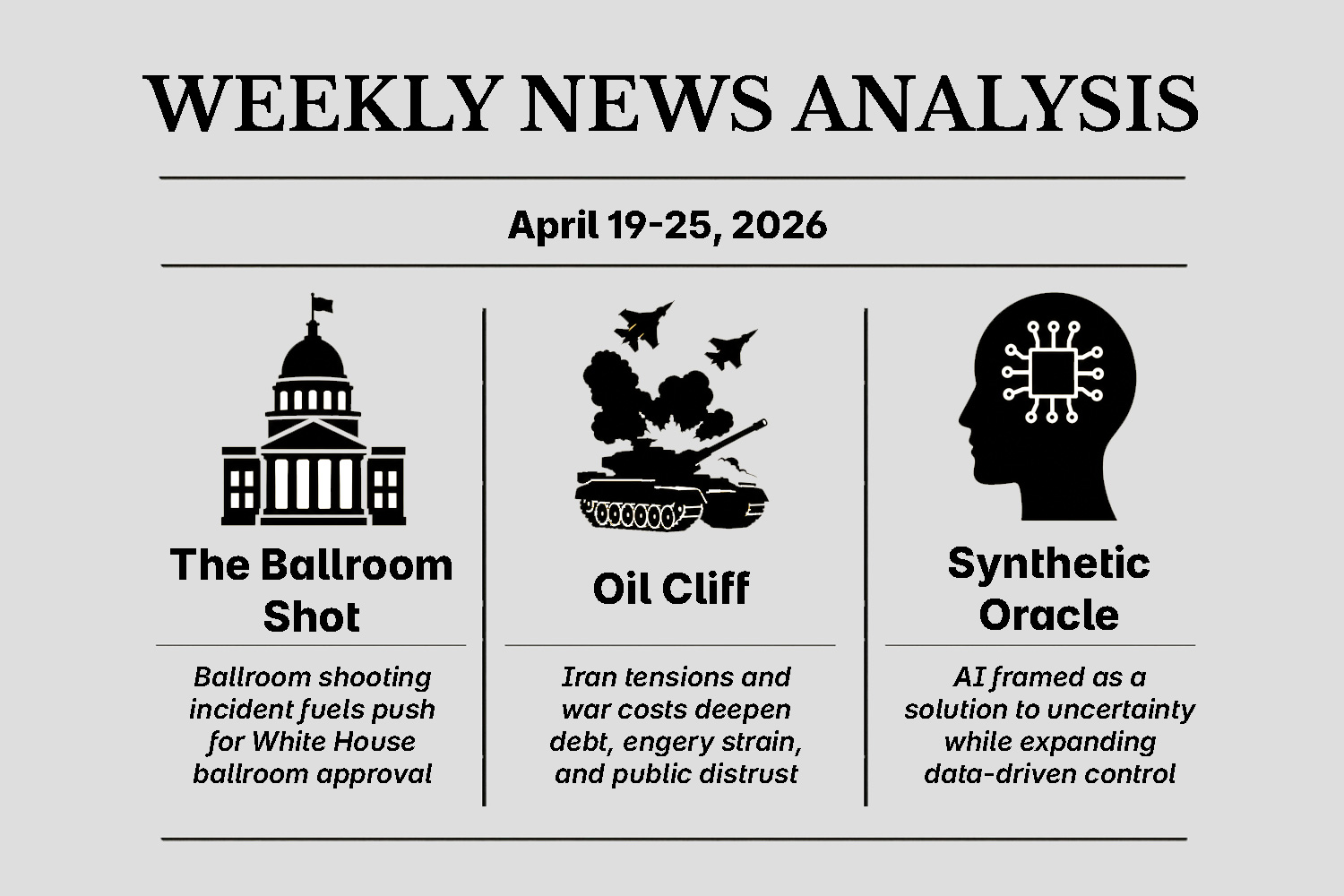
This week unfolded as a single operating system: spectacle, war, and artificial intelligence each serving a specific role within the same framework. The first narrative transformed violence into architectural authorization. The second turned war into debt, energy management, and inevitable fiscal outcomes. The third translated uncertainty into a software issue, providing artificial confidence as an additional layer in social governance. The pattern remains familiar: a crisis emerges, authorities interpret it, institutions seek new power, and the public is compelled to accept expansion as necessary, as governments strengthen their control under the guise of safety and service.
The Ballroom Shot
White House Correspondents’ Dinner shooting suspect ID’d, FBI secures his California home - Fox News
Trump White House Correspondents’ Dinner live updates - CNN
Trump White House Correspondents’ Dinner Live Updates - BBC
A false flag, in its strict sense, refers to a malicious or militant act designed to appear as if it was carried out by someone other than the true perpetrator. Its main goal is often to shift blame, garner sympathy, or justify political actions. However, not every suspicious event qualifies as a false flag, nor are all crises staged. A good crisis is never wasted. It is crucial to analyze not just the incident itself but also the political motives or benefits associated with it. Psychological operations operate similarly: they influence perception, emotion, and behavior by transforming fear into consent, often playing all sides. The military has long viewed psychological operations as force multipliers that leverage information rather than physical force alone.
The White House Correspondents’ Dinner shooting quickly took on a symbolic meaning. Fox reported that 31-year-old Cole Allen was accused of shooting at the Washington Hilton during the event, leading to the evacuation of Trump and senior officials, with authorities investigating the motive. The event was immediately depicted as another assassination attempt, a highly charged phrase in American media. While 'shooting' describes the event itself, 'assassination attempt' elevates it into a mythic narrative involving destiny, persecution, enemies, and a national crisis. This rhetorical shift is significant because it turns a security lapse into a source of authority and legitimacy.
The deeper question is not whether officials can point to a suspect or whether shots were fired; it is why this event became useful so quickly. Within hours, the Justice Department argued that a lawsuit challenging Trump’s White House ballroom plan endangered the president and urged the National Trust for Historic Preservation to drop its legal challenge. Sen. Tim Sheehy moved to approve construction of the ballroom, citing safety, while Trump and allies argued that the Washington Hilton’s vulnerability proved the need for a secure presidential ballroom on White House grounds. A ballroom crisis became justification for a new ballroom. That is not evidence-based analysis; that is policy by symbolic symmetry.
This marks the return of the first assassination attempt in Butler, Pennsylvania, as a piece of political storytelling. Officially, Trump was reported to have been shot in the right ear during the July 13, 2024, rally, with the gunman killed and one attendee dead. The immediate public imagery—blood, a fist, a flag, chants, and “Fight”—became iconic campaign symbolism. However, the Journalistic Revolution interpretation sees that moment as rhetorical rather than purely factual: it resembled a WWE-style kayfabe scene, in which danger, injury, resurgence, and ritual intertwine into a political spectacle. The later appointment of Linda McMahon, a WWE co-founder, as the U.S. Secretary of Education deepened this symbolism—shifting spectacle from entertainment to government.
The new incident appears similar in its narrative function. It depicts a ruler under siege, a loyal crowd facing threats, an ambiguous villain, and a ready-made policy request lurking in the background. Recognizing the rhetorical structure doesn't require proving the entire event was staged. Political theater doesn't require that all participants be aware of the script; it only demands that institutional players turn chaos to their advantage. Trump’s allies didn't just mourn the danger or call for investigations. Instead, they moved toward asserting construction authority, pressuring through lawsuits, arguing for DHS funding, and expanding security measures. The fallacy here is an emotional appeal: since people felt fear, the ballroom must be approved.
The distraction is quite evident. Trump’s approval ratings on the economy plummeted, with AP-NORC reporting only 30% support and 33% overall, while Reuters/Ipsos showed a 36% job approval rating amid tensions with Iran and economic hardships. The national debt passed $39 trillion, ongoing Iran conflicts drain resources and erode trust, and economic pressures from energy costs, war expenses, and public skepticism intensify. In this context, a compelling assassination story serves as a political escape hatch, merging concerns about affordability, debt, and competence into a single emotional rallying cry to defend the ruler.
The ballroom fight exposes the core mechanism: using crisis to sidestep consent. Critics of the ballroom aren't just challenging costs, history, or procedures; they are portrayed as endangering the president. This is an act of moral outsourcing. The public is encouraged to stop judging the project on its merits and instead feel guilty for opposing it. Such is the role of emergency language: it transforms ordinary civic doubt into complicity with violence. Regardless of whether the event was spontaneous, manipulated, or fully scripted, its political purpose is evident—it provides the administration with a security myth, a justification for action, and a media cycle that masks the debt, war, and economic collapse behind another spectacle of survival.
The Open Strait Mirage
Iran war Trump Israel live updates - CNN
Thanks to Trump: The US Now Controls the World’s Major Oil Transit Chokepoints - The Gateway Pundit
Harvard policy expert warns Iran war cost to taxpayers will exceed $1 trillion - Fortune
The Iran conflict has become a paradox. It is portrayed as nearly concluded, with a temporary pause and diplomatic efforts to recover, yet it remains strategically successful and continues to expand operationally. Fox reported that Trump canceled planned peace talks in Islamabad as the U.S. Navy started removing Iranian sea mines from the Strait of Hormuz, a process that could last up to six months. This alone shatters the illusion of an ending. A war involving months of naval mine clearance, ongoing blockade enforcement, stalled negotiations, rising oil prices, and military repositioning is not over; it has simply shifted into a more bureaucratic stage, where conflict persists under the pretext of stabilization.
Trump’s rhetoric claims victory, but the facts show ongoing conflict. He canceled diplomatic trips, saying Iran could call anytime, even as oil prices rose due to stalled peace talks and the Strait of Hormuz remaining nearly closed. The contradiction is clear: if the administration “has all the cards,” why are a blockade, naval operations, intermediary negotiations, and shipping warnings still necessary? The underlying assumption is that dominance equals peace, but this often leads to the opposite—retaliation, supply chain disruptions, domestic inflation, and sustained military spending, even as the war claims to make America safer.
The Gateway Pundit describes the situation as a strategic win, claiming that the U.S. now dominates the world’s key oil transit choke points. This perspective is important because it reveals the imperial mindset underlying the rhetoric of peace. Oil chokepoints are more than just maritime routes; they act as pressure valves in the global economy. Controlling Hormuz, Malacca, Bab el-Mandeb, Suez, Gibraltar, and Panama gives the empire influence over oil movement without owning all the oil. The article’s positive framing normalizes energy coercion as a patriotic achievement while obscuring the clear cost: managing chokepoints means bearing responsibility for every crisis that follows.
Fortune’s analysis reframes the war as a financial drain rather than a foreign policy issue. Harvard policy expert Linda Bilmes warned that the real taxpayer cost could exceed $1 trillion, with current daily spending around $2 billion. Fortune also reported that the initial week cost about $11.3 billion and that long-term war expenses include veterans’ disability costs and replacement munitions, adding to an overall debt of $39 trillion. The initial calculations are rarely accurate at the war's onset. Iraq and Afghanistan were initially justified with low estimates and moral certainty, but over time, these costs grew into trillions of dollars in obligations. Iran appears to be following a similar financial pattern, with a larger debt and declining public trust.
The national debt isn’t just background noise; it’s the foundation cracking beneath the empire. A $39 trillion debt means each new conflict isn’t only paid through taxes but also financed by borrowing from the future. Citizens pay twice—once through taxes and again via inflation, interest, reduced purchasing power, and poorer public services. This is the same flawed logic as the broken-window fallacy, applied to empire: missiles are launched, contracts awarded, shipping routes secured, and all this spending is seen as economic growth. However, wealth isn’t generated by turning productive capacity into munitions, debt payments, and geopolitical damage; instead, it shifts upward to defense firms, energy companies, bondholders, and security agencies.
The question “when will the system collapse?” has become more concrete. If the conflict persists and debt levels continue to rise, the system heads toward a crisis point where international conflict, domestic inflation, energy issues, and interest payments all intersect at the system’s breaking point. The Iran conflict might still be ongoing when this downturn starts, as war often serves to mask imminent collapse. It provides the government with an enemy, a reason, and a source of resources. Officials can blame economic difficulties on foreign threats rather than monetary failure. It also encourages the public to see sacrifice as patriotic, even when it unwittingly sustains the very structures responsible for the crisis.
Synthetic Oracle
The billion-dollar startup with a different idea for AI - Artifical Intelligence News
Teaching AI models to say “I’m not sure” - MIT News
Altman apologizes after OpenAI failed to alert police before Tumbler Ridge killings - AP News
OpenAI releases GPT-5.5, bringing company one step closer to an AI ‘super app’ - TechCrunch
Artificial intelligence started the week with two contrasting themes: humility and expansion. MIT showcased efforts to make AI models acknowledge uncertainty by teaching them to say “I’m not sure,” addressing a key reliability issue. Meanwhile, TechCrunch reported that OpenAI has launched GPT-5.5 and is advancing toward a “super app"—a unified platform integrating ChatGPT, Codex, browser features, and enterprise tools. One narrative emphasizes that AI must understand and communicate its limitations. The other advocates for AI to become more central, autonomous, and integrated into daily work and life. This apparent contradiction reflects the entire industry: recognizing AI's unreliability while simultaneously expanding its scope.
Yann LeCun’s AMI Labs signifies a challenge to the AI establishment. According to Artificial Intelligence News, LeCun left Meta to establish Advanced Machine Intelligence Labs, focusing on building modular AI systems from domain-specific components such as world models, actors, critics, perception modules, short-term memory, and configurators. This approach directly critiques the dominance of large general-purpose LLMs. Instead of consolidating the world into a single statistical model, AMI Labs advocates smaller, specialized architectures tailored to specific environments. This shift suggests that the current AI competition may be driven more by scale, investment, and control of infrastructure than by genuine intelligence. The industry terms this "size progress" because increasing size leads to greater dependency.
The story of MIT MathNet reveals another aspect of the same arms race. MIT unveiled a dataset containing over 30,000 expert-created Olympiad-level math problems and solutions, covering 47 countries, 17 languages, and 143 competitions. Officially, it is presented as an educational and scientific resource: offering tougher benchmarks, improved training, and more rigorous testing. However, benchmarks are also powerful tools. Once a dataset becomes the standard for measurement, model developers optimize their models for it, investors allocate funding based on it, institutions rely on its scores, and the public often equates benchmark performance with true understanding. This reflects the logical fallacy of proxy worship: assuming that high performance on symbolic tests indicates genuine judgment.
MIT’s research on uncertainty calibration is crucial because AI confidence levels can be risky. The article highlights that reasoning models often sound equally sure whether they are correct or just guessing, and that overconfident AI in fields like medicine, law, and finance can mislead users who cannot identify errors externally. This isn't just a technical issue; it's a societal concern. Humans are already conditioned to trust authoritative confidence from institutions. When confidence is automated, it mirrors bureaucratic authority, but through algorithms. The machine doesn't need to be accurate; it only needs to sound sufficiently credible to prevent people from asking further questions.
The AP story about Tumbler Ridge highlights the governance dilemma. Sam Altman apologized after OpenAI did not alert law enforcement about an account linked to a mass shooting. OpenAI explained it identified the account for “furtherance of violent activities,” considered reporting it, but concluded it did not meet the threshold for police referral. Following the shootings, the apology shifted the focus from platform capabilities to platform responsibilities. If AI companies can detect dangerous behavior, the government will expect them to report it. If they do report, they act as intelligence intermediaries; if they don’t, they are blamed for a tragedy that could have been prevented.
This marks the beginning of algorithmic deputization. The public is told this is about preventing violence, protecting children, stopping terrorism, and identifying threats early. These claims are emotionally compelling because the dangers are real. However, the underlying assumption is that private AI platforms should serve as pre-crime monitors for the government. This language of safety facilitates the development of surveillance systems. Once companies are tasked with identifying and reporting “violent activity,” the scope can broaden. Today, it may be school shootings; tomorrow, extremism; then misinformation; next, "anti-government rhetoric"; followed by financial risk; and eventually, psychological instability. Each emergency becomes a potential data category.
The framing of the TechCrunch “super app" completes the picture. A super app isn’t just a product; it defines a behavioral environment. When a single interface manages conversation, search, coding, browsing, documents, payments, workplace activities, and task automation, it essentially becomes the central nervous system of digital life. Adding features like uncertainty calibration, violence detection, specialized AI modules, and benchmarked reasoning creates not just neutral innovation but a foundation for soft governance. The AI oracle won’t appear as a dictator; rather, it will introduce convenience, safety, productivity, and a humble acknowledgment of uncertainty—gradually becoming the gatekeeper for more decisions.
The Managed Fall
The ballroom shooting turns danger into a tool for building authority. The Iran war transforms geopolitical chaos into leverage over oil and increases debt. AI changes uncertainty into machine confidence, enabling private platforms to act as law-enforcement sensors. All three narratives employ the same rhetorical tactic: they present a real or perceived danger as justification for greater central control. The fallacy lies in viewing the institution that created or benefits from the crisis as the sole entity capable of resolving it.
This describes the machinery of the new Age of Tyranny: instead of a single dictator issuing commands, it is a complex system of emergency narratives, debt reliance, energy coercion, surveillance alliances, and artificial intelligence interfaces. Natural rights typically aren't abolished suddenly; they are gradually restricted through administrative measures, technological mediation, financial pressures, and moral shame. The public isn't required to kneel all at once, but is asked to comply with one crisis after another.
The warning trajectory is subtle because collapse doesn't have to start as street-level ruins. It can manifest as polished ballrooms, naval briefings, AI benchmarks, confidence scores, apology letters, and trillion-dollar forecasts. It may appear as institutions that pledge to protect the public but create systems that make people easier to monitor, bill, direct, and govern. The machine doesn't require universal belief. It only needs enough people to view the next crisis as normal.
Listen to this week's news in verse for a quick recap!